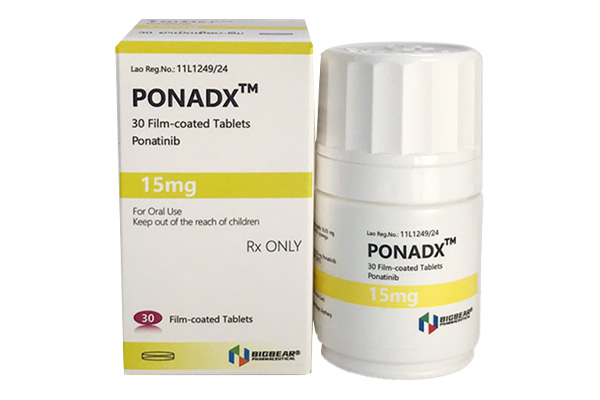
Ponatinib is used to treat T315I-positive chronic myeloid leukemia (CML) in the chronic, accelerated, or blast crisis phase in adults.
Ponatinib Indications
1. Ponatinib can also be used for chronic-phase CML that is resistant to or intolerant of at least two prior kinase inhibitors, and for accelerated or blast crisis CML without other applicable kinase inhibitors. It is not recommended for the treatment of newly diagnosed chronic-phase CML.
2. As monotherapy for Philadelphia chromosome-positive acute lymphoblastic leukemia (ALL) without other applicable kinase inhibitors, or for T315I-positive ALL.
3. In combination with chemotherapy for the treatment of newly diagnosed Philadelphia chromosome-positive ALL. This indication received accelerated approval based on the minimal residual disease (MRD)-negative complete remission rate at the end of induction therapy; continued approval is contingent on confirmation of clinical benefit in confirmatory clinical trials.
Dosage and Administration
1. Administration
(1) Once daily, orally, with or without food.
(2) Swallow tablets whole; do not crush, break, cut, or chew.
(3) If a dose is missed, take it at the usual time the following day.
2. Recommended Dosage
(1) Chronic Phase Chronic Myeloid Leukemia
Initial dose: 45 mg once daily; when the BCR-ABL1 International Normalized Ratio (IS) ≤ 1%, reduce the dose to 15 mg once daily.
If efficacy is lost at the 15 mg once daily dose, the dose can be increased back to the previously tolerated 30 mg or 45 mg once daily.
Continue treatment until efficacy is lost after dose increase, or if intolerable toxic reactions occur.
If hematologic remission is not achieved after 3 months of treatment, consider discontinuing the drug.
(2) Accelerated and blast crisis chronic myeloid leukemia
Initial dose: 45 mg once daily. Optimal dose not yet determined.
For accelerated phase chronic myeloid leukemia patients achieving major cytogenetic remission, consider dose reduction.
Continue treatment until loss of efficacy or intolerable toxicity occurs.
If hematologic remission is not achieved after 3 months of treatment, consider discontinuing the drug.
(3) Philadelphia chromosome-positive acute lymphoblastic leukemia
Newly diagnosed patients: Initial dose: 30 mg once daily, in combination with chemotherapy; upon achieving minimal residual disease-negative complete remission (BCR::ABL1/ABL1≤0.01%) after induction therapy, the dose is reduced to 15 mg once daily. Continue treatment in combination with chemotherapy for up to 20 cycles until loss of efficacy or intolerable toxicity occurs.
(4) Patients without other applicable kinase inhibitors or who are T315I positive
Oral monotherapy, initial dose: 45 mg once daily. Optimal dose not yet determined. Continue treatment until loss of efficacy or intolerable toxicity occurs. If remission is not achieved after 3 months of treatment, discontinuation of the drug should be considered.
Special Populations
Pregnancy
Based on its mechanism of action and animal studies, ponatinib may cause harm to the fetus. There are currently no data on its use during human pregnancy. Confirm the pregnancy status of women of childbearing potential before starting treatment; if ponatinib is used during pregnancy or if the patient becomes pregnant during treatment, the potential risks to the fetus should be explained to the patient.
Lactation
There are currently no data on the presence of ponatinib in human milk, its effects on breastfed infants, or milk production. Patients are advised to avoid breastfeeding during treatment and for one week after the last dose.
Women of childbearing potential and men
Based on its mechanism of action and animal studies, ponatinib may cause harm to the fetus. Confirm the pregnancy status of women of childbearing potential before starting treatment; women of childbearing potential are advised to use effective contraception during treatment and for three weeks after the last dose.
Ponatinib may impair fertility in women of childbearing potential; the reversibility of this effect is not yet clear.
Pediatric Use
Safety and efficacy have not been established.
Geriatric Use
Patients ≥65 years of age have a higher incidence of certain toxicities; dosage selection requires caution.
Hepatic Impairment
Patients with hepatic impairment have a higher incidence of adverse events; patients with baseline hepatic impairment in chronic/accelerated/blast crisis chronic myeloid leukemia or Philadelphia chromosome-positive acute lymphoblastic leukemia receiving monotherapy require a reduced initial dose. Patients newly diagnosed with Philadelphia chromosome-positive acute lymphoblastic leukemia with moderate/severe hepatic impairment require close monitoring for adverse event incidence and dose adjustment as necessary.
Renal Impairment
Pharmacokinetics were not clinically significant in patients with mild to moderate renal impairment (creatinine clearance 30–89 mL/min); relevant data are missing for patients with severe renal impairment.
Warnings and Precautions
Arterial Occlusive Events
In clinical trials, patients receiving ponatinib hydrochloride experienced arterial occlusive events, including death (see black box warning).
Pre-treatment assessment determines whether the benefits outweigh the risks. During treatment, monitor for signs of arterial occlusive events. If arterial occlusion is suspected, pause or discontinue treatment, and reassess the risks and benefits of restarting treatment.
Venous Thromboembolic Events
A serious venous thromboembolic event occurred in a patient receiving ponatinib hydrochloride (see black box warning).
Monitor for signs of venous thromboembolic events. If such an event occurs, pause treatment and subsequently resume the original dose, reduce the dose, or discontinue the drug depending on the recurrence/severity.
Heart Failure
A serious heart failure event, including death, occurred in a patient receiving ponatinib hydrochloride (see black box warning).
Monitor for signs of heart failure and manage according to clinical indications. If new or worsening heart failure occurs, pause treatment and reduce the dose or discontinue the drug upon resumption.
Hepatotoxicity
There is a risk of hepatotoxicity, including liver failure and death (see black box warning). Rare cases of fulminant hepatic failure leading to death have occurred after 1 week of treatment. Elevated liver enzymes are a common adverse reaction.
Liver function should be monitored before treatment begins and at least monthly during treatment, or as needed based on clinical indications. If hepatotoxicity occurs, treatment should be suspended, the dose reduced, or the drug discontinued.
Drug Interactions
Potent CYP3A Inhibitors
Pharmacokinetic interactions may occur, leading to increased ponatinib plasma concentrations. Avoid concomitant use whenever possible; if unavoidable, reduce the ponatinib dose.
Potent CYP3A Inducers
Pharmacokinetic interactions may occur, leading to decreased ponatinib plasma concentrations. It is recommended to choose drugs with no or weak CYP3A inducing effects; avoid concomitant use unless the benefit outweighs the risk of reduced ponatinib exposure; if unavoidable, monitor for signs of decreased ponatinib efficacy.
Adverse Reactions
Monotherapy
Adverse reactions with an incidence >20% include rash and related diseases, arthralgia, abdominal pain, headache, constipation, dry skin, hypertension, fatigue, fluid retention and edema, fever, nausea, pancreatitis/elevated lipase, bleeding, anemia, abnormal liver function, and arterial occlusive events; grade 3/4 laboratory abnormalities with an incidence >20% include thrombocytopenia, neutropenia, and leukopenia.
Combined use with chemotherapy
Highly common adverse reactions include abnormal liver function, arthralgia, rash and related complications, headache, fever, abdominal pain, constipation, fatigue, nausea, stomatitis, hypertension, pancreatitis/elevated lipase, peripheral neuropathy, bleeding, febrile neutropenia, fluid retention and edema, vomiting, paresthesia, and arrhythmia; grade 3/4 laboratory abnormalities with an incidence >20% include leukopenia, neutropenia, thrombocytopenia, lymphopenia, decreased hemoglobin, elevated lipase, and elevated alanine aminotransferase.
Contraindications
Not yet clear.
Storage method
Store at 20-25℃, temporarily stored within the range of 15-30℃.