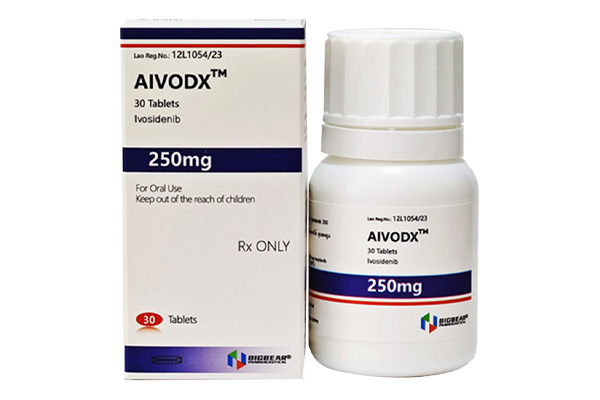
Common Adverse Reactions of Ivosidenib
1. In patients with acute myeloid leukemia (AML), common adverse reactions (including laboratory abnormalities) (≥25%): leukopenia, diarrhea, decreased hemoglobin, thrombocytopenia, elevated blood glucose, fatigue, increased alkaline phosphatase, edema, decreased potassium, nausea, vomiting, decreased phosphate, decreased appetite, decreased sodium, leukocytosis, decreased magnesium, elevated aspartate aminotransferase, arthralgia, dyspnea, elevated uric acid, abdominal pain, elevated creatinine, mucositis, rash, QT prolongation, differentiation syndrome, decreased calcium, neutropenia, and myalgia.
2. In patients with relapsed or refractory myelodysplastic syndromes (MDS), common adverse reactions (including laboratory abnormalities) (≥25%): elevated creatinine, decreased hemoglobin, arthralgia, decreased albumin, elevated aspartate aminotransferase, fatigue, diarrhea, cough, decreased sodium, mucositis, decreased appetite, myalgia, decreased phosphate, pruritus, and rash.
3. In patients with cholangiocarcinoma, common adverse reactions (≥15%): fatigue, nausea, abdominal pain, diarrhea, cough, decreased appetite, ascites, vomiting, anemia, and rash. Common laboratory abnormalities (≥10%): decreased hemoglobin, elevated aspartate aminotransferase, and elevated bilirubin.
Specific Drug Interactions of Ivosidenib
1. Antacids: No clinically significant pharmacokinetic differences were observed.
2. Antiarrhythmic agents: May increase the risk of QT prolongation. Avoid concomitant use and consider alternative therapy; if co-administration cannot be avoided, monitor ECG and serum electrolytes more frequently.
3. Azole antifungal agents (e.g., fluconazole, itraconazole, ketoconazole):
(1) Itraconazole (strong CYP3A4 inhibitor): increased ivosidenib AUC by 269%, with no change in peak concentration.
(2) Fluconazole (moderate CYP3A4 inhibitor): simulation showed a 173% increase in AUC for a single ivosidenib dose, with no change in peak concentration; at steady state, ivosidenib AUC and peak concentration increased by 190% and 152%, respectively.
(3) Itraconazole (CYP3A4 substrate): simulation showed a clinically significant reduction in itraconazole systemic exposure.
(4) Strong CYP3A4 inhibitors (e.g., itraconazole): consider alternative antifungal agents with less CYP3A4 inhibition potential; if co-administration cannot be avoided, reduce ivosidenib dose from 500 mg daily to 250 mg daily (after the strong CYP3A4 inhibitor has been discontinued for ≥5 elimination half-lives, the dose may be resumed to 500 mg daily), and monitor ECG and serum electrolytes more frequently.
(5) Moderate CYP3A4 inhibitors (e.g., fluconazole): consider alternative antifungal agents with less CYP3A4 inhibition potential; if co-administration cannot be avoided, monitor ECG and serum electrolytes more frequently.
(6) CYP3A4 substrates (e.g., itraconazole, ketoconazole): concomitant use is not recommended.
4. 5-HT3 receptor antagonists: May increase the risk of QT prolongation. Avoid concomitant use and consider alternative therapy; if co-administration cannot be avoided, monitor ECG and serum electrolytes more frequently.
5. Fluoroquinolone anti-infectives: May increase the risk of QT prolongation. Avoid concomitant use and consider alternative therapy; if co-administration cannot be avoided, monitor ECG and serum electrolytes more frequently.
6. Histamine H2 receptor antagonists: No clinically significant pharmacokinetic differences were observed.
7. Hormonal contraceptives: May reduce plasma concentrations of hormonal contraceptives and decrease contraceptive efficacy. Consider alternative non-hormonal contraceptive methods.
8. Proton pump inhibitors: No clinically significant pharmacokinetic differences were observed.
9. Rifampin: Simulation showed a 33% and 19% reduction in ivosidenib AUC and peak concentration, respectively. Avoid concomitant use.
Pharmacokinetics of Ivosidenib
1. Absorption
Bioavailability: Over the ivosidenib dose range of 200–1200 mg daily, peak concentration and AUC are less than dose-proportional.
Time to peak: Median time to peak concentration is approximately 2 to 3 hours after dosing.
Steady state: Steady-state concentrations are achieved after approximately 14 days of once-daily dosing; systemic accumulation is observed (peak concentration and AUC increase by approximately 1.2- to 1.9-fold).
Steady-state pharmacokinetics in patients with newly diagnosed AML, relapsed/refractory AML, and relapsed/refractory MDS are similar, whereas lower values are observed in patients with cholangiocarcinoma.
Food effect: Administration of a single 500 mg dose with a high-fat meal (900–1000 calories, with 500–600 calories from fat) increased ivosidenib peak concentration and AUC by 98% and approximately 25%, respectively.
2. Distribution
Distribution extent: It is unknown whether ivosidenib or its metabolites distribute into human milk.
Plasma protein binding: 92–96%.
3. Elimination
Metabolism: Primarily metabolized by CYP3A4, with secondary metabolism via N-dealkylation and hydrolysis.
After a radiolabeled dose, >92% of total plasma radioactivity is unchanged ivosidenib.
Elimination pathways: Primarily excreted in feces (77%; 67% as unchanged drug), with minor excretion in urine (17%; 10% as unchanged drug).
Half-life: Approximately 129 hours in patients with cholangiocarcinoma, 58 hours in patients with relapsed/refractory AML, 98 hours in patients with newly diagnosed AML receiving azacitidine combination, and 96 hours in patients with relapsed/refractory MDS.
4. Special Populations
Age (range: 18–89 years), sex, race, body weight (range: 38–150 kg), and Eastern Cooperative Oncology Group (ECOG) performance status had no significant effect on ivosidenib clearance.
Important Counseling Information
1. Advise patients to swallow ivosidenib tablets whole, without chewing, crushing, or splitting. Avoid high-fat meals during treatment.
2. Advise patients to take ivosidenib as prescribed, at approximately the same time each day.
3. If a dose is missed by ≤12 hours, advise patients to take the missed dose as soon as remembered on the same day, and resume the next dose at the regularly scheduled time the following day. If vomiting occurs after dosing, take the next dose at the regularly scheduled time; do not take an extra dose to make up for the vomited dose. Advise patients not to take two doses within 12 hours.
4. Patients with AML and MDS are at risk of differentiation syndrome: advise patients to immediately inform their healthcare provider if they experience signs of differentiation syndrome (e.g., fever, cough, dyspnea, rash, decreased urine output, hypotension, rapid weight gain, peripheral edema).
5. Advise females of reproductive potential to inform their healthcare provider if they are pregnant, plan to become pregnant, or plan to breastfeed. Inform patients of the potential risk to the fetus if used during pregnancy. Advise women to avoid breastfeeding during treatment and for ≥1 month after the last dose.