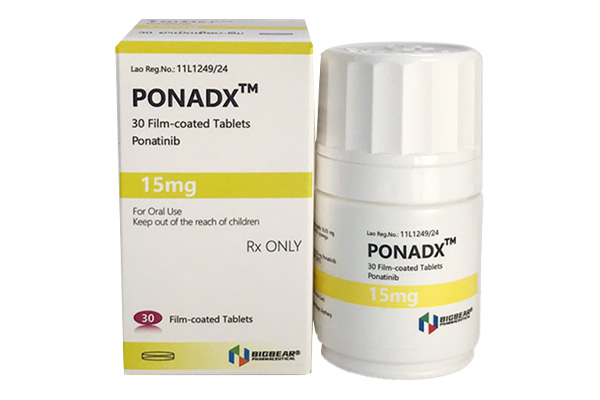
Ponatinib is a prescription drug and should be used under close monitoring by a hematologist.
Correct Dosage and Administration of Ponatinib
1. Recommended Dose for Newly Diagnosed Philadelphia Chromosome-Positive (Ph+) Acute Lymphoblastic Leukemia (ALL)
The recommended starting dose of ponatinib in combination with chemotherapy is 30 mg orally once daily. After achieving complete remission with MRD negativity (BCR::ABL1/ABL1 ≤ 0.01%) at the end of induction, the dose is reduced to 15 mg orally once daily. Continue ponatinib in combination with chemotherapy for up to 20 cycles until loss of efficacy or unacceptable toxicity occurs.
2. Monotherapy for Philadelphia Chromosome-Positive (Ph+) Acute Lymphoblastic Leukemia (ALL) (No other kinase inhibitor indications or T315I-positive Philadelphia Chromosome-Positive (Ph+) Acute Lymphoblastic Leukemia (ALL))
The optimal dose of ponatinib has not yet been determined.
The recommended starting dose is 45 mg orally once daily. Continue ponatinib treatment until loss of efficacy or unacceptable toxicity occurs.
If no response is achieved after 3 months of treatment, consider discontinuing ponatinib.
3. Recommended Dose for Chronic Phase Chronic Myeloid Leukemia (CML)
The recommended starting dose is 45 mg orally once daily. After achieving a BCR::ABL1IS ≤ 1%, the dose is reduced to 15 mg orally once daily. For patients who have lost efficacy, the ponatinib dose can be escalated back to the previously tolerated dose (30 mg or 45 mg orally once daily). Continue ponatinib treatment until loss of efficacy or unacceptable toxicity occurs at the escalated dose. If no hematologic remission is achieved after 3 months of treatment, consider discontinuing ponatinib.
4. Accelerated and Blast Phase Chronic Myeloid Leukemia (CML)
The optimal dose of ponatinib has not been determined. The recommended starting dose is 45 mg orally once daily. For patients with accelerated-phase chronic myeloid leukemia (CML) who have achieved a major cytogenetic response, consider reducing the ponatinib dose. Continue ponatinib treatment until loss of efficacy or unacceptable toxicity occurs.
If no response is achieved after 3 months of treatment, consider discontinuing ponatinib.
5. Administration
Ponatinib can be taken with food or on an empty stomach.
Swallow the tablet whole. Do not crush, break, cut, or chew the tablet.
6. Management of Missed Doses
If a dose is missed, take the next dose at the scheduled time the following day.
Ponatinib Dosage Adjustment for Adverse Reactions
1. Arterial Occlusion Events: Cardiovascular or Cerebrovascular Events
(1) Grade 1: Discontinue ponatinib until the event resolves, then resume administration at the same dose.
(2) Grade 2: Discontinue ponatinib until the event resolves to Grade 0 or 1, then resume administration at the next lower dose. If relapse occurs, discontinue ponatinib.
(3) Grade 3 or 4: Discontinue ponatinib.
2. Heart Failure
(1) Grade 2 or 3: Suspend ponatinib until the event resolves to Grade 0 or 1, then resume administration at the next lower dose. If relapse occurs, discontinue ponatinib.
(2) Grade 4: Discontinue ponatinib.
3. Hepatotoxicity
(1) AST or ALT greater than 3 times the ULN: Suspend ponatinib until the event resolves to Grade 0 or 1, then resume administration at the next lower dose.
(2) AST or ALT at least 3 times the ULN, accompanied by total bilirubin greater than 2 times the ULN and alkaline phosphatase less than 2 times the ULN: Discontinue ponatinib.
4. Pancreatitis and Elevated Lipase
(1) Serum lipase greater than 1 to 1.5 times the ULN: Consider suspending ponatinib until resolution, then resume administration at the same dose.
(2) Serum lipase levels greater than 1.5 to 2 times the ULN, 2 to 5 times the ULN, and asymptomatic, or asymptomatic radiographic pancreatitis: Discontinue ponatinib until the event resolves to grade 0 or 1 (less than 1.5 times the ULN), then resume administration at the next lower dose.
(3) Serum lipase levels greater than 2 to 5 times the ULN and symptomatic, symptomatic grade 3 pancreatitis, or serum lipase levels greater than 5 times the ULN and asymptomatic: Discontinue ponatinib until symptoms completely resolve and lipase levels return to grade 0 or 1, then resume administration at the next lower dose.
(4) Symptomatic pancreatitis with serum lipase levels greater than 5 times the ULN: Discontinue ponatinib.
5. Myelosuppression
ANC < 1 × 10^9/L or platelet count < 50 × 10^9/L: Discontinue ponatinib until ANC is at least 1.5 × 10^9/L and platelet count is at least 75 × 10^9/L, then resume administration at the same dose. If relapse occurs, discontinue ponatinib until remission, then resume administration at the next lower dose.
6. Other Non-Hematologic Adverse Reactions
(1) Grade 1: Discontinue ponatinib until the event is resolved, then resume administration at the same dose.
(2) Grade 2: Discontinue ponatinib until the event is resolved to Grade 0 or 1, then resume administration at the same dose. If relapse occurs, discontinue ponatinib until the event is resolved to Grade 0 or 1, then resume administration at the next lower dose.
(3) Grade 3 or 4: Discontinue ponatinib until the event is resolved to Grade 0 or 1, then resume administration at the next lower dose. If relapse occurs, discontinue ponatinib.
Dosage Adjustment for Ponatinib with Potent CYP3A Inhibitors
Current Ponatinib dose: 45 mg orally once daily. When used with a potent CYP3A inhibitor, the recommended dose is 30 mg orally once daily.
Current Ponatinib dose: 30 mg orally once daily. When used with a potent CYP3A inhibitor, the recommended dose is 15 mg orally once daily.
Current Ponatinib dose: 15 mg orally once daily. When used with a potent CYP3A inhibitor, the recommended dose is 10 mg orally once daily.
Current Ponatinib dose: 10 mg orally once daily. Avoid using ponatinib with potent CYP3A inhibitors.
Dosage Adjustment for Patients with Hepatic Impairment
For patients with chronic phase chronic myeloid leukemia (CML), accelerated phase CML, blast crisis CML, and Philadelphia chromosome-positive (Ph+) acute lymphoblastic leukemia (ALL) receiving monotherapy, the starting dose of ponatinib should be reduced from 45 mg once daily to 30 mg once daily in patients with pre-existing hepatic impairment (Child-Pugh A, B, or C).
For newly diagnosed patients with Philadelphia chromosome-positive (Ph+) ALL, no dose adjustment is required when ponatinib is administered to patients with mild hepatic impairment (Child-Pugh A). Closely monitor patients with moderate or severe hepatic impairment (Child-Pugh B or C) and adjust the ponatinib dose according to the occurrence of adverse reactions.
Special Populations for Ponatinib Use
1. Pregnancy
Based on animal studies and its mechanism of action, ponatinib administration to pregnant women may cause fetal harm. There are currently no data on the use of ponatinib in pregnant women. In animal reproductive studies, oral administration of ponatinib to pregnant rats during organogenesis caused adverse developmental effects at exposure levels below the maximum recommended daily human dose of 45 mg. Pregnant women should be informed of the potential risks to the fetus.
2. Lactation
There are no data on whether ponatinib is present in human breast milk, its effects on breastfed infants, or its effects on milk production. Due to the potential for serious adverse reactions in breastfed infants, women are advised not to breastfeed during ponatinib treatment and for one week after the last dose.
3. Women of Childbearing Potential
Ponatinib administration to pregnant women may cause fetal harm. The pregnancy status of women of childbearing potential should be verified before initiating ponatinib treatment.
Women of childbearing potential are advised to use effective contraception during ponatinib treatment and for 3 weeks after the last dose.
4. Pediatric Use
The safety and efficacy of ponatinib in pediatric patients have not been established.
5. Elderly Use
Patients aged 65 years or older are more likely to experience adverse reactions, including vascular occlusion, decreased platelet count, peripheral edema, elevated lipase, dyspnea, fatigue, muscle cramps, and decreased appetite. Dosage selection in elderly patients should generally be cautious, taking into account their decreased hepatic, renal, or cardiac function, as well as the frequency of comorbidities or other drug treatments.
6. Hepatic Impairment
Patients with hepatic impairment are more likely to experience adverse reactions compared to patients with normal hepatic function. For patients receiving monotherapy in chronic phase CML, accelerated phase CML, blast crisis CML, and Ph+ALL, the starting dose of ponatinib should be reduced if the patient has pre-existing hepatic impairment (Child-Pugh A, B, or C).
For newly diagnosed Ph+ALL patients with mild hepatic impairment (Child-Pugh A), dose adjustment is not recommended when administering ponatinib. There are no clinical data on newly diagnosed Ph+ALL patients with pre-existing moderate or severe hepatic impairment (Child-Pugh B or C); these patients should be closely monitored for an increased incidence of potential adverse reactions.
If adverse reactions occur, the dose of ponatinib should be adjusted. The safety of multiple doses or doses higher than 30 mg has not been studied in patients with hepatic impairment.