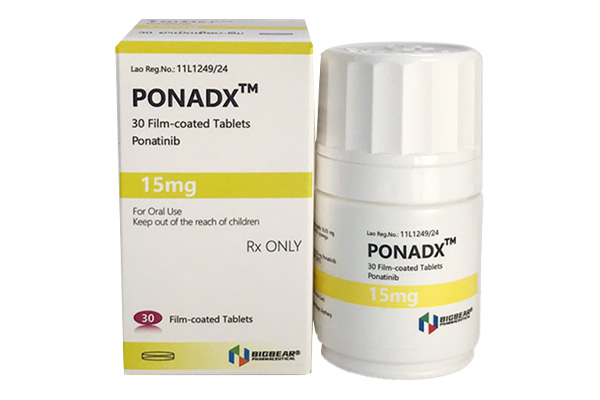
Ponatinib is a tyrosine kinase inhibitor and should be used under the guidance of a physician.
Ponatinib Dosage and Administration
1. Newly diagnosed Philadelphia chromosome-positive (Ph+) acute lymphoblastic leukemia (ALL) (combined with chemotherapy)
(1) Starting dose: 30 mg orally, once daily, in combination with chemotherapy.
(2) Dose adjustment: At the end of induction therapy, if complete remission (CR) with minimal residual disease (MRD) negativity (≤0.01% BCR::ABL1/ABL1) is achieved, the dose should be reduced to 15 mg once daily, and combined with chemotherapy.
2. Philadelphia chromosome-positive (Ph+) acute lymphoblastic leukemia (ALL) monotherapy
Starting dose: 45 mg orally, once daily.
3. Chronic phase chronic myeloid leukemia (CML) (CP-CML)
(1) Starting dose: 45 mg orally, once daily.
(2) Dosage Adjustment: After achieving ≤1% BCR::ABL1^IS, the dose should be reduced to 15 mg once daily. If loss of efficacy occurs, the dose can be increased back to the previously tolerated dose (30 mg or 45 mg).
4. Accelerated or Blast Phase Chronic Myeloid Leukemia (CML) (AP-CML/BP-CML)
(1) Starting Dose: 45 mg orally once daily.
(2) Dosage Adjustment: For AP-CML patients, a dose reduction may be considered after achieving major cytogenetic remission.
5. Dosage Instructions
Ponatinib can be taken with food or on an empty stomach.
It should be swallowed whole and should not be crushed, broken, chewed, or dissolved.
6. Management of Missed Doses
If a dose is missed, the next dose should be taken at the usual time the following day. Two doses should not be taken simultaneously to make up for the missed dose.
Dosage Adjustment of Ponatinib
1. Principles for Adjustment Based on Specific Serious Adverse Reactions
(1) Arterial Occlusive Events (AOE): Cardiovascular or cerebrovascular events graded ≥3 require permanent discontinuation of the drug. For peripheral vascular events, discontinuation, dose reduction, or termination of the drug may be implemented depending on the recurrence and grade.
(2) Venous Thromboembolic Events (VTE): Discontinuation, dose reduction, or permanent termination of the drug may be implemented depending on the recurrence and grade (especially ≥4).
(3) Heart Failure: New-onset or worsening heart failure (grade ≥2) requires discontinuation of the drug, followed by a dose reduction to restart after recovery; if recurrence or grade 4, permanent discontinuation is necessary.
(4) Hepatotoxicity: Discontinuation of the drug may occur if AST or ALT is >3 times the upper limit of normal (ULN), followed by a dose reduction to restart after recovery; if bilirubin is also >2 times the ULN, permanent discontinuation is necessary. (5) Pancreatitis/Elevated Lipase: Depending on the degree of lipase elevation and whether symptoms are present, monitoring, discontinuation of administration, dose reduction, or permanent discontinuation may be implemented.
(6) Hematologic Toxicity (Myelosuppression): Discontinue administration if ANC < 1.0 x 10⁹/L or platelet count < 50 x 10⁹/L. Resume administration at the original dose or a reduced dose after recovery.
(7) Other Non-Hematologic Adverse Reactions: Discontinue administration, dose reduction, or discontinue treatment depending on the grade and recurrence.
2. Dosage Adjustment Due to Drug Interactions
(1) Potent CYP3A4 Inhibitors: Concomitant use should be avoided. If unavoidable, the ponatinib dose should be reduced accordingly (e.g., from 45 mg to 30 mg).
(2) Potent CYP3A4 Inducers: Concomitant use should be avoided as it may reduce ponatinib blood concentrations and potentially affect efficacy.
Special Populations for Ponatinib Use
1. Patients with Hepatic Impairment
Patients on monotherapy for CP/AP/BP-CML and Ph+ALL: If baseline hepatic impairment (Child-Pugh A, B, or C) is present, the starting dose should be reduced from 45 mg/day to 30 mg/day.
Newly diagnosed Ph+ALL patients receiving chemotherapy: No dose adjustment is required for mild hepatic impairment (Child-Pugh A); data are limited for moderate to severe hepatic impairment (Child-Pugh B or C), and adverse reactions should be closely monitored, with dose adjustments as needed.
2. Elderly Patients (≥65 years old)
Elderly patients have a higher risk of adverse reactions (especially vascular occlusive events). Efficacy data vary across different studies, but overall, caution is advised when using this medication.
Dosage selection should take into account potential decline in hepatic, renal, and cardiac function, as well as concomitant medication use.
3. Pregnancy, lactation, and patients of childbearing potential
(1) Pregnancy: Based on its mechanism of action and animal data, ponatinib may cause fetal harm. Pregnant women should be informed of the potential risks to the fetus.
(2) Women of childbearing potential: A pregnancy test is required before starting treatment. Effective contraception must be used during treatment and for 3 weeks after the last dose, as ponatinib may impair female fertility.
(3) Lactation: Breastfeeding is advised against during treatment and for 1 week after the last dose.
4. Pediatric patients
The safety and efficacy of ponatinib in pediatric patients have not been established.