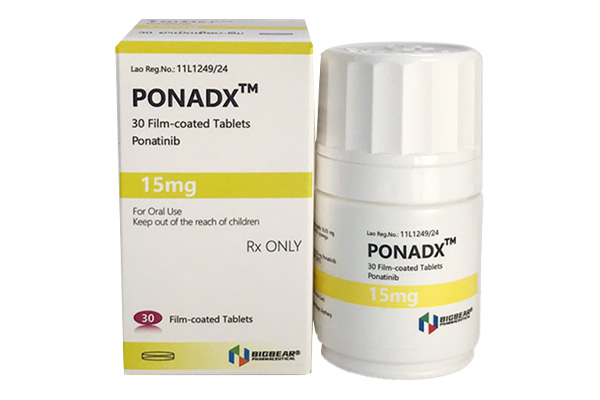
Ponatinib (ICLUSIG, Ponatinib, Incoxin) is an oral tyrosine kinase inhibitor used to treat certain types of Philadelphia chromosome-positive acute lymphoblastic leukemia (Ph+ALL) and chronic myeloid leukemia (CML). Its pharmacokinetic characteristics have been studied in cancer patients. The following data synthesize key information on absorption, distribution, metabolism, and excretion to provide a reference for clinical use.
Overall Pharmacokinetic Characteristics
Within the dose range of 2 mg to 60 mg (equivalent to 0.04 to 1.33 times the maximum recommended starting dose), the increase in steady-state peak plasma concentration (Cmax) and area under the curve (AUC) of ponatinib is approximately dose-proportional.
45 mg once daily (steady-state): In patients with advanced hematologic malignancies, the mean Cmax was 73 ng/mL (coefficient of variation CV% = 74%), and the mean AUC (0-24) was 1253 ng∙hr/mL (CV% = 73%).
30 mg once daily (steady-state): In patients with advanced hematologic malignancies, the mean Cmax was 65 ng/mL (CV% = 28%), and the mean AUC (0-24) was 1080 ng∙hr/mL (CV% = 29%).
From the first dose to steady-state, the median exposure increased by approximately 90% (range: 20% to 440%).
Absorption
Bioavailability: Absolute bioavailability has not been established.
Time to Peak Concentration: Peak plasma concentrations are reached within 6 hours after oral administration.
Food Effects: A study of 22 healthy volunteers showed no significant difference in plasma exposure (AUC and Cmax) of ponatinib after consuming a high-fat or low-fat meal compared to a fasting state.
Distribution
Protein Binding: In in vitro studies, ponatinib binds to plasma proteins at a rate exceeding 99%. Other highly protein-bound drugs (such as ibuprofen and nifedipine) did not show protein-binding displacement effects on ponatinib (145 nM) in vitro.
Apparent Volume of Distribution: After oral administration of 45 mg daily for 28 consecutive days in cancer patients, the mean apparent steady-state volume of distribution was 1223 liters (CV% = 102%).
Metabolism
At least 64% of the dose is metabolized via phase I and phase II.
Phase I Metabolism: Primarily involves CYP3A4, followed by CYP2C8, CYP2D6, and CYP3A5 (in vitro studies).
Other Pathways: Also metabolized by esterases and/or amidases.
Excretion
Following a single oral dose of radiolabeled ponatinib, approximately 87% of the radioactive dose is excreted in feces and approximately 5% in urine.
Elimination Half-Life: After daily oral administration of 45 mg for 28 consecutive days in cancer patients, the mean terminal elimination half-life is approximately 24 hours (range: 12 to 66 hours).
Pharmacokinetics in Special Populations
Age (19–85 years), weight (41–152 kg), and mild to moderate renal impairment (creatinine clearance 30–89 mL/min): No clinically significant pharmacokinetic differences were observed.
Severe Renal Impairment
Studies have not been conducted in this patient group. Although renal excretion is not the primary route of elimination for ponatinib, it is unclear whether severe renal impairment affects its hepatic elimination.
Hepatic Impairment
Compared to patients with normal liver function, no trend of increased ponatinib exposure was observed after a single 30 mg dose in patients with mild (Child-PughA), moderate (Child-PughB), and severe (Child-PughC) hepatic impairment. However, the incidence of adverse reactions (such as gastrointestinal disorders, including one case of severe pancreatitis) was higher in patients with hepatic impairment.
Drug Interaction Studies
Clinical Studies
Potent CYP3A Inhibitors: In combination with ketoconazole (a potent CYP3A inhibitor), ponatinib increased AUC0-INF by 78% and Cmax by 47%.
Potent CYP3A Inducers: In combination with rifampin (a potent CYP3A inducer), ponatinib decreased AUC0-INF by 62% and Cmax by 42%.
Gastric acid-reducing agents: When used in combination with lansoprazole (a proton pump inhibitor), ponatinib reduced AUC0-INF by 6% and Cmax by 25%.
In vitro studies
CYP enzymes: Ponatinib does not inhibit CYP1A2, CYP2B6, CYP2C8, CYP2C9, CYP2C19, CYP3A, or CYP2D6, nor does it induce CYP1A2, CYP2B6, or CYP3A.
Transport systems
Ponatinib is a weak substrate of P-glycoprotein (P-gp) and breast cancer resistance protein (BCRP); it is not a substrate of OATP1B1, OATP1B3, or OCT1. Ponatinib inhibits P-gp, BCRP, and the bile salt export pump (BSEP); it does not inhibit OATP1B1, OATP1B3, OCT1, OCT2, OAT1, or OAT3.
The pharmacokinetic characteristics of ponatinib show that its oral absorption is not significantly affected by food, it has a large volume of distribution, high protein binding, and is mainly metabolized in the liver and excreted in feces. Its pharmacokinetics are not significantly altered in patients with age, weight, or mild to moderate renal impairment, but close monitoring is required when used concomitantly with potent CYP3A inhibitors or inducers. These characteristics should be considered comprehensively in clinical use to optimize efficacy and safety.