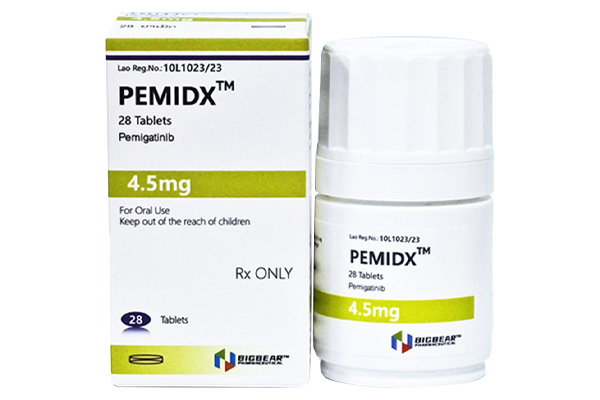
Properly understanding the timing of pemigatinib administration, adjusting the appropriate dosage, and its interactions with food are crucial for improving patient adherence and reducing adverse reactions.
Patient Selection for Pemigatinib
1. Cholangiocarcinoma Patient Selection: Pemigatinib can be considered for patients with locally advanced or metastatic cholangiocarcinoma exhibiting FGFR2 rearrangement, but its clinical feasibility requires confirmation through FDA-approved testing methods.
2. Myeloid/Lymphoid Tumor Patient Selection: Pemigatinib is recommended for patients with relapsed or refractory myeloid/lymphoid tumors exhibiting FGFR1 rearrangement. Currently, there is no FDA-approved testing method for screening FGFR1 rearranged patients for pemigatinib treatment.
Recommended Dosage of Pemigatinib: Take pemigatinib orally at approximately the same time daily, with or without food.
Swallow the tablet whole; do not crush, chew, break, or dissolve the tablet.
If a dose is missed by more than 4 hours or vomiting occurs, skip that dose and take the next dose as scheduled.
1. Treatment Regimen for Cholangiocarcinoma: Recommended dose 13.5 mg once daily for 14 days, followed by a 7-day break, constituting a 21-day treatment cycle.
Continue treatment until disease progression or intolerable toxicity occurs.
2. Treatment Regimen for FGFR1 Rearrangement Myeloid/Lymphoid Tumors: Recommended dose 13.5 mg once daily continuously (without intervals).
Continue treatment until disease progression or intolerable toxicity occurs.
Pemigatinib Adverse Reactions and Dosage Adjustment Regimen
Chlorochocarcinoma (FGFR2 fusion/rearrangement)
Initial dose reduction: 9 mg/day, taken on the first 14 days of each 21-day cycle.
Second dose reduction: 4.5 mg/day, taken on the first 14 days of each 21-day cycle.
Third dose reduction: Permanent discontinuation.
Myeloid/Lymphoid Tumors (FGFR1 rearrangement)
Initial dose reduction: 9 mg/day continuously.
Second dose reduction: 4.5 mg/day continuously.
However, the final discontinuation dose is always 4.5 mg/day, and all patients must continue treatment long-term (treatment should be discontinued if adverse reactions occur at this dose).
Pemigatinib Adverse Reactions Management
Retinal Pigment Erection (RPED)
Continue treatment if asymptomatic and stable.
Discontinue treatment if symptoms occur or the condition worsens.
If symptoms are asymptomatic and improve, resume medication and reduce the dose.
If symptoms persist or do not improve, consider permanent discontinuation of medication.
Hyperphosphatemia
(1) Serum phosphorus 7-10 mg/dL:
Initiate phosphorus-lowering therapy and monitor weekly.
If it does not decrease to <7 mg/dL after 2 weeks, discontinue medication.
However, if it first decreases to below 7 mg/dL again, the original drug dose can be resumed. For relapses, the dose should be reduced or other antihypertensive drugs should be used.
(2) Serum phosphorus >10 mg/dL:
Based on current clinical guidelines and the patient's specific condition, phosphorus-lowering therapy should be initiated promptly, and weekly monitoring of phosphorus toxicity indicators should be conducted to correct the condition in a timely manner and prevent further deterioration.
If it does not decrease to ≤10 mg/dL after 1 week, discontinue medication.
Use the next lower dose after decreasing to <7 mg/dL.
If it remains >10 mg/dL after two dose reductions, permanently discontinue medication. Other adverse reactions (classified according to NCITCAE 4.03):
Grade 3: Discontinue use until recovery to Grade 1 or baseline. If recovery occurs within 2 weeks, reduce the dose; otherwise, permanently discontinue use. Relapse after two dose reductions requires permanent discontinuation.
Grade 4: Permanent discontinuation.
Dose adjustment when using pemigatinib in combination with potent/intermediate CYP3A inhibitors:
Concomitant use of pemigatinib with potent or intermediate CYP3A inhibitors should be avoided. If concomitant use cannot be avoided:
Initial dose of 13.5 mg, eventually reduced to 9 mg.
If already at 9 mg, further reduce to 4.5 mg.
After discontinuing potent/intermediate CYP3A inhibitors (after 3 plasma half-lives of the inhibitor), the pemigatinib dose can be restored to the level before concomitant use.
Recommended Dosage of Pemigatinib in Patients with Severe Renal Impairment:
For patients with severe renal impairment (eGFR 15-29 mL/min/1.73 m², estimated using the MDRD formula):
The recommended dose is 9 mg, administered according to the appropriate intermittent or continuous dosing regimen.
Recommended Dosage of Pemigatinib in Patients with Severe Hepatic Impairment:
For patients with severe hepatic impairment (total bilirubin >3 times ULN and accompanied by any elevation of AST):
The recommended dose is 9 mg, administered according to the appropriate intermittent or continuous dosing regimen.