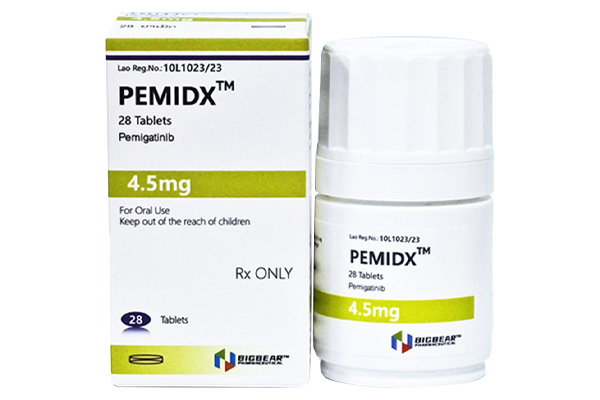
Properly understanding the timing of pemitinib administration, dosage adjustment principles, and interactions with food is crucial for improving treatment adherence and reducing adverse reactions.
I. Common Adult Dosage for Biliary Tract and Cholangiocarcinoma
Dosage Regimen: Oral administration of 13.5 mg once daily for 14 days, followed by a 7-day break, for a 21-day treatment cycle.
Duration of Treatment: Continue treatment until disease progression or intolerable toxicity.
Note: Pemigatinib should only be used to treat locally advanced or metastatic biliary tract and cholangiocarcinoma if the patient has a confirmed fibroblast growth factor receptor 2 (FGFR2) fusion or rearrangement.
FGFR2 positivity must be confirmed in the patient before initiating treatment.
The approval of pemitinib for this indication was based on the "accelerated approval" mechanism, with approval based on overall response rate and duration of response. Continued approval for this indication may depend on the confirmation and description of clinical benefit in confirmatory trials.
Use: For the treatment of adult patients with previously treated, unresectable locally advanced or metastatic biliary tract cancer who have been confirmed to have FGFR2 fusions or other rearrangements by a US FDA-approved test.
II. Usual Dosage for Adults with Malignant Myeloid/Lymphoid Tumors
Dosage Regimen: Oral, 13.5 mg once daily.
Duration of Treatment: Continue treatment until disease progression or intolerable toxicity.
Note: Pemitinib should only be used to treat relapsed or refractory myeloid/lymphoid tumors (MLNs) if the patient has been confirmed to have FGFR1 rearrangements.
Currently, there is no FDA-approved assay for detecting FGFR1 rearrangements in such patients.
Indications: For the treatment of adult patients with relapsed or refractory myeloid/lymphoid neoplasms (MLNs) with FGFR1 rearrangements.
III. Dosage Adjustment for Patients with Renal Impairment
Mild to moderate renal impairment (estimated glomerular filtration rate [eGFR] 30-89 mL/min/1.73 m²): No dose adjustment required.
Severe renal impairment (eGFR 15-29 mL/min/1.73 m²):
Bile duct and cholangiocarcinoma: Oral administration of 9 mg once daily for 14 days, followed by a 7-day break, for a 21-day treatment cycle.
Myeloid/lymphoid neoplasms (MLNs): Oral administration of 9 mg once daily.
Note: The degree of renal impairment is estimated based on the Modification of Dietary Renal Disease formula.
IV. Dosage Adjustment for Patients with Hepatic Impairment
Mild or Moderate Hepatic Impairment
Mild: Total bilirubin > Upper Limit of Normal (ULN) to 1.5 times the upper limit of normal (1.5 × ULN), or aspartate aminotransferase (AST) > Upper Limit of Normal.
Moderate: Total bilirubin > 1.5 × ULN to 3 × ULN, and any level of aspartate aminotransferase (AST).
Management: No dose adjustment required.
Severe Hepatic Impairment (Total bilirubin > 3 × ULN, and any level of aspartate aminotransferase [AST])
Bile Ductal Carcinoma: Oral administration of 9 mg once daily for 14 days, followed by a 7-day break, for a 21-day treatment cycle.
Myeloid/Lymphoid Tumors (MLNs): Oral administration of 9 mg once daily.
V. Dosage Adjustment (Based on Adverse Reactions and Concomitant Medications)
(I) General Recommended Dosage Adjustment Regimens Related to Adverse Reactions
Bile Duct Cholangiocarcinoma with FGFR2 Fusions or Rearrangements
First Dose Reduction: Oral administration of 9 mg once daily for the first 14 days of each 21-day cycle.
Second Dose Reduction: Oral administration of 4.5 mg once daily for the first 14 days of each 21-day cycle.
If the dose of 4.5 mg once daily cannot be tolerated, pemitinib should be discontinued.
Myeloid/Lymphoid Neoplasia (MLNs) with FGFR1 Rearrangements
First Dose Reduction: Oral administration of 9 mg once daily.
Second Dose Reduction: Oral administration of 4.5 mg once daily.
Third Dose Reduction: Oral administration of 4.5 mg once daily for the first 14 days of each 21-day cycle.
If the patient cannot tolerate a dose of 4.5 mg once daily for the first 14 days of each 21-day cycle, pemitinib should be permanently discontinued.
(II) Recommended Dose Adjustments Related to Specific Adverse Reactions
Retinal Pigment Erection
If asymptomatic and confirmed by a series of examinations, pemitinib can be continued.
If symptoms develop or confirmed by a series of examinations that the condition has worsened, pemitinib should be discontinued.
If subsequent examinations confirm asymptomatic and improved condition, pemitinib can be resumed at a reduced dose.
If symptoms persist or examinations show no improvement, permanent discontinuation of pemitinib should be considered based on the patient's clinical condition.
Hyperphosphatemia
Serum phosphate >7-10 mg/dL: Initiate phosphate-lowering therapy and monitor serum phosphate levels weekly. If serum phosphate does not decrease to below 7 mg/dL within 2 weeks of initiating phosphate-lowering therapy, pemitinib should be discontinued; for the first occurrence, the original dose can be resumed once serum phosphate decreases to below 7 mg/dL; for subsequent recurrences, the dose should be reduced before resuming use.
Serum phosphate >10 mg/dL: Initiate phosphate-lowering therapy and monitor serum phosphate levels weekly. If serum phosphate does not decrease to below 10 mg/dL within one week of initiating phosphate-lowering therapy, discontinue pemitinib; once serum phosphate decreases to below 7 mg/dL, reduce the dose to the next lower level and resume therapy.
If serum phosphate rises again to >10 mg/dL after two dose reductions, permanently discontinue pemitinib.
Other Adverse Reactions
Grade 3 Adverse Reactions: Discontinue treatment until the adverse reaction resolves to Grade 1 or baseline levels. If resolved within 2 weeks, reduce the dose to the next lower level and resume treatment; if not resolved within 2 weeks, permanently discontinue pemitinib. If a Grade 3 adverse reaction recurs after two dose reductions, permanently discontinue pemitinib.
Grade 4 Adverse Reactions: Permanently discontinue pemitinib.
(III) Dosage Adjustments Related to Concomitant Use of Potent or Intermediate CYP4503A Inhibitors
Concomitant use of pemitinib with potent or intermediate CYP4503A inhibitors should be avoided; if it cannot be avoided:
If the original dose was 13.5 mg, it should be reduced to 9 mg.
If the original dose was 9 mg, it should be reduced to 4.5 mg.
If a potent or intermediate CYP4503A inhibitor is discontinued, wait three plasma half-lives after discontinuation before restoring the pemitinib dose to the level before inhibitor use.