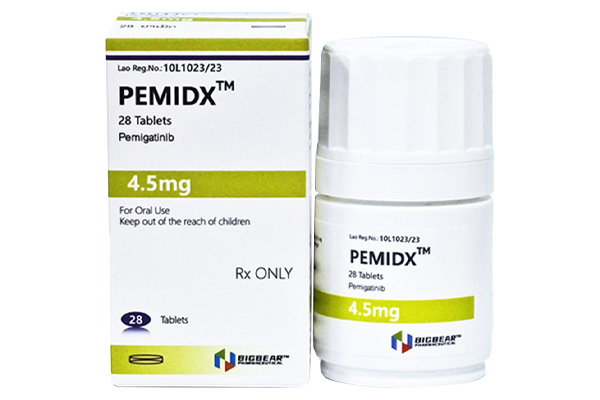
Pemigatinib has proven therapeutic activity in patients with previously treated locally advanced/metastatic cholangiocarcinoma with FGFR2 fusions/rearrangements, and in patients with relapsed/refractory myeloid/lymphoid neoplasms (MLNs) with FGFR1 rearrangements.
1. Pemigatinib Indications
1.1 Cholangiocarcinoma
Pemigatinib is indicated for the treatment of adult patients with previously treated, unresectable locally advanced or metastatic cholangiocarcinoma who have been confirmed by FDA-approved testing to have fibroblast growth factor receptor 2 (FGFR2) fusions or other rearrangements.
Approval for this indication is primarily contingent on the overall response rate and the acceleration of the relative duration of response of this treatment regimen, and subsequent approval will depend on the results of further confirmatory trials demonstrating its clinical benefit.
1.2 FGFR1 Rearrangement in Myeloid/Lymphoid Neoplasms
Pemigatinib is indicated for the treatment of adult patients with relapsed or refractory myeloid/lymphoid neoplasms (MLNs) exhibiting fibroblast growth factor receptor 1 (FGFR1) rearrangement.
2. Dosage and Administration of Pemigatinib
2.1 Patient Selection
Patients with cholangiocarcinoma must have FGFR2 fusion/rearrangement confirmed by an FDA-approved assay.
Patients with FGFR1 rearrangement in MLNs must have FGFR1 rearrangement confirmed. Currently, there is no FDA-approved assay for screening patients with FGFR1 rearrangement for pemigatinib treatment.
2.2 Recommended Dosage
(1) Instructions for Use:
Pemigatinib is taken at approximately the same time daily, with or without food. Swallow the tablet whole; do not crush, chew, split, or dissolve it.
If a dose is missed by more than 4 hours or vomiting occurs, skip the dose and take the next dose as scheduled.
(2) Cholangiocarcinoma: The recommended dose is 13.5 mg orally once daily for 14 consecutive days, followed by a 7-day break (21 days per cycle), until disease progression or intolerable toxicity occurs.
(3) FGFR1 rearrangement myeloid/lymphoid tumors: The recommended dose is 13.5 mg orally once daily (continuously) until disease progression or intolerable toxicity occurs.
2.3 Dosage Adjustment When Used in Concomitantly with Potent/Intermediate CYP3A Inhibitors
Avoid concomitant use of pemigatinib with potent or intermediate CYP3A inhibitors. If concomitant use cannot be avoided:
The initial dose of pemigatinib was adjusted from 13.5 mg to 9 mg.
If the original dose was 9 mg, further reduce it to 4.5 mg.
After discontinuing a potent/intermediate CYP3A inhibitor (after 3 plasma half-lives of the inhibitor), resume the pre-combination dose of pemigatinib.
2.4 Recommended Dose for Patients with Severe Renal Impairment
For patients with severe renal impairment (eGFR 15-29 mL/min/1.73 m², estimated using the MDRD formula):
The recommended dose is 9 mg, administered according to the intermittent or continuous dosing regimen corresponding to the indication.
2.5 Recommended Dose for Patients with Severe Hepatic Impairment
For patients with severe hepatic impairment (total bilirubin >3 × ULN and any elevated AST):
The recommended dose is 9 mg, administered according to the intermittent or continuous dosing regimen corresponding to the indication.
3. Pemigatinib Dosage Forms and Specifications
(1) 4.5 mg, round, white to off-white tablets, marked with "I" on one side and "4.5" on the other.
(2) 9 mg, oval, white to off-white tablets, marked with "I" on one side and "9" on the other.
(3) 13.5 mg, round, white to off-white tablets, marked with "I" on one side and "13.5" on the other.
4. Contraindications of Pemigatinib
None.
5. Precautions for Pemigatinib
5.1 Ocular Toxicity
(1) Retinal Pigment Epithelial Detachment (RPED)
Pemigatinib may cause RPED, clinically manifested as blurred vision, floaters, or photic hallucinations. In clinical trials of pemigatinib, optical coherence tomography (OCT) was not routinely used to monitor asymptomatic recurrent eye disorders (RPED), therefore the incidence of asymptomatic RPED remains unclear.
Monitoring Requirements:
A comprehensive ophthalmological examination, including OCT, is required before medication.
Follow-up examinations should be performed every 2 months for the first 6 months of treatment, and then every 3 months thereafter.
Emergency ophthalmological evaluation is required if visual symptoms occur, and follow-up should be conducted every 3 weeks until symptoms subside or medication is discontinued.
(2) Dry Eye Syndrome: The incidence was 31% in 635 patients (grades 3-4 accounted for 1.6%).
Ocular demulcents (eye lubricants) are recommended for treatment as needed.
5.2 Hyperphosphatemia and Soft Tissue Calcification:
Pemigatinib may induce hyperphosphatemia, leading to soft tissue calcification, skin calcification, calcification, and non-uremic calcification defense. Elevated serum phosphorus levels are a pharmacodynamic effect of pemigatinib.
Monitoring and Management:
Initiate a low-phosphorus diet when serum phosphorus > 5.5 mg/dL;
Start phosphorus-lowering therapy immediately when serum phosphorus > 7 mg/dL.
Suspend/reduce/permanently discontinue treatment based on the duration and severity of hyperphosphatemia.
5.3 Embryo-Fetal Toxicity
(1) Mechanism of Action: As shown in animal studies, pemigatinib administration can cause fetal malformations, growth retardation, and even death in organogenesis-stage fetuses, with fetal toxicity below the clinically safe AUC of 13.5 mg.
(2) Risk Management Measures:
Pregnant women should be informed of the potential fetal risks.
Women of childbearing age should use effective contraception during treatment and for one week after the last dose.
Male patients with female partners of childbearing age should use contraception during treatment and for one week after the last dose.
6. Adverse Reactions/Side Effects of Pemigatinib:
Ocular toxicity, hyperphosphatemia, and soft tissue calcification.
7. Drug Interactions of Pemigatinib:
7.1 Effects of Other Drugs on Pemigatinib:
(1) Potent/Intermediate CYP3A Inducers: Concomitant use of pemigatinib with potent or intermediate CYP3A inducers may decrease plasma concentrations of pemigatinib, potentially leading to decreased efficacy. Concomitant use of pemigatinib with potent or intermediate CYP3A inducers should be avoided.
(2) Potent/Intermediate CYP3A Inhibitors: Concomitant use of pemigatinib with potent or intermediate CYP3A inhibitors may increase plasma concentrations of pemigatinib, potentially exacerbating the incidence and severity of adverse reactions. Such concomitant use should be avoided. If unavoidable, the pemitinib dose should be reduced.
8. Special Populations for Pemitinib Use
8.1 Pregnancy
Based on animal studies and its mechanism of action, pemitinib use in pregnant women may lead to fetal harm or miscarriage. Currently, there are no clinical data on the use of pemitinib in pregnant women. Even with plasma exposure to pemitinib at a dose lower than clinically known as 13.5 mg in humans, a range of fetal abnormalities, including malformations, growth retardation, and embryonic death, were observed in organogenesis-stage pregnant rats. Pregnant women should be informed of the potential risks to the fetus.
In the general U.S. population, the background risk of major birth defects in clinically confirmed pregnancies is 2%–4%, and the risk of spontaneous abortion is 15%–20%.
8.2 Lactation
There are no data on the content of pemitinib and its metabolites in breast milk or their effects on infants. Given the potential for serious adverse reactions to pemigatinib in breastfed infants, it is recommended to discontinue breastfeeding during treatment and for one week after the last dose.
8.3 Women/Men of Childbearing Potential Pemigatinib use in pregnant women may cause fetal harm.
Women should use effective contraception during treatment and for one week after the last dose.
Men with female partners of childbearing potential should use effective contraception during treatment and for one week after the last dose.
8.4 Pediatric Use To date, the safety and efficacy of pemigatinib in children have not been adequately studied and established.
8.5 Geriatric Use There is no overall difference in safety and efficacy between elderly and younger patients.
8.6 Renal Impairment Patients with severe renal impairment should use the drug with caution and dose reduction. Patients with mild to moderate renal impairment do not require dose adjustment.
No dose adjustment is required for end-stage renal disease patients undergoing intermittent hemodialysis.
8.7 Hepatic Impairment
Patients with severe hepatic impairment (total bilirubin >3×ULN with any elevated AST) require dose reduction.
No dose adjustment is required for mild (total bilirubin >ULN to 1.5×ULN or AST >ULN) and moderate (total bilirubin >1.5-3×ULN with any elevated AST).
9. Description of Pemigatinib
Pemigatinib is a kinase inhibitor with the chemical name 3-(2,6-difluoro-3,5-dimethoxyphenyl)-1-ethyl-8-(morpholin-4-ylmethyl)-1,3,4,7-tetrahydro-2H-pyrrolo[3',2':5,6]pyrido[4,3-d]pyrimidin-2-one. The molecular formula is C24H27F2N5O4, and the molecular weight is 487.5 g/mol.
Pemigatinib is a white to off-white solid. The solubility of pemigatinib is pH-dependent, decreasing as the pH increases. Pemigatinib tablets are uncoated and for oral administration. Tablet strengths are 4.5 mg, 9 mg, or 13.5 mg, with pemigatinib as the active ingredient. Inactive ingredients include magnesium stearate, microcrystalline cellulose, and sodium glycolate starch.
10. Clinical Pharmacology of Pemigatinib
10.1 Mechanism of Action
Pemigatinib is a small molecule kinase inhibitor targeting FGFR1, 2, and 3, with an IC50 value less than 2 nM. Pemigatinib exhibits an inhibitory potency against FGFR4 that is up to 100 times greater than that against FGFR1,2, and3, and this inhibitory effect on FGFR4 is clearly observed in in vitro experiments. Pemigatinib inhibits FGFR1-3 phosphorylation and signaling, and reduces cell viability in cancer cell lines that exhibit activated FGFR amplification and fusion, leading to constitutive activation of FGFR signaling. Constitutive FGFR signaling supports the proliferation and survival of malignant cells.
10.2 Pharmacodynamics
Serum Phosphate
Due to FGFR inhibition, pemigatinib leads to an increase in serum phosphate levels. The increase in serum phosphate is proportional to the increase in pemigatinib dosage (i.e., within the daily dose range of 1 to 20 mg), thus increasing the risk of hyperphosphatemia in patients.
Cardiac Electrophysiology
At doses 1.5 times the maximum recommended dose, pemigatinib did not cause a significant mean increase in the QTc interval (i.e., >20 ms).
10.3 Pharmacokinetics
The geometric mean (CV%) of the oral steady-state AUC0-24h was only 2620 nM·h (54%), and Cmax was only 236 nM (56%), significantly below the expected effect. Steady-state concentrations of pemigatinib increased proportionally over a dose range of 1 to 20 mg (0.07 to 1.5 times the recommended dose). Steady-state pemigatinib reached steady state within 4 days, with a median accumulation ratio of 1.63 (range 0.63 to 3.28) after repeated once-daily dosing.
(1) Absorption
The median time to reach peak plasma concentration (Tmax) of pemigatinib was 1.13 (0.50–6.00) hours.
Effects of Food
Concomitant administration of pemigatinib with a high-fat, high-calorie diet (approximately 1000 calories, of which 150 calories are from protein, 250 calories from carbohydrates, and 500-600 calories from fat) had no clinically significant effect on the pharmacokinetics of pemigatinib.
(2) Distribution
The estimated apparent volume of distribution after an oral dose of 13.5 mg was 235 L (60.8%). Protein binding of pemigatinib was 90.6%, independent of in vitro concentrations.
(3) Elimination
The geometric mean (%CV) elimination half-life (t½) of pemigatinib was 15.4 (51.6%) hours, and the geometric mean apparent clearance (CL/F) was 10.6 L/h (54%).
(4) Metabolism
Pemigatinib is primarily metabolized by CYP3A4 in vitro. The major drug-related component in plasma was unchanged pemigatinib. (5) Excretion Following a single oral dose of 11 mg of radiolabeled pemigatinib, 82.4% of the dose was recovered in feces (1.4% unchanged) and 12.6% in urine (1% unchanged).
11. Nonclinical Toxicology of Pemigatinib
11.1 Carcinogenicity, Mutagenicity, and Impaired Fertility No carcinogenicity studies have been conducted on pemigatinib.
In the in vitro bacterial reverse mutation (Ames) assay, pemigatinib was not mutagenic; in the in vitro chromosomal aberration assay and the in vivo micronucleus assay in rats, pemigatinib was not cleavage-inducing.
No fertility studies have been conducted specifically on pemigatinib. No dose-related results have been observed from oral administration of pemigatinib that could lead to impaired fertility in male and female reproductive organs.
12. Storage of Pemigatinib:
Store pemigatinib tablets at room temperature (20°C to 25°C, 68°F to 77°F); allow for temperature fluctuations of 15°C to 30°C (59°F to 86°F).