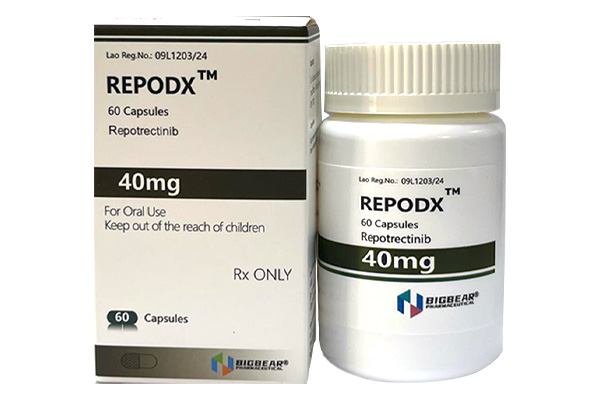
Repotrectinib, as a next-generation ROS1 and NTRK targeted inhibitor, can effectively overcome multiple resistance mutations to other tyrosine kinase inhibitors (TKIs); the generic version REPODX (specification 40mg×60 capsules/bottle) launched by Lao Big Bear Pharma (BIGBEAR Pharma) is providing a new treatment option for ROS1-positive locally advanced or metastatic non-small cell lung cancer (NSCLC) patients with greater accessibility.
Is there a Lao generic version of Repotrectinib?
Yes, there is a Lao generic version of Repotrectinib. The Lao Big Bear version of Repotrectinib is available in 40mg*60 capsules/box. For more questions, we recommend you contact our professional customer service for detailed consultation.
Mechanism of action of Repotrectinib
Development history: Repotrectinib was originally developed by Turning Point Therapeutics, a biotechnology company focused on precision oncology drugs. In 2022, the company was acquired by Bristol-Myers Squibb, which integrated global resources and accelerated the drug's approval, production, and commercialization.
Target characteristics: As a next-generation tyrosine kinase inhibitor, this drug precisely acts on the abnormal fusion proteins produced by ROS1 and NTRK gene fusions. These genetic alterations cause the tyrosine kinase to act like a "stuck accelerator," continuously emitting growth signals that drive uncontrolled cancer cell proliferation.
Molecular design advantage: Repotrectinib is deliberately designed as a compact small-molecule structure, enabling it to bind tightly to the active pocket of the kinase domain, effectively overcoming certain resistance mutations such as ROS1 G2032R and restoring tumor suppression. At the same time, this structure endows it with excellent blood-brain barrier penetration, directly addressing the highly challenging issue of brain metastases that are very common in ROS1-positive lung cancer.
Therapeutic concept: Unlike the broad-spectrum killing of traditional chemotherapy, Repotrectinib blocks specific oncogenic signals, thereby killing tumors while minimizing damage to normal tissues, reflecting the trend of precision and personalized cancer therapy.
Indications for Repotrectinib
ROS1-positive non-small cell lung cancer: Approved by the U.S. FDA in November 2023, based on the global TRIDENT-1 trial. In TKI-naïve patients, the objective response rate was 79%, with a median duration of response exceeding 34 months; in patients previously treated with TKIs, the response rate was 38%, with a duration of response of nearly 15 months. The study clearly demonstrated efficacy against brain metastases.
Long-term efficacy update: Updated data published in the New England Journal of Medicine in 2024 showed that the median progression-free survival in TKI-naïve patients was close to 36 months, and 9 months in pretreated patients, confirming durable disease control. Most side effects were mild to moderate, and discontinuation due to adverse events was rare.
NTRK-fusion solid tumors: Granted accelerated approval in June 2024 for patients aged 12 years and older with NTRK fusion-positive advanced solid tumors who lack standard therapeutic options. In the TRIDENT-1 trial, the response rate in TKI-naïve patients was 58%, with most responses being durable; in patients previously treated with TRK inhibitors, the response rate was 50%, with a median response duration of 9.9 months.
Clinical value: This drug brings significant and durable tumor shrinkage to patients with rare gene fusions, and fills the therapeutic gaps in brain metastases and resistance.