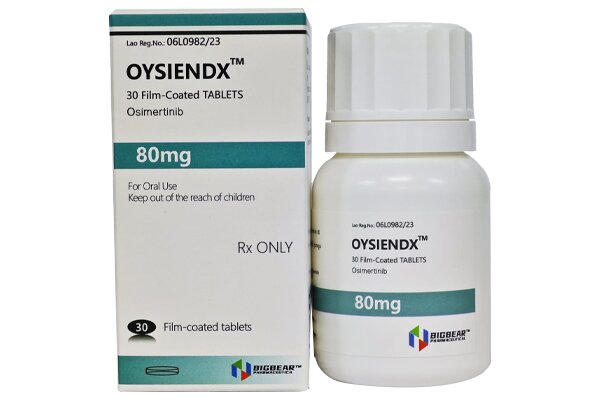
AstraZeneca recently announced that its supplemental New Drug Application (sNDA) for Tagrisso (osimertinib), an epidermal growth factor receptor (EGFR) tyrosine kinase inhibitor, in combination with chemotherapy, has been approved by the U.S. FDA for the treatment of adult patients with locally advanced or metastatic EGFR-mutant (EGFRm) non-small cell lung cancer (NSCLC).
Tagrisso is a third-generation, irreversible EGFR-TKI that has demonstrated clinical efficacy against NSCLC. It is approved as a monotherapy in more than 100 countries, including the U.S., EU, China, and Japan, for indications including first-line treatment of patients with locally advanced or metastatic EGFRm NSCLC, first-line treatment of patients with locally advanced or metastatic EGFR T790M mutation-positive NSCLC, and adjuvant therapy for early-stage EGFRm NSCLC.
Last August, Tagrisso in combination with chemotherapy received Breakthrough Therapy Designation from the U.S. FDA for first-line treatment of adult patients with locally advanced or metastatic EGFRm NSCLC. In December of the same year, based on positive data from the FLAURA2 trial, Tagrisso in combination with chemotherapy was included in the NCCN Clinical Practice Guidelines in Oncology (NCCN Guidelines) as an NCCN Category 1 additional recommendation for non-small cell lung cancer patients with EGFR exon 19 deletions or exon 21L858R mutations.
This approval was primarily based on the results of the FLAURA2 Phase 3 clinical trial previously published in the *New England Journal of Medicine*. Compared to Tagrisso monotherapy (the global first-line standard of care), Tagrisso in combination with chemotherapy reduced the risk of disease progression or death by 38% (HR: 0.62; 95% CI: 0.49–0.79; p<0.0001). The investigator-assessed median progression-free survival (PFS) in patients receiving Tagrisso in combination with chemotherapy was 25.5 months, an improvement of 8.8 months compared to Tagrisso monotherapy (16.7 months).
The PFS results from the blinded independent central review (BICR) were consistent with the investigator's assessment, showing a median PFS of 29.4 months in patients receiving Tagrisso in combination with chemotherapy, an improvement of 9.5 months compared to Tagrisso monotherapy (19.9 months) (HR: 0.62; 95% CI: 0.48–0.80; p = 0.0002).
In the FLAURA2 trial, a predetermined exploratory analysis by BICR in patients with brain metastases at baseline showed that Tagrisso in combination with chemotherapy reduced the risk of central nervous system (CNS) disease progression or death by 42% compared to Tagrisso alone (HR: 0.58; 95% CI: 0.33–1.01). After two years of follow-up, 74% of patients receiving Tagrisso in combination with chemotherapy did not experience CNS disease progression or death, compared to 54% of patients receiving Tagrisso alone.
The safety profile of Tagrisso in combination with chemotherapy is generally manageable and consistent with the characteristics of different components in established combination therapies.
As part of AstraZeneca's ongoing commitment to early treatment for lung cancer patients, Tagrisso is also undergoing neoadjuvant treatment in the NeoADAURA Phase III trial, with results expected later this year, and is being studied as early adjuvant resectable treatment in the ADAURA2 Phase III trial.