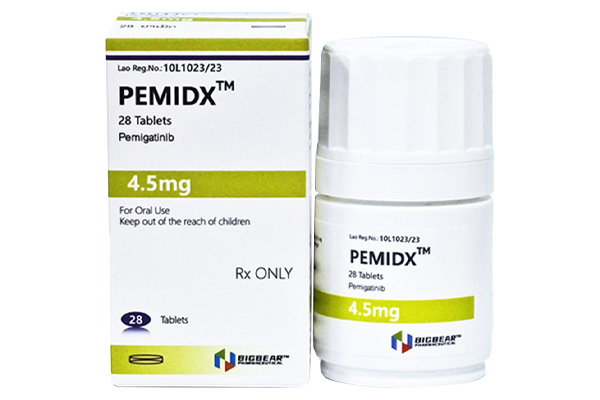
On August 26, 2022, Incyte announced that the U.S. Food and Drug Administration (FDA) has approved Pemazyre (pemigatinib) for the treatment of adult patients with relapsed or refractory myeloid or lymphoid neoplasms (MLNs) harboring FGFR1 gene recombinants.
Pemazyre's active pharmaceutical ingredient, pemigatinib, is a potent, selective, orally administered small molecule inhibitor targeting FGFR isoforms 1, 2, and 3. In preclinical studies, pemigatinib has demonstrated potent and selective pharmacological activity against cancer cells with FGFR gene alterations.
Notably, this is Pemazyre's second approved indication, making it the first approved precision therapy for treating patients with MLNs harboring FGFR1 gene recombinants. Previously, Pemazyre received accelerated approval from the FDA in 2020 for the treatment of relapsed or refractory, locally unresectable or metastatic cholangiocarcinoma (MLN) with FGFR2 fusions or other types of gene recombinations, as determined by FDA-approved testing.
The approval was based on data from the FIGHT-203 trial. FIGHT-203 was a multicenter, open-label, single-arm phase 2 clinical trial designed to examine the efficacy and safety of Pemazyre in 28 patients with relapsed or refractory MLN carrying FGFR1 gene recombinations. Patients may have relapsed after allogeneic hematopoietic stem cell transplantation (allo-HSCT) or disease-related treatment, or may not have been eligible for allo-HSCT or other disease-related therapies.
Data analysis showed that in patients with chronic bone marrow disease, regardless of the presence of end-stage renal disease (EMD) (N=18), the complete response (CR) rate was 78% (14/18, 95% CI: 52-94), with a median time to complete response of 104 days (range: 44-435 days). The median duration of response has not yet been reached (range 1+ to 988+ days). In patients with acute myeloma, regardless of EMD (N=4), 2 achieved complete remission (duration: 1+ to 94 days). In patients with EMD only (N=3), 1 achieved complete remission (duration: 64+ days). Among all patients (N=28, including 3 without morphological abnormalities), the complete cytogenetic remission rate was 79% (22/28, 95% CI: 59-92).
“The approval of Pemazyre represents a significant therapeutic advance for MLNs with FGFR1 rearrangements, who currently have limited treatment options,” said Hervé Hopenot, CEO of Incyte, in a press release. “These are complex hematologic malignancies with a range of presentations, and this approval underscores Incyte’s continued leadership and commitment to advancing patient care for rare hematologic malignancies.”
Regarding safety, the most common (≥20%) adverse events included hyperphosphatemia (74%) and nail toxicity. (62%), alopecia (59%), stomatitis (53%), diarrhea (50%), dry eye (50%), rash (35%), abdominal pain (35%), anemia (35%), constipation (32%), dry mouth (32%), epistaxis (29%), retinal pigment epithelial cell detachment (26%), extremity pain (26%), decreased appetite (24%), dry skin (24%), indigestion (24%), back pain (24%), nausea (21%), blurred vision (21%), peripheral edema (21%), and dizziness (21%).
In March 2021, Pemazyre was approved by the Japanese Ministry of Health, Labour and Welfare (MHLW) for the treatment of patients with unresectable cholangiocarcinoma carrying the FGFR2 fusion gene whose disease has worsened after receiving anticancer chemotherapy.
Pemazyre is the first and only targeted therapy for bile duct cancer in the United States, Japan, and the European Union. This drug works by blocking FGFR2 in tumor cells to inhibit their growth and spread. Pemazyre has previously been granted Orphan Drug Designation, Breakthrough Therapy Designation, Priority Review Designation, and Accelerated Evaluation Designation.