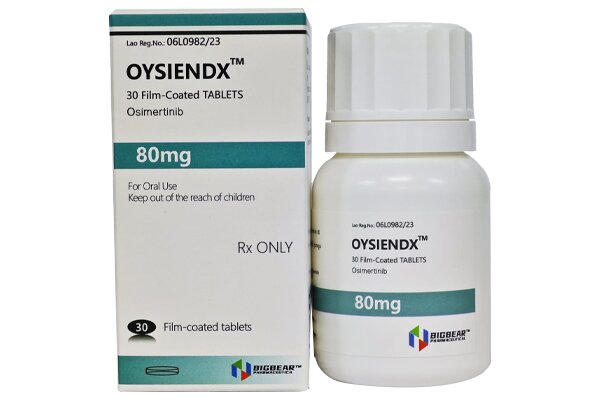
On February 19, 2024, AstraZeneca announced that its drug, osimertinib, has received approval in the United States for use in combination with chemotherapy for adult patients with locally advanced or metastatic epidermal growth factor receptor-mutated (EGFRm) non-small cell lung cancer (NSCLC).
This approval, granted under the U.S. Food and Drug Administration’s (FDA) Priority Review designation, is based on results from the Phase III FLAURA2 clinical trial, which were published in *The New England Journal of Medicine*. The results demonstrated that adding chemotherapy to osimertinib monotherapy—currently the global standard of care for first-line treatment—reduced the risk of disease progression or death by 38% (Hazard Ratio [HR] 0.62; 95% Confidence Interval [CI] 0.49–0.79; p<0.0001). Based on investigator assessment, the median progression-free survival (PFS) for patients treated with osimertinib plus chemotherapy was 25.5 months—an improvement of 8.8 months compared to osimertinib monotherapy (16.7 months).
PFS results assessed by Blinded Independent Central Review (BICR) were consistent with the investigator assessments, showing a median PFS of 29.4 months in the osimertinib plus chemotherapy arm—an improvement of 9.5 months compared to the osimertinib monotherapy arm (19.9 months) (HR 0.62; 95% CI 0.48–0.80; p=0.0002). Dave Fredrickson, Executive Vice President of AstraZeneca’s Oncology Business Unit, stated: “This important new treatment option can delay disease progression by nearly nine months, setting a new benchmark for the longest progression-free survival benefit ever reported in the first-line treatment of advanced disease. This approval solidifies the position of osimertinib as a cornerstone in the treatment of EGFR-mutated lung cancer, whether administered as a monotherapy or in combination with chemotherapy. This news is particularly significant for patients with a poorer prognosis, including those whose cancer has metastasized to the brain and those harboring the L858R mutation.”
Laurie Ambrose, President and CEO of GO2 for Lung Cancer, commented: “We are delighted to see the continued progress being made in advancing more personalized treatment options for our community. The better we are able to provide the right treatment to the right patient at the right time, the better the outcomes will be for our community—a shared goal for all of us.”
Osimertinib Safety and Tolerability
The safety profile of osimertinib in combination with chemotherapy was generally manageable and consistent with the known safety profiles of the individual agents. The incidence of adverse events (AEs) was higher in the osimertinib-plus-chemotherapy arm, driven primarily by well-characterized chemotherapy-related AEs. Discontinuation rates due to AEs were low in both arms of the trial (11% in the osimertinib-plus-chemotherapy arm and 6% in the monotherapy arm).
Osimertinib Guideline Updates
In December 2023, based on data from the FLAURA2 trial, the osimertinib-plus-chemotherapy regimen was incorporated into the National Comprehensive Cancer Network® (NCCN®) Clinical Practice Guidelines in Oncology (NCCN Guidelines®) as a Category 1 "Other Recommended Regimen" for patients with non-small cell lung cancer (NSCLC) harboring EGFR exon 19 deletions or exon 21 L858R mutations.