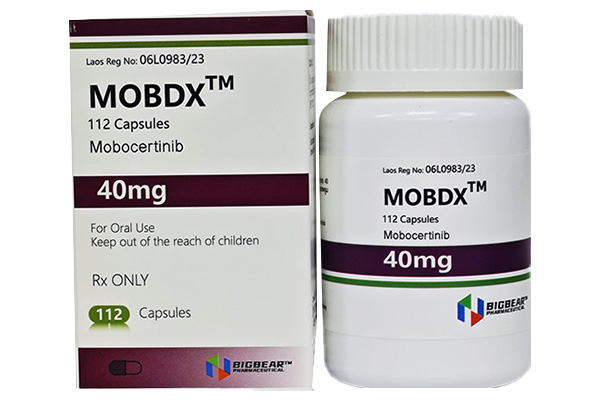
Recently, the UK's National Institute for Health and Care Excellence (NICE) released its final guidelines, recommending Exkivity (Mobocertinib) for the treatment of patients with advanced non-small cell lung cancer (NSCLC) positive for epidermal growth factor receptor (EGFR) exon 20 insertion mutations who have previously received platinum-based chemotherapy. Mobocertinib is an EGFR kinase inhibitor that irreversibly binds to and inhibits EGFR exon 20 insertion mutations at lower concentrations than wild-type (WT) EGFR. Following oral administration of mobocertinib, two pharmacologically active metabolites (AP32960 and AP32914) with similar inhibitory spectra to mobocertinib have been identified in plasma. In vitro, mobocertinib also inhibits the activity of other EGFR family members (HER2 and HER4) and another kinase (BLK) at clinically relevant concentrations (IC₅₀ <2 nM). In cultured cell models, mobocertinib inhibited cell proliferation driven by various EGFR exon 20 insertion mutation variants at concentrations 1.5 to 10 times lower than WT-EGFR signaling inhibitors. NICE primarily supports the results from an international multicenter phase 1/2 clinical trial (NCT02716116). This trial included 114 NSCLC patients with EGFR ex20ins mutations who had previously received platinum-based chemotherapy and received oral mobocertinib (160 mg once daily).
The study results were presented at the 2021 American Society of Clinical Oncology (ASCO) Annual Meeting: According to the assessment of the Independent Review Committee (IRC), the objective response rate (ORR) was 28%, the median duration of response (DOR) was 17.5 months, the disease control rate (DCR) was 78%, the median overall survival (OS) was 24 months, the 1-year survival rate was 70%, and the median progression-free survival (PFS) was 7.3 months. Treatment response was observed in patients with various EGFRex20ins mutations in NSCLC. The safety profile observed in this study was manageable and consistent with previous results.
The most common adverse reactions were diarrhea, rash, nausea, stomatitis, vomiting, decreased appetite, paronychia, fatigue, dry skin, and musculoskeletal pain. Prescribing information included boxed warnings for QTc prolongation and torsades de pointes, as well as warnings and precautions for interstitial lung disease/pneumonia, cardiotoxicity, and diarrhea.
“This is the first NICE-approved treatment for this specific gene mutation in a patient with advanced NSCLC,” said Helen Knight, interim director of drug evaluation at NICE, in a press release. “I am delighted that we can recommend this innovative treatment for patients with this rare and aggressive lung cancer in the UK. Evidence suggests that it not only extends lives but also extends how long before cancer progresses.” Furthermore, on September 17, 2021, the U.S. Food and Drug Administration (FDA) approved EXKIVITY (mobocertinib, TAK-788) for the treatment of adult patients with locally advanced or metastatic non-small cell lung cancer (NSCLC) whose disease has progressed during or after platinum-based chemotherapy and who have an epidermal growth factor receptor (EGFR) exon 20 insertion mutation (detected by an FDA-approved test).