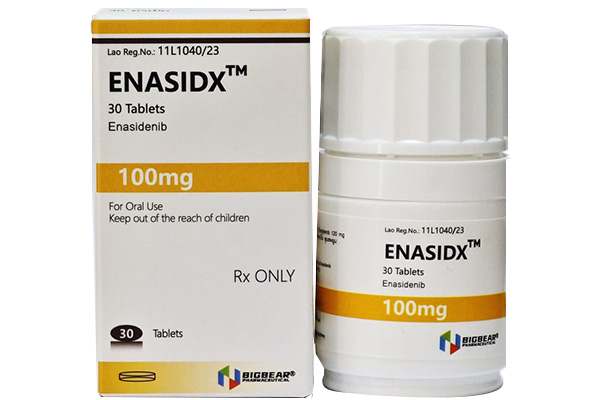
Enasidenib, an antineoplastic agent, is a potent and selective inhibitor of isocitrate dehydrogenase-2 (IDH2), indicated for the treatment of relapsed or refractory acute myeloid leukemia (AML) with an IDH2 mutation.
Enasidenib – Precautions
1. Differentiation Syndrome
(1) IDH2 inhibitors (such as enasidenib) may trigger this syndrome. Patients with bone marrow blasts >20% or those who have received fewer prior antileukemic therapies are at higher risk. Onset ranges from 1 day to 5 months after starting therapy. About half of patients can continue treatment without interruption. Key management: early recognition and early treatment (intravenous or oral dexamethasone 10 mg every 12 hours, with gradual tapering after symptom resolution). If no other clear cause is identified and relevant symptoms appear, corticosteroid therapy should be initiated immediately. If respiratory support or renal impairment persists for >48 hours, interrupt enasidenib. Hospital monitoring is recommended for patients with pulmonary/renal manifestations.
(2) Boxed Warning. Use of enasidenib may be associated with differentiation syndrome (with or without leukocytosis), which can be life‑threatening or fatal. If signs or symptoms suggestive of differentiation syndrome occur (e.g., fever, dyspnea, acute respiratory distress, pulmonary infiltrates, pleural/pericardial effusion, rapid weight gain, peripheral edema, lymphadenopathy, bone pain, hepatic/renal or multiorgan dysfunction), immediately initiate corticosteroid therapy and monitor hemodynamic parameters until symptom improvement. If severe pulmonary symptoms requiring respiratory support (e.g., intubation, assisted ventilation) and/or renal dysfunction persist after 48 hours of corticosteroid therapy, interrupt enasidenib. For patients with pulmonary and/or renal manifestations, close inpatient monitoring is advised.
2. Fetal/Neonatal Risk
Animal studies show teratogenicity, embryotoxicity, and fetal toxicity. Contraceptive requirements: females of reproductive potential and their male partners must use highly effective contraception during treatment and for 2 months after the last dose. Those using hormonal contraceptives should add a non‑hormonal method.
Enasidenib – Adverse Reactions
Common adverse reactions (≥20%) include nausea, vomiting, diarrhea, increased bilirubin, and decreased appetite.
Enasidenib – Drug Interactions
1. Metabolic Pathways
(1) Enasidenib
Metabolized by CYP1A2/2B6/2C8/2C9/2C19/2D6/3A4 and UGT1A1/1A3/1A4/1A9/2B7/2B15 to the active metabolite AGI‑16903.
(2) AGI‑16903
Metabolized by CYP1A2/2C19/3A4 and UGT1A1/1A3/1A9.
(3) Interaction mechanisms
Enasidenib inhibits CYP1A2/2B6/2C8/2C9/2C19/2D6/3A4 and UGT1A1, induces CYP2B6/3A4; inhibits P‑gp, BCRP, OAT1, OATP1B1/1B3, OCT2. AGI‑16903 inhibits BCRP, OAT1/3, OATP1B1, OCT2, and is a substrate of P‑gp and BCRP.
2. Clinical Recommendations
(1) CYP1A2 or CYP2C19 substrates (e.g., omeprazole)
May increase substrate exposure → avoid co‑administration (unless permitted in the substrate’s prescribing information); caffeine‑sensitive patients should reduce intake frequency.
(2) CYP3A substrates (e.g., midazolam)
May decrease substrate exposure → avoid co‑administration (especially antifungals). Hormonal contraceptive concentrations may be reduced → switch to non‑hormonal contraception.
(3) OATP1B1/1B3 or BCRP substrates (e.g., rosuvastatin)
May increase substrate exposure → reduce dose as per the substrate’s prescribing information.
(4) P‑gp substrates (e.g., digoxin)
May increase exposure → intensify monitoring for adverse effects.