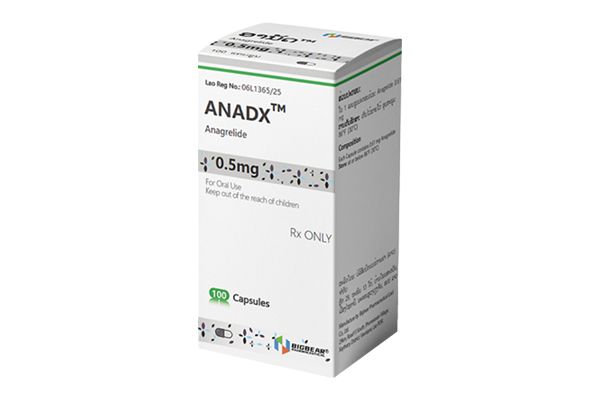
Composition of Anagrelide
(1) Anagrelide hydrochloride, USP is a platelet-reducing agent. Its chemical name is 6,7-dichloro-1,5-dihydroimidazo[2,1-b]quinazolin-2(3H)-one hydrochloride monohydrate. The molecular formula is C₁₀H₇Cl₂N₃O·HCl·H₂O, and the molecular weight is 310.56.
(2) Each Anagrelide capsule USP (oral) contains 0.5 mg or 1 mg of anagrelide (as anagrelide hydrochloride) and the following inactive ingredients: black iron oxide, gelatin, croscarmellose sodium, lactose monohydrate, magnesium stearate, microcrystalline cellulose, hydroxypropyl cellulose, propylene glycol, shellac, titanium dioxide, and potassium hydroxide.
Pharmacokinetics of Anagrelide
Anagrelide exhibits dose-proportional pharmacokinetics over the dose range of 0.5 mg to 2.5 mg.
1. Absorption
After oral administration, at least 70% of anagrelide is absorbed from the gastrointestinal tract. In fasting subjects, peak plasma concentrations of anagrelide occur approximately 1 hour after dosing. Pharmacokinetic data obtained from healthy volunteers comparing fed and fasted states showed that administration of a 1 mg dose of anagrelide with food reduced Cmax by 14% but increased AUC by 20%. Food reduced the Cmax of the active metabolite, 3-hydroxy anagrelide, by 29% but had no effect on its AUC.
2. Elimination
The plasma elimination half-lives of anagrelide and 3-hydroxy anagrelide are approximately 1.5 hours and 2.5 hours, respectively. When administered according to the clinical dosing regimen, anagrelide and 3-hydroxy anagrelide do not accumulate in plasma.
3. Metabolism
Anagrelide is primarily metabolized by CYP1A2 to the active metabolite 3-hydroxy anagrelide, which is subsequently metabolized by CYP1A2 to the inactive metabolite RL603. In urine, less than 1% of the administered dose is recovered as unchanged anagrelide, approximately 3% as 3-hydroxy anagrelide, and approximately 16% to 20% as RL603.
4. Drug Interactions
(1) Aspirin: Two pharmacodynamic interaction studies in healthy subjects showed that coadministration of a single 1 mg dose of anagrelide with 900 mg aspirin, or repeated doses of anagrelide 1 mg once daily with aspirin 75 mg once daily, produced greater in vitro antiplatelet aggregation effects than aspirin alone. Coadministration of a single 1 mg dose of anagrelide with 900 mg aspirin had no effect on bleeding time, prothrombin time (PT), or activated partial thromboplastin time (aPTT).
(2) Digoxin or Warfarin: In vivo interaction studies in humans have demonstrated that anagrelide does not affect the pharmacokinetic properties of digoxin or warfarin, and digoxin or warfarin does not affect the pharmacokinetic properties of anagrelide.
5. Specific Populations
(1) Pediatric: In children and adolescents with essential thrombocythemia (age range 7 to 16 years), dose-normalized Cmax and AUC of anagrelide were 17% and 56% higher, respectively, compared to adult patients (19 to 57 years).
(2) Elderly: In elderly patients (age range 65 to 75 years), Cmax and AUC of anagrelide were 36% and 61% higher, respectively, compared to younger adults (age range 22 to 50 years), but Cmax and AUC of the active metabolite 3-hydroxy anagrelide were 42% and 37% lower, respectively, in elderly patients.
(3) Renal Impairment: A pharmacokinetic study of a single 1 mg dose of anagrelide in subjects with severe renal impairment showed no significant effect on the pharmacokinetics of anagrelide.
(4) Hepatic Impairment: A pharmacokinetic study of a single 1 mg dose of anagrelide in subjects with moderate hepatic impairment (Child-Pugh score 7 to 9) showed that, compared to healthy subjects, mean anagrelide Cmax increased by 2-fold and total anagrelide exposure (AUC) increased by 8-fold. In addition, mean 3-hydroxy anagrelide Cmax was 24% lower and mean 3-hydroxy anagrelide AUC was 77% higher in subjects with moderate hepatic impairment compared to healthy subjects.
Storage of Anagrelide
Store at 20°C to 25°C (68°F to 77°F); excursions permitted between 15°C and 30°C (59°F to 86°F). Store in a tight, light-resistant container. Keep Anagrelide out of the reach of children.