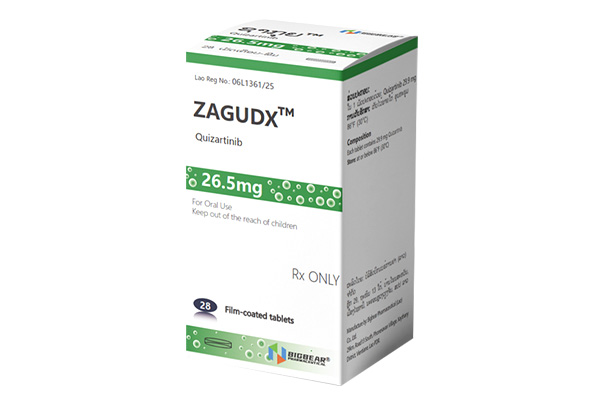
The U.S. FDA has recently accepted and granted priority review to quizartinib's New Drug Application (NDA). The NDA grant is for the treatment of newly diagnosed adult patients with FLT3-ITD-positive acute myeloid leukemia (AML) using quizartinib in combination with standard cytarabine plus anthracycline induction and standard cytarabine consolidation chemotherapy, as well as quizartinib as a consolidation-following continuous monotherapy. The FDA has set the target date for the Prescription Drug User Fee Act (PDUFA) as April 24, 2023.
Mechanism of Action of Quizartinib
Quizartinib is a second-generation FLT3 inhibitor. It is an orally administered small molecule receptor tyrosine kinase inhibitor that selectively targets and inhibits FLT3 (FMS-like tyrosine kinase 3). FLT3 is a tyrosine kinase receptor protein normally expressed by hematopoietic stem cells and plays an important role in cell development, promoting cell survival, growth, and differentiation through various signaling pathways.
The Most Common FLT3 Mutation Type in Leukemia
AML is one of the most common types of leukemia in adults, accounting for 23.1% of all leukemia cases worldwide in 2017. In the United States, an estimated 20,050 new cases of AML are expected in 2022, with a five-year survival rate of 30.5%. FLT3 (FMS-like tyrosine kinase 3) gene mutations are among the most common genetic abnormalities in AML, with FLT3-ITD (inner tandem repeat) being the most common type of FLT3 mutation, occurring in approximately 25% of newly diagnosed AML patients. This is associated with a particularly unfavorable prognosis, including an increased risk of relapse and shortened overall survival.
Quizartinib Approval Status
Quizartinib (brand name Vanflyta) received approval from the Japanese Ministry of Health, Labour and Welfare (MHLW) in June 2019 for the treatment of adult patients with relapsed or refractory FLT3-ITD AML. This was the first regulatory approval for this drug globally. Outside of Japan, quizartinib is an investigational drug and has not yet been approved.
Quizartinib Global Phase 3 Study Data
This NDA is based on the results of the Quantum-First trial (NCT02668653). This was a randomized, double-blind, placebo-controlled global phase 3 study that enrolled 539 newly diagnosed FLT3-ITD-positive AML patients aged 18-75 years. The study evaluated quizartinib in combination with standard cytarabine and anthracyclines for induction and consolidation chemotherapy with standard cytarabine, as well as quizartinib as continuous monotherapy after consolidation. In the trial, patients were randomized 1:1 to receive either quizartinib or placebo in combination with anthracyclines and cytarabine. Eligible patients, including those who underwent hematopoietic stem cell transplantation (HSCT), continued quizartinib or placebo for up to 36 cycles.
Data showed that the quizartinib regimen reduced the risk of death by 22.4% compared to standard chemotherapy (HR=0.776 [95% CI: 0.615–0.979]; two-sided p=0.0324). With a median follow-up of 39.2 months, the quizartinib regimen significantly prolonged overall survival compared to standard chemotherapy (median OS: 31.9 months vs 15.1 months). The safety profile of the quizartinib regimen was generally manageable in this trial, and no new safety signals were observed. The trial results were presented at the European Society of Hematology Congress 2022 (EAH2022).
Based on the results of the QuANTUM-First trial, the application for quizartinib to treat newly diagnosed FLT3-ITD-positive adult AML patients is also under review by regulatory agencies in the EU and Japan.