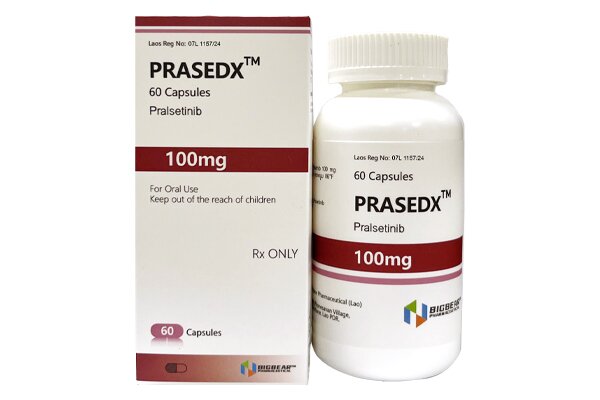
Recently, the U.S. Food and Drug Administration (FDA) approved Gavreto (pralsetinib) capsules, a precision oncology drug and RET kinase inhibitor, for the treatment of adult patients with metastatic non-small cell lung cancer (NSCLC) confirmed by FDA-approved testing methods to be RET fusion-positive.
Regarding dosage: Retevmo is taken orally twice daily, with or without food. Retevmo is the first approved treatment specifically for cancer patients carrying RET gene alterations. This drug is indicated for the treatment of: (1) adult patients with advanced or metastatic NSCLC; (2) patients aged ≥12 years with advanced or metastatic MTC requiring systemic therapy; and (3) patients aged ≥12 years with advanced RET fusion-positive thyroid cancer who require systemic therapy, have stopped responding to radioactive iodine therapy, or are unsuitable for radioactive iodine therapy.
Gavreto (Pralsetinib) Mechanism of Action
Pralsetinib is a kinase inhibitor of wild-type RET and oncogenic RET fusion proteins (CCDC6-RET) and mutants (RETV804L, RETV804M, and RETM918T), with an inhibitory maximum half-concentration (IC50s) of less than 0.5 nM. In purified enzyme assays, palacitinib inhibited DDR1, TRKC, FLT3, JAK1-2, TRKA, VEGFR2, PDGFRb, and FGFR1 at high concentrations, while Cmax remained clinically achievable. In cellular analyses, palacitinib inhibited RET concentrations 14, 40, and 12 times lower than those of VEGFR2, FGFR2, and JAK2, respectively.
Some RET fusion proteins and activation point mutations can drive tumorigenic potential by overactivating downstream signaling pathways that lead to uncontrolled cell proliferation. Pralsetinib demonstrated antitumor activity in cultured cells and animal tumor implantation models with oncogenic RET fusions or mutations, including KIF5B-RET, CCDC6-RET, RETM918T, RETC634W, RETV804E, RETV804L, and RETV804M. Furthermore, pralsetinib prolonged survival in mice with intracranial implantation of tumors expressing KIF5B-RET or CCDC6-RET.
Gavreto (Pracitinib) Indications and Usage
GAVRETO is a kinase inhibitor detectable in FDA-approved trials for the treatment of adult patients with metastatic rearrangements during metastatic non-small cell lung cancer (NSCLC) that has undergone RET fusion-positive disease.
This indication was approved under accelerated approval based on overall response rate and duration of response. Continued approval for this indication may depend on validation and description of confirmatory trials demonstrating clinical benefit.
Gavreto (Pracitinib) Dosage and Administration
Patients are selected for GAVRETO treatment based on the presence of the RET gene fusion.
The recommended adult dose is 400 mg orally once daily on an empty stomach (without food for at least 2 hours before and at least 1 hour after taking GAVRETO).
Gavreto (Pracitinib) Contraindications
None.
Gavreto (Plasicitinib) Warnings and Precautions
1. Interstitial Lung Disease (ILD)/Pneumonia: For Grade 1 or 2 responses, discontinue Gavreto until resolution, then resume at a reduced dose. For recurrent ILD/pneumonia, permanently discontinue; for Grade 3 or 4 responses, permanently discontinue.
2. Hypertension: Do not initiate Gavreto in patients with hypertension. Optimize blood pressure (BP) before initiating Gavreto. Monitor blood pressure after 1 week, and at least monthly thereafter, with clinical examination. Discontinue, reduce the dose, or permanently discontinue Gavreto depending on severity.
3. Hepatotoxicity: Before initiating Gavreto, monitor ALT and AST every 2 weeks for the first 3 months, and monthly thereafter, with clinical examination. Discontinue, reduce the dose, or permanently discontinue Gavreto depending on severity.
4. Bleeding Events: Permanently discontinue Gavreto in patients with severe or life-threatening bleeding.
5. Risk of impaired wound healing: Discontinue GAVRETO at least 5 days prior to elective surgery. Do not take GAVRETO for at least 2 weeks after major surgery until the wound has fully healed. The safety of resuming GAVRETO after resolving wound healing complications has not been established.
6. Embryo-fetal toxicity: May cause fetal harm. Recommended for female fetuses at reproductive risk, and use effective non-hormonal contraception.
Adverse Reactions of Gavreto (Pracitinib)
The most common adverse reactions (≥25%) are fatigue, constipation, musculoskeletal pain, and hypertension. The most common grade 3-4 laboratory abnormalities (≥2%) are lymphopenia, neutropenia, phosphate depletion, hemoglobin depletion, sodium depletion, calcium depletion (corrected), and increased alanine aminotransferase (ALT).
Drug Interactions of Gavreto (Pracitinib)
1. Potent CYP3A inhibitors: Avoid concomitant administration.
2. P-gp with strong CYP3A inhibitors: Avoid co-administration. If co-administration cannot be avoided, reduce the dose of GAVRETO.
3. Strong CYP3A inducers: Avoid co-administration. If co-administration cannot be avoided, increase the dose of GAVRETO.
Gavreto (Pracitinib) Use in Specific Populations
Lactation: Breastfeeding is not recommended.
Gavreto (Pracitinib) Packaging, Supply/Storage and Handling
GAVRETO (Pracitinib) 100 mg, pale blue, opaque, immediately releasing hydroxypropyl methylcellulose (HPMC) hard capsules, with “BLU-667” printed on the capsule shell and “100mg” printed on the capsule cap, as follows:
• 60 capsules per bottle (NDC72064-210-60).
• 90 capsules per bottle (NDC72064-210-90).
• 120 capsules per bottle (NDC72064-210-12).
Store at 20°C to 25°C (68°F to 77°F); allowable deviations between 15°C and 30°C (59°F to 86°F) [see USP-controlled room temperature]. Keep away from moisture.