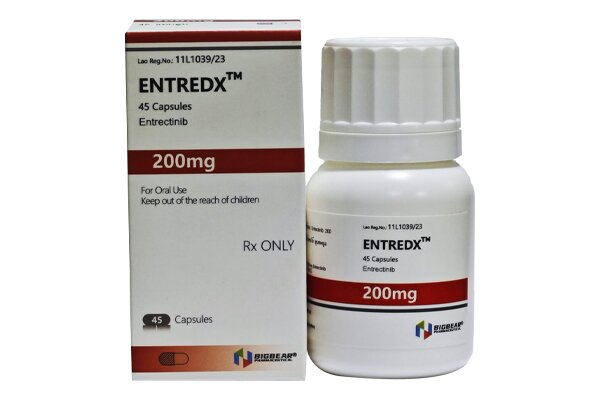
Due to significant individual differences among cancer patients, including tumor molecular characteristics, physical function, and comorbidities, drug metabolism and response can all affect medication use. Therefore, strict adherence to the doctor's prescription is crucial.
1. Patient Selection
Entrectinib is selected for metastatic NSCLC patients based on the presence of ROS1 rearrangements in tumor or plasma samples. Plasma sample testing is only applicable when tumor tissue is unavailable.
Entrectinib is selected for locally advanced or metastatic solid tumor patients based on the presence of NTRK gene fusions in tumor or plasma samples. Plasma sample testing is only applicable when tumor tissue is unavailable.
2. Recommended Assessments and Tests Before Initiating Entrectinib Treatment
Before initiating entrectinib treatment, left ventricular ejection fraction (LVEF), serum uric acid levels, QT interval, and electrolytes should be assessed.
3. Entrectinib Dosage Forms
The physician should prescribe the most appropriate entrectinib dosage form based on the required dose and the patient's needs. Entrectinib is available in two dosage forms: as capsules (swallowed whole), as an oral suspension (or for enteral administration), or as oral granules with soft food.
100mg and 200mg capsules: Whole capsules are suitable for patients who can swallow capsules whole and require doses multiples of 100mg. Oral suspension capsules are suitable for patients who have difficulty or cannot swallow capsules, or who require enteral administration (e.g., via gastric or nasogastric tube), and should only be used when a 10mg dose increment is required.
50mg oral granules per packet: Granules should be sprinkled on one or more spoonfuls of soft food. These are suitable for patients who have difficulty or cannot swallow capsules but can swallow soft food and require doses multiples of 50mg. Granules should not be used to prepare suspensions, nor should portions of granules be taken from a 50mg granule packet to prepare a dose. Granules should not be used for enteral administration to avoid clogging the tube.
4. Entrectinib Administration
Entrectinib capsules, suspension capsules, or granules are administered once daily, with or without food.
If a dose of entrectinib is missed, it should be taken as soon as possible, unless the next dose is within 12 hours. In this case, skip the missed dose and take the next dose at the usual time.
If vomiting occurs immediately after taking the medication, the dose should be repeated.
5. Recommended Dosage of Entrectinib for ROS1-positive Non-Small Cell Lung Cancer
The recommended dose of entrectinib is 600 mg orally once daily, with or without food, until disease progression or unacceptable toxicity occurs.
6. Recommended Dosage of Entrectinib for NTRK Gene Fusion-positive Solid Tumors
For adults and children with BSA ≥ 1.51 m², the recommended dose of entrectinib is 600 mg orally once daily, with or without food, until disease progression or unacceptable toxicity occurs.
For pediatric patients older than 6 months, the recommended dose is determined based on age and body surface area (BSA):
When BSA ≤ 0.50 m², the recommended daily dose is 300 mg/m².
When BSA is 0.51–0.80 m², the recommended daily dose is 200 mg.
When BSA is 0.81–1.10 m², the recommended daily dose is 300 mg.
When BSA is 1.11–1.50 m², the recommended daily dose is 400 mg.
When BSA ≥ 1.51 m², the recommended daily dose is 600 mg once daily.
For pediatric patients older than 1 month but ≤ 6 months, the recommended dose is 250 mg/m², orally once daily. To achieve a 10 mg dose increment, capsules prepared as oral suspensions must be used.
7. Entrectinib Dosage Adjustment for Adverse Reactions
For adult and pediatric patients, the recommended dose reduction regimen for entrectinib to manage adverse reactions is as follows:
When the starting dose is 250 mg/m² or 300 mg/m², the first dose is reduced to two-thirds of the starting dose, and the second dose is reduced to one-third of the starting dose. If the patient still cannot tolerate entrectinib after two dose reductions, the drug should be permanently discontinued.
When the starting dose is 200 mg, the first dose is reduced to 150 mg once daily; the second dose is reduced to 100 mg once daily.
When the starting dose is 300 mg, the first dose is reduced to 200 mg once daily; the second dose is reduced to 100 mg once daily.
When the starting dose is 400 mg, the first dose is reduced to 300 mg once daily; the second dose is reduced to 200 mg once daily.
When the starting dose is 600 mg, the first dose is reduced to 400 mg once daily; the second dose is reduced to 200 mg once daily. To achieve a 10 mg dose increment, capsules formulated as oral suspensions must be used.
Dose adjustments corresponding to different adverse reactions and their severity are as follows:
Congestive Heart Failure: For grade 2 or 3 congestive heart failure, entrectinib treatment should be suspended until recovery to grade ≤1, then resumed at a reduced dose; for grade 4 congestive heart failure, entrectinib should be permanently discontinued.
Central Nervous System Effects: For intolerable grade 2 central nervous system effects, entrectinib treatment should be suspended until recovery to grade ≤1 or baseline, then resumed at the same or reduced dose depending on clinical condition; for grade 3 central nervous system effects, entrectinib treatment should be suspended until recovery to grade ≤1 or baseline, then resumed at a reduced dose; for grade 4 central nervous system effects, entrectinib should be permanently discontinued.
Hepatotoxicity: For grade 3 hepatotoxicity, entrectinib treatment should be suspended until recovery to grade ≤1 or baseline. If remission is achieved within 4 weeks, treatment can be resumed at the same dose; if remission is not achieved within 4 weeks, entrectinib should be permanently discontinued; if a relapsed grade 3 event is resolved within 4 weeks, treatment can be resumed at a reduced dose. In cases of grade 4 hepatotoxicity, entrectinib treatment should be suspended until recovery to ≤ grade 1 or baseline levels. If remission is achieved within 4 weeks, treatment can be resumed at a reduced dose; if remission is not achieved within 4 weeks, entrectinib should be permanently discontinued; if a relapsed grade 4 event occurs, entrectinib should be permanently discontinued. If ALT or AST is greater than 3 times the ULN, and total bilirubin is greater than 1.5 times the ULN (without cholestasis or hemolysis), entrectinib should be permanently discontinued.
Hyperuricemia: In cases of symptomatic or grade 4 hyperuricemia, urate-lowering medication should be initiated, and entrectinib treatment should be suspended until symptoms improve, then entrectinib treatment should be resumed at the same or reduced dose depending on the severity.
QT interval prolongation: If QTc is greater than 500 ms, entrectinib treatment should be suspended until the QTc interval returns to baseline. If the cause of QT prolongation is identified and corrected, treatment can be resumed at the same dose; if no other cause of QT prolongation is identified, treatment should be resumed at a reduced dose. Entrectinib should be permanently discontinued if signs/symptoms of torsades de pointes, polymorphic ventricular tachycardia, or serious arrhythmias occur.
Visual impairment: If grade 2 or higher visual impairment occurs, entrectinib treatment should be suspended until improvement or stabilization, with an ophthalmological evaluation if necessary, followed by resumption of treatment at the same or reduced dose based on clinical condition.
Anemia or neutropenia: If grade 3 or 4 anemia or neutropenia occurs, entrectinib treatment should be suspended until recovery to ≤ grade 2, followed by resumption of treatment at the same or reduced dose based on clinical condition.
Other adverse reactions: If a grade 3 or 4 adverse reaction occurs, entrectinib treatment should be suspended until the adverse reaction resolves or improves to ≤ grade 1 or baseline level. If the reaction resolves within 4 weeks, treatment can be resumed at the same or reduced dose; if the reaction does not resolve within 4 weeks, entrectinib should be permanently discontinued; if a grade 4 event recurs, entrectinib should be permanently discontinued.
8. Entrectinib Dosage Adjustment for Drug Interactions Moderate and potent CYP3A inhibitors Adults and children aged 2 years and older:
Avoid co-administration of entrectinib with moderate or potent CYP3A inhibitors. If co-administration cannot be avoided, reduce the entrectinib dose and limit the co-administration period to 14 days or less. Specific dosage adjustments are as follows:
If the starting dose is 200 mg, and a moderate CYP3A inhibitor is co-administered, adjust to 50 mg once daily; if a potent CYP3A inhibitor is co-administered, adjust to 50 mg every other day.
When starting at a dose of 300 mg, if co-administered with a moderate CYP3A inhibitor, adjust the dose to 100 mg once daily; if co-administered with a potent CYP3A inhibitor, adjust the dose to 50 mg once daily.
When starting at a dose of 400 mg, if co-administered with a moderate CYP3A inhibitor, adjust the dose to 200 mg once daily; if co-administered with a potent CYP3A inhibitor, adjust the dose to 50 mg once daily.
When starting at a dose of 600 mg, if co-administered with a moderate CYP3A inhibitor, adjust the dose to 200 mg once daily; if co-administered with a potent CYP3A inhibitor, adjust the dose to 100 mg once daily.
For pediatric patients starting at a dose less than 200 mg, avoid co-administration with moderate or potent CYP3A inhibitors.
After discontinuing the potent or moderate CYP3A inhibitor for 3-5 elimination half-lives, restore the entrectinib dose to the level before starting co-administration of the CYP3A inhibitor.
Moderate and potent CYP3A inducers
Avoid concomitant use of entrectinib with moderate or potent CYP3A inducers, as this may reduce the efficacy of entrectinib.
9. Preparation and Administration Instructions for entrectinib
Entrectinib Capsules: Swallow whole; do not crush or chew the capsules.
Preparation of entrectinib Capsule Suspension for Oral or Enteral Administration: It is recommended that healthcare professionals discuss the volume of water or milk to be added and the volume of oral suspension to be drawn with the patient or caregiver before the first dose. Using the required entrectinib dose, use 100 mg or 200 mg capsules. Pour the capsule contents into room temperature drinking water or milk, let stand for 15 minutes, and prepare an oral suspension. Administer immediately after preparation. Discard any unused suspension if not used within 2 hours. Patients should drink water after taking the oral suspension to ensure complete swallowing. For enteral administration (e.g., via gastric or nasogastric tube), use an 8FR or larger enteral tube. When the administration volume is ≥3 mL, divide the volume into at least two portions. Flush the tube after each administration, with the flush volume equal to the volume of the administered aliquot.
Entrectinib oral granules: Sprinkle one or more spoonfuls of soft food (e.g., applesauce, yogurt, or pudding) and take within 20 minutes of preparation. Do not crush or chew to avoid bitterness. Patients should drink water after taking the granules to ensure complete swallowing. Do not use portions of 50 mg granule packets to prepare a dose, and do not use granule formulations for enteral tube administration to avoid clogging the tube.