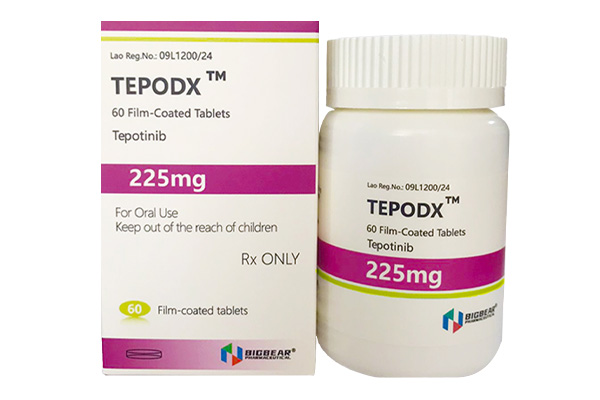
Tepotinib use must strictly adhere to individualized treatment principles. The dosage and administration method should be determined by a specialist physician based on the patient's condition, genetic testing results, and tolerability.
Routine Dosage for Adult Non-Small Cell Lung Cancer
Dosage: Oral administration, 450 mg once daily.
Duration of Treatment: Continue treatment until disease progression or intolerable toxicity.
Indications: For the treatment of patients with metastatic non-small cell lung cancer (NSCLC) harboring mesenchymal-epithelial transition (MET) exon 14 skipping mutations.
Dose Adjustment for Patients with Renal Impairment
Mild to moderate renal impairment (creatinine clearance CrCl 30-89 mL/min): Dose adjustment is not recommended.
Severe renal impairment (creatinine clearance CrCl less than 30 mL/min): There is no data to support dose adjustment.
Note: The recommended dose for patients with severe renal impairment has not yet been determined.
Dosage Adjustment for Patients with Hepatic Impairment
(I) Dosage Adjustment for Baseline Hepatic Impairment (Child-Pugh Classification)
Mild to Moderate Hepatic Impairment (Child-Pugh Class A or B): Dosage adjustment is not recommended.
Severe Hepatic Impairment (Child-Pugh Class C): There is no data to support dosage adjustment.
Note: Pharmacokinetic and safety studies have not been conducted for patients with severe hepatic impairment.
(II) Dosage Adjustment for Abnormal Liver Function During Treatment
Adjust the dosage according to the abnormalities in liver function indicators (ALT, AST, total bilirubin):
Elevated ALT and/or AST, but no increase in total bilirubin
Grade 3 Abnormality: Discontinue administration until ALT/AST returns to baseline levels; if it returns to baseline within 7 days, restart administration at the original dose; if it returns after 7 days, restart administration at a reduced dose (oral, once daily, 225 mg).
Grade 4 Abnormality: Permanently discontinue treatment.
Elevated ALT and/or AST, and elevated total bilirubin (without cholestasis or hemolysis)
If ALT and/or AST exceed 3 times the upper limit of normal (3×ULN), and total bilirubin exceeds 2 times the upper limit of normal (2×ULN): Discontinue use permanently.
Elevated total bilirubin, but ALT and/or AST not simultaneously elevated
Grade 3 abnormality: Discontinue use until total bilirubin returns to baseline levels; if it returns to baseline within 7 days, restart use at a reduced dose (oral, once daily, 225 mg); if it returns after 7 days, discontinue use permanently.
Grade 4 abnormality: Discontinue use permanently.
Dose Adjustment Related to Adverse Reactions
(I) Recommended Dose Reduction
The recommended dose reduction regimen for adverse reaction management is: oral administration, once daily, 225 mg. If the patient cannot tolerate a daily dose of 225 mg, discontinue use permanently.
(II) Management of Interstitial Lung Disease (ILD)/Pneumonia
Regardless of grade: If interstitial lung disease is suspected, medication should be discontinued immediately; if interstitial lung disease is diagnosed, medication should be permanently discontinued.
(III) Management of Other Adverse Reactions
Grade 2 Adverse Reactions: Maintain the current dose; if intolerable, consider discontinuing medication until the adverse reaction subsides, then restarting medication at a reduced dose.
Grade 3 Adverse Reactions: Discontinue medication until the adverse reaction subsides, then restarting medication at a reduced dose.
Grade 4 Adverse Reactions: Medication should be permanently discontinued.