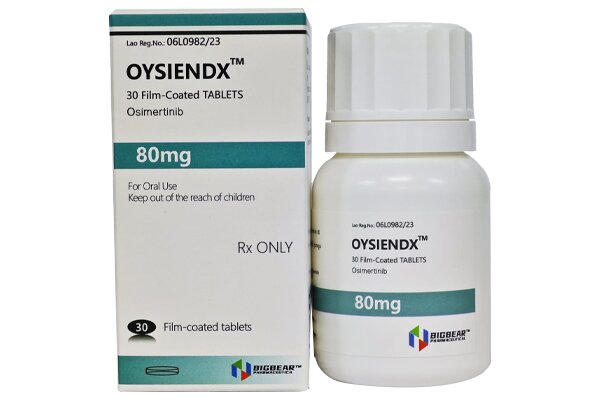
Osimertinib Pharmacokinetics
1. Absorption
(1) Peak plasma concentration reached approximately 6 hours (range 3–24 hours) after oral administration.
(2) AUC and peak concentration increased in a dose-proportional manner over the dose range of 20–240 mg.
(3) Steady-state concentrations achieved after approximately 15 days.
(4) Food effect: High-fat meal increased AUC and peak concentration slightly by 19% and 14%, respectively; considered not clinically significant.
2. Distribution
(1) Unknown whether secreted into human milk. Limited animal data indicate drug distributes to the brain.
(2) Plasma protein binding: 95%.
3. Elimination
(1) Metabolism: Primarily metabolized by CYP3A. Metabolized into two active metabolites (AZ7550 and AZ5104), each accounting for approximately 10% of total drug exposure. AZ7550 has similar potency to the parent drug; AZ5104 has higher potency against mutant EGFR and wild‑type EGFR.
(2) Elimination routes: Excreted via feces (68%) and urine (14%); 2% excreted as unchanged parent.
(3) Half‑life: approximately 48 hours.
4. Special Populations
Age, body weight, sex, smoking status, baseline albumin concentration, line of therapy, and race (Asian vs non‑Asian) have no substantial effect on osimertinib pharmacokinetics.
Osimertinib Storage
25°C (excursions permitted between 15–30°C).
Osimertinib Mechanism of Action
(1) Irreversibly and selectively binds to mutant forms of EGFR, including EGFR sensitising mutations (e.g., exon 19 deletion [del19], exon 21 substitution [L858R]) and secondary T790M mutation.
(2) Also inhibits HER2/ErbB2, HER3/ErbB3, HER4/ErbB4, ACK1 and BLK in vitro.
(3) Demonstrates antitumour activity in NSCLC cell lines expressing EGFRL858R/T790M, L858R, T790M/del19 and del19, with weaker activity against wild‑type EGFR.
(4) Affinity for mutant EGFR is approximately nine‑fold higher than for wild‑type EGFR.
Important Reminders
1. Emphasise that any new or worsening respiratory symptoms (e.g., dyspnoea, shortness of breath, cough, fever) must be reported to the doctor immediately.
2. Any symptoms suggestive of QT interval prolongation (e.g., dizziness, light‑headedness, syncope) must be reported to the doctor immediately.
3. Any signs of heart failure (e.g., palpitations, shortness of breath, oedema) must be reported to the doctor immediately.
4. Any signs of keratitis (e.g., ocular inflammation, tearing, photophobia, eye pain, red eye, vision changes) should be reported to the doctor.
5. Targetoid skin lesions or severe skin blistering/peeling must be reported to the doctor immediately.
6. Multiple non‑blanching red papules on limbs or buttocks, or large urticarial plaques on the trunk that persist for more than 24 hours and appear bruised, must be reported to the doctor.
7. Any signs or symptoms such as new or persistent fever, bruising, bleeding, or pallor should be reported to the doctor.
8. Advise females of reproductive potential to use effective contraception during treatment and for 6 weeks after the last dose. Advise males with female partners of reproductive potential to use effective contraception during treatment and for 4 months after the last dose. Emphasise that women must inform their doctor if they are pregnant or think they may be pregnant. If pregnant, inform the patient of potential fetal risk.
9. Advise women to avoid breastfeeding during osimertinib treatment and for 2 weeks after the last dose.
10. Emphasise the importance of informing the doctor of all concomitant therapies being used or planned (including prescription drugs, over‑the‑counter medications, dietary supplements, or herbal products) and of any coexisting medical conditions.