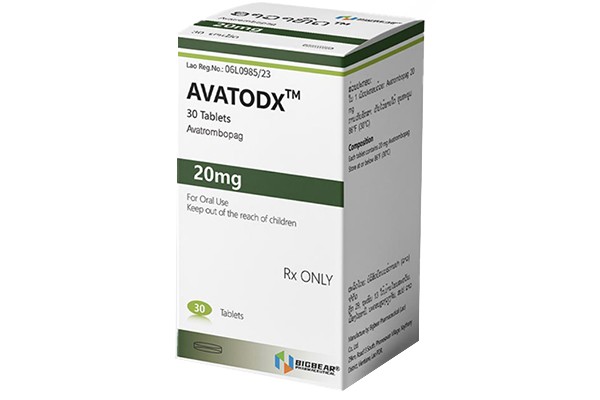
The U.S. Food and Drug Administration (FDA) has approved DOPTELET as a prescription drug for adult patients with thrombocytopenia due to long-term (chronic) liver disease who are scheduled for medical or dental surgery. Its active ingredient is avatrombopag.
The approval was based on two international, identically designed, randomized, placebo-controlled trials, ADAPT-1 and ADAPT-2. Patients with chronic liver disease and thrombocytopenia (430 patients) received either avatrombopag (274 patients) or placebo (156 patients) daily for 5 days prior to their scheduled surgery, with at least one post-dose safety assessment. Patients were randomized (2:1) to the avatrombopag or placebo group and stratified according to hepatocellular carcinoma status and bleeding risk associated with elective surgery (low, intermediate, or high). Patients randomized to avatrombopag received different doses of treatment based on mean platelet count at admission. Patients with a baseline platelet count below 40,000/uL (low baseline platelet cohort) will receive avatrombopag 60 mg orally once daily for 5 consecutive days. Patients with a baseline platelet count between 40,000 and below 50,000/uL (high baseline platelet cohort) will receive avatrombopag 40 mg orally once daily for 5 consecutive days. Eligible patients are scheduled to receive treatment 5 to 8 days after the last dose of the study drug.
The primary treatment outcome will be reflected in the proportion of patients who do not require platelet transfusions or any bleeding resuscitation procedures within 7 days after randomization and elective surgery.
The results showed that in the low platelet count group, 66% and 69% of patients receiving DOPTELET in Trial 1 and Trial 2, respectively, responded, compared to 23% (treatment difference 43%; 95% confidence interval: 27, 58; p < 0.0001) and 35% (treatment difference 34%; 95% confidence interval: 16, 52; p = 0.0006) of patients receiving placebo. In the high platelet count group, 88% of patients receiving DOPTELET in both Trial 1 and Trial 2 responded, compared to 38% (treatment difference 50%; 95% confidence interval: 32, 68; p < 0.0001) and 33% (treatment difference 55%; 95% confidence interval: 37, 73; p < 0.0001) of patients receiving placebo.
In trials, at least 3% of patients experienced adverse reactions such as fever, abdominal pain, nausea, headache, fatigue, and peripheral edema.
The recommended dose of DOPTELET is based on the patient's platelet count prior to the scheduled procedure.
What important information should you know about DOPTELET?
What is DOPTELET used to treat?
It is indicated for the treatment of adult patients with low platelet counts due to long-term (chronic) liver disease who are scheduled for medical or dental surgery.
It is not indicated for adult patients with chronic liver disease who have normal platelet counts.
It is not known whether DOPTELET is safe and effective in children.
Before taking DOPTELET, inform your doctor of all your medical conditions, including:
Have you ever had blood clots?
Are you pregnant or planning to become pregnant? (DOPTELET may harm your baby; please tell your doctor honestly if you are pregnant or suspect you are pregnant while taking DOPTELET.)
Do not breastfeed for at least two weeks after your last dose of DOPTELET. It is currently unclear whether DOPTELET will pass into breast milk, so please discuss the best way to feed your baby during this period with your treating physician.
Inform your treating physician about all medications you are taking, including prescription drugs, over-the-counter medications, vitamins, and herbal supplements.
How to use DOPTELET:
Take DOPTELET strictly as directed by your treating physician.
Your treating physician will tell you the dosage and when to take it.
Take the prescribed dose once daily for 5 consecutive days as directed.
If you miss a dose of DOPTELET, take it as soon as possible. Never take two doses of DOPTELET at once. Take the medication at the normal time the next day and complete the 5-day course.
If you have taken too much of this medication, call your treating physician immediately or go to the nearest hospital emergency room for treatment.
What are the possible side effects of DOPTELET?
Possible side effects include:
Blood clots.
People with chronic liver disease and certain clotting disorders may be at higher risk of developing blood clots. If you experience any signs or symptoms of blood clots, tell your healthcare professional immediately, including:
Swelling, pain, or tenderness in the legs.
Rapid heartbeat.
Stomach (abdomen) pain or tenderness.
Shortness of breath.
Chest pain.
Most common side effects:
Fever.
Headache.
Fatigue.
Swelling in the hands or feet.
Stomach pain (abdominal pain).
Nausea.
Note: These are not all possible side effects of DOPTELET.
How to properly store DOPTELET?
Store at room temperature (20°C–25°C).
Store DOPTELET in its original packaging.
Keep DOPTELET and all medications out of the reach of children.