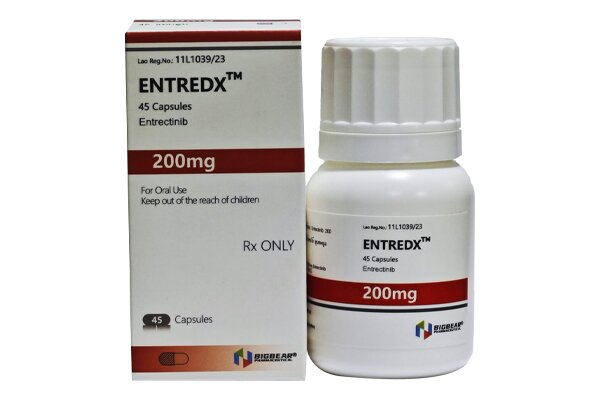
Patient Precautions for Entrectinib
1. It is recommended to swallow the entrectinib capsules whole, and do not chew or crush the capsules.
2. It is recommended that women avoid breastfeeding during treatment and for 1 week after the last dose.
3. Patients are advised to inform their clinicians of all concomitant medications they are using or planning to use, including prescription drugs, over‑the‑counter medicines, and herbal supplements, as well as any concomitant diseases.
4. If taking an oral suspension prepared from entrectinib capsules, patients and caregivers should use the supplied measuring device (e.g., oral syringe, measuring cup) to prepare and measure the prescribed dose. Instruct patients and/or caregivers on how to use the measuring device, and inform them that it may be necessary to measure a portion of the prepared oral suspension to obtain the prescribed dose. Instruct patients and/or caregivers that the oral suspension should be taken immediately after preparation, or stored at room temperature (<30°c) 2="" for="" no="" more="" than="" hours.="">
5. Instruct patients and caregivers to sprinkle entrectinib oral granules onto one or more spoonfuls of soft food (such as applesauce, yogurt, or pudding) and that it must be taken within 20 minutes after preparation.
Basic Properties of Entrectinib
Dosage Form, Composition, and Specification Details
This product is presented as hard capsules for oral administration only. Its active pharmaceutical ingredient is entrectinib, and the excipients comply with the original formulation standards without altering the properties of the active substance.
Appearance Identification and Expiry Management
Apart from differences in colour and printing, both strengths of capsules have hard gelatin shells, with contents that are off‑white to pale yellow powder or granules, and no peculiar odour. Each batch has undergone strict quality testing to ensure that content uniformity and dissolution meet the registered standards. The shelf life of the drug is 24 months from the date of manufacture. Patients and healthcare institutions should use the product before the expiry date indicated on the packaging; expired drugs must not be taken. In addition, the original bottle contains a desiccant or protective liner. After opening, the desiccant should be kept in the bottle, and the cap should be tightly closed after each removal of the drug to maintain the physicochemical stability of the contents.
Storage Conditions for Entrectinib
Strict Environmental Storage Requirements
The long‑term storage conditions for entrectinib capsules are clearly defined: the drug must be stored at a constant temperature of 20°C to 25°C, protected from direct light and moisture. Under special circumstances such as transportation, pharmacy dispensing, or temporary patient carry, brief deviations in storage temperature are permitted, i.e., the range may extend to 15°C to 30°C, but such deviations should be as short as possible and must not be used as routine storage. The drug must be kept in its original container, with the cap tightly sealed, and effective moisture‑protection measures should be taken (e.g., avoid placing in bathrooms, kitchens, or other humid areas). If, due to swallowing difficulties or other reasons, the capsule contents need to be made into an oral suspension, the prepared suspension should be stored at room temperature below 30°C, and the total time from preparation to administration must not exceed 2 hours. Any suspension not used within that time must be discarded and must not be refrigerated or reused.
Operation Warnings and Medication Safety Tips
Patients should keep their hands dry when removing each dose to avoid the capsule shell becoming soft from moisture or the contents caking. When adjusting the dose or changing strengths, carefully check the capsule colour and printing to prevent errors. For paediatric patients or those unable to swallow whole capsules, a temporary suspension should only be prepared under the guidance of a physician or pharmacist, and the 2‑hour time limit must be strictly observed. Improper storage (e.g., repeated temperature excursions or exposure to moisture) may lead to drug degradation, altered dissolution behaviour, and consequently affect efficacy and safety. Therefore, the appearance of the drug and the storage environment should be checked periodically; drugs kept under non‑compliant conditions should not be used. All the above requirements are based on the original manufacturer's prescribing information, and the storage and handling procedures must not be altered without authorisation.