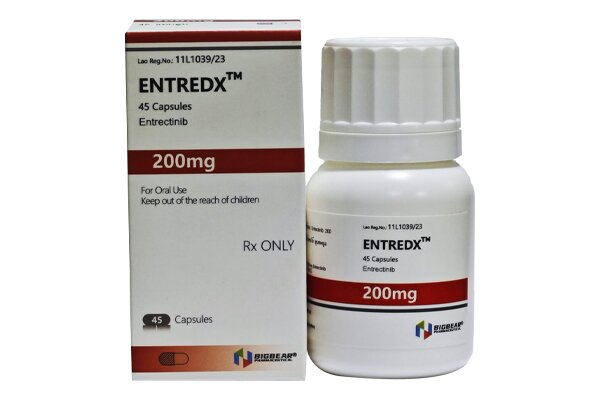
Entrectinib Common Adverse Reactions
Adverse reactions with an incidence of ≥20%: fatigue, constipation, dysgeusia, edema, dizziness, diarrhea, nausea, dysesthesia, dyspnea, myalgia, cognitive disorder, weight gain, cough, vomiting, pyrexia, arthralgia, visual impairment.
Entrectinib Drug Interactions
1. Entrectinib is primarily metabolized by CYP3A4 to form M5 (the major active metabolite).
2. Entrectinib itself is not a substrate of P‑glycoprotein (P‑gp) or breast cancer resistance protein (BCRP), but its metabolite M5 is a substrate of both P‑gp and BCRP.
3. Neither entrectinib nor M5 is a substrate of organic anion transporting polypeptide (OATP) 1B1 or 1B3.
4. Drugs and foods that affect hepatic microsomal enzymes:
(1) Moderate and strong CYP3A inhibitors: may increase systemic exposure and toxicity of entrectinib. Avoid concomitant use. If concomitant use cannot be avoided in adults or pediatric patients ≥2 years of age, reduce the entrectinib dose as described above (Table 4) and limit use of the concomitant drug to 14 days or less. After discontinuing the strong CYP3A inhibitor (3‑5 elimination half‑lives after stopping the inhibitor), resume the entrectinib dose used before the inhibitor.
(2) Pediatric patients<2 years="" of="" age:="" avoid="" concomitant="" use="" with="" moderate="" or="" strong="" cyp3a="" inhibitors.="">
(3) CYP3A inducers: may reduce systemic exposure of entrectinib and decrease its efficacy. Avoid concomitant use.
5. Drugs that prolong the QT interval: because entrectinib itself is associated with QT interval prolongation, avoid concomitant use with other drugs known to prolong the QT interval.
Specific Drug and Food Interactions with Entrectinib
1. Digoxin: digoxin peak concentration and AUC increased by 28% and 18%, respectively.
2. Efavirenz: expected to reduce systemic exposure of entrectinib. Avoid concomitant use.
3. Erythromycin: expected to increase systemic exposure of entrectinib. Avoid concomitant use; if concomitant use cannot be avoided in adults or pediatric patients ≥2 years of age, reduce the entrectinib dose as described above (Table 4). After discontinuing erythromycin (3‑5 elimination half‑lives after stopping erythromycin), resume the entrectinib dose used before erythromycin.
4. Grapefruit juice: may increase systemic exposure of entrectinib. Avoid concomitant use.
5. Itraconazole: increases entrectinib peak plasma concentration and AUC by 1.7‑fold and 6‑fold, respectively. Avoid concomitant use; if concomitant use cannot be avoided in adults or pediatric patients ≥2 years of age, reduce the entrectinib dose as described above (Table 4). After discontinuing itraconazole (3‑5 elimination half‑lives after stopping itraconazole), resume the entrectinib dose used before itraconazole.
6. Lansoprazole:
(1) Entrectinib capsules: peak concentration and AUC decreased by 23% and 25%, respectively.
(2) Oral suspension prepared from entrectinib capsules: peak concentration and AUC increased by 17% and 25%, respectively.
7. Midazolam: midazolam peak concentration decreased by 21% and AUC increased by 50%.
8. Rifampin: entrectinib peak concentration and AUC decreased by 56% and 77%, respectively. Avoid concomitant use.