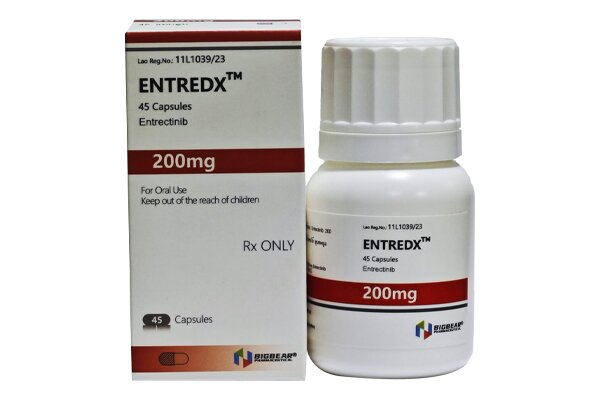
Entrectinib Pharmacokinetics
1. Absorption
(1) Bioavailability: When administered with food, the pharmacokinetics of entrectinib and its active metabolite are linear and time-independent over the dose range of 100–400 mg/m².
(2) Time to peak concentration: Peak plasma concentrations are achieved 4–6 hours after oral administration.
(3) Steady-state concentrations: Steady-state concentrations of entrectinib and its active metabolite are reached within 1–2 weeks; systemic accumulation is approximately 2-fold.
(4) Food effect: Co-administration with a high-fat, high-calorie meal has no clinically important effect on the systemic exposure of the capsule formulation.
2. Distribution
(1) Extent: It is unknown whether entrectinib or its metabolites distribute into human milk. In animals, it can cross the blood-brain barrier.
(2) Plasma protein binding: Entrectinib and M5: >99% bound to plasma proteins.
3. Elimination
(1) Metabolism: Primarily metabolized by CYP3A4 to form M5.
(2) Elimination routes: Eliminated via feces (83% [36% as unchanged drug, 22% as M5]) and urine (3%).
(3) Half-life: Entrectinib: 20 hours. M5: 40 hours.
Entrectinib Storage
Store at 20°C–25°C; excursions permitted between 15°C and 30°C for short-term transport. Store in the original container, keep tightly closed to protect from moisture. If prepared as an oral suspension, store at<30°c 2="" for="" no="" more="" than="" hours.="">
Entrectinib Mechanism of Action
(1) It is a potent inhibitor of TrkA, TrkB, TrkC, ROS-1, and ALK.
(2) TrkA, TrkB, and TrkC are encoded by the NTRK1, NTRK2, and NTRK3 genes, respectively, and are involved in initiating multiple intracellular signaling cascades (i.e., Ras/MAPK/ERK, PI3K/Akt, and PLCγ1/Pkc signaling pathways) that lead to cell proliferation, differentiation, apoptosis, and key processes regulating neuronal survival in the central and peripheral nervous systems.
(3) Chromosomal rearrangements of the NTRK1, NTRK2, and NTRK3 genes result in constitutively active chimeric Trk oncogenic fusion proteins, leading to dysregulated Trk signaling and subsequent tumorigenesis.
(4) Fusion proteins containing the ROS-1 or ALK kinase domain also activate tumorigenesis through overactivation of downstream signaling pathways.
(5) It demonstrates inhibitory activity in various tumor cell lines harboring NTRK, ROS-1, and ALK fusion genes across multiple tumor types.
(6) The major metabolite M5 shows inhibitory activity against TrkA, TrkB, TrkC, ROS-1, and ALK similar to that of entrectinib.
(7) In vitro studies show that its activity against ROS-1 is 10- to 100-fold more potent than crizotinib, and its activity against ALK is 7- to 8-fold more potent than crizotinib.
(8) It also inhibits Janus kinase 2 (JAK2) and non-receptor tyrosine kinase 2 (TNK2).
(9) Clinical resistance has been reported attributable to secondary point mutations in the NTRK kinase domain (e.g., G595R and G667C point mutations in the TrkA kinase domain; G623R point mutation in the TrkC kinase domain).