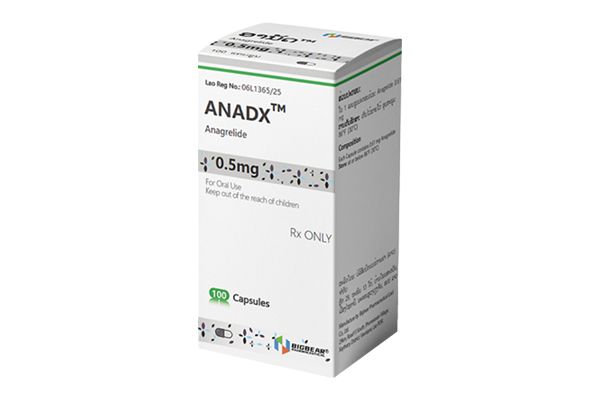
Anagrelide is an oral platelet-reducing agent that decreases platelet production by inhibiting the maturation and division of megakaryocytes in the bone marrow, thereby lowering elevated platelet counts, reducing the risk of thrombosis, and improving related symptoms including thrombotic and hemorrhagic events.
What Drug Is Anagrelide?
Excessive platelets can lead to thrombotic events (such as stroke, deep vein thrombosis, and myocardial infarction) as well as hemorrhagic events. Anagrelide is primarily indicated for the treatment of thrombocythemia secondary to myeloproliferative neoplasms (MPN).
Anagrelide Overview
Specification: 0.5 mg capsules, each containing 0.5 mg of anagrelide (equivalent to 0.61 mg of anagrelide hydrochloride), 100 capsules/bottle.
Storage: Store at 25°C, with excursions permitted between 15–30°C; keep in a light-resistant container.
Approval Timeline: First approved by the US FDA in 1997; filed under orphan drug designation pathways in both the US and EU.
Prescription Drug: Must be obtained with a prescription through hospital pharmacies or authorized drugstores; there is no compliant route for self-purchase.
Mechanism of Action of Anagrelide
Anagrelide is a PDE3 inhibitor. Both anagrelide and its active metabolite, 3-hydroxyanagrelide, inhibit cyclic adenosine monophosphate phosphodiesterase 3 (PDE3), with 3-hydroxyanagrelide being approximately 40 times as potent as the parent drug (IC₅₀ of 0.9 nM vs. 36 nM, respectively).
PDE3 inhibition produces cardiovascular effects: vasodilation, positive inotropy, and positive chronotropy (i.e., increased heart rate).
One molecule, two distinct pharmacological pathways. Lowering platelets is the therapeutic effect, while palpitations and tachycardia are expected effects arising from the PDE3 inhibition pathway. This distinction directly determines how you view "side effects" down the line: they are predictable, not an allergic reaction, and not a sign that the medication is inappropriate.
Kind Reminder:
Anagrelide is not an anticoagulant: it does not directly anticoagulate blood, nor does it dissolve already formed thrombi. It reduces platelet production, not platelet activity.
Anagrelide is not in the same drug class as hydroxyurea: their mechanisms differ. Prescribing information indicates that anagrelide is equally effective in patients who have previously undergone phlebotomy, as well as those receiving concomitant hydroxyurea, aspirin, interferon, radioactive phosphorus, or alkylating agents—it can serve as a substitute or as a combination therapy, depending on the physician's clinical choice.
Anagrelide is not a heart failure medication: although other PDE3 inhibitors (such as milrinone) are used for cardiac conditions, the prescribing information clearly states that other PDE3 inhibitors decreased survival compared to placebo in patients with Class III–IV congestive heart failure. Therefore, co-administration of anagrelide with other PDE3 inhibitors should be avoided, and patients with underlying heart disease should use it only when the benefits outweigh the risks.