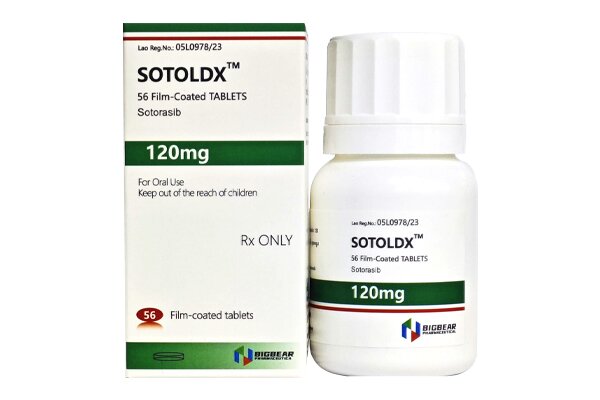
Mechanism of Action of Sotorasib
Irreversibly and selectively inhibits KRASG12C mutation, selectively inhibits KRAS signaling and cell growth in vitro, and promotes apoptosis in KRASG12C-positive cell lines; rapidly and irreversibly binds to KRASG12C, resulting in sustained inhibition of the mitogen-activated protein kinase (MAPK) signaling pathway. In KRASG12C mouse tumor xenograft models, it induces tumor regression, prolongs survival, and enhances antitumor immunity, with minimal off-target activity for KRASG12C inhibition in vitro and in vivo.
Pharmacokinetics of Sotorasib
Absorption
Bioavailability: Pharmacokinetics are nonlinear and time-dependent within the 180–960 mg once-daily dose range.
Time to peak concentration: Median 1 hour, steady-state plasma concentrations achieved within 22 days.
Formulation effect: Under fasting conditions, systemic exposure from film-coated tablets is comparable to that from film-coated tablets dispersed in water.
Food effect: A high-fat, high-calorie meal has no significant effect on sotorasib pharmacokinetics.
Sotorasib in Special Populations
Hepatic impairment: AUC after a single 960 mg dose in patients with moderate (Child-Pugh B) impairment is 25% lower than in patients with normal hepatic function, and 4% higher in severe (Child-Pugh C) impairment.
Renal impairment: Mild to moderate (estimated GFR ≥30 mL/min/1.73m²) impairment has no significant effect on pharmacokinetics; severe impairment has not been studied.
Age (26–86 years), sex, race/ethnicity, and body weight (36.8–157.9 kg) have no significant effect on pharmacokinetics.
Distribution
Plasma protein binding: 89%; it is unknown whether it enters human milk.
Elimination
Metabolism: Primarily metabolized via non-enzymatic conjugation and CYP3A oxidative metabolism.
Excretion: Fecal excretion accounts for 74% (53% as unchanged drug), urinary excretion accounts for 6% (1% as unchanged drug), half-life 5 hours.