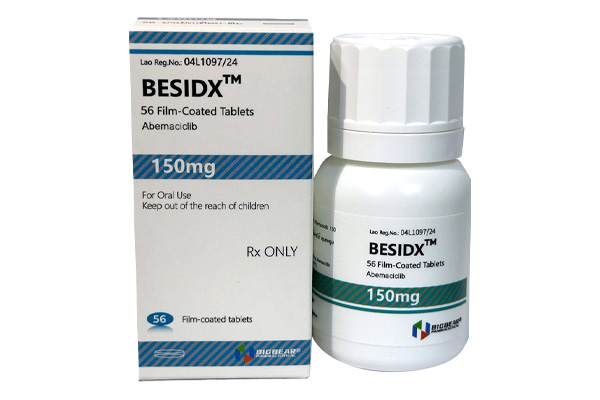
As an important alternative to the original drug, the abemaciclib generic (BESIDX) produced by Lao Big Bear Pharmaceutical has entered the market at a price significantly lower than the original version, providing a more accessible treatment pathway for breast cancer patients worldwide.
What are the purchasing channels for Lao Big Bear version of abemaciclib (Abemaciclib)
The Lao Big Bear version of abemaciclib (Abemaciclib) is available in the specification of 150mg*56 tablets/box. For specific purchasing methods, we recommend adding our professional customer service for detailed consultation.
Serious safety warnings for abemaciclib (Abemaciclib)
During VERZENIO treatment, some adverse reactions may develop into severe or even life-threatening conditions. Therefore, the drug label contains boxed safety warnings, requiring clinicians and patients to pay close attention and take anticipatory measures.
Severity of diarrhea: Diarrhea is not only common but can also be severe, leading to fluid and electrolyte disturbances, renal impairment, or sepsis due to intestinal flora imbalance. In clinical trials, the median time to onset of diarrhea was within the first month of treatment, and some patients required dose interruption or hospitalization for fluid replacement. Once loose stools occur, antidiarrheal therapy such as loperamide should be initiated immediately, and fluid intake should be increased; if symptoms do not improve within 24 hours, urgent contact with the medical team is needed to assess whether to interrupt VERZENIO.
Neutropenia and infection: Neutropenia can significantly impair immune defense function, increasing the risk of serious infections such as pneumonia and bacteremia, and may even be fatal. Baseline complete blood count must be obtained before treatment, with repeat testing every 2 weeks during the first 2 months of treatment, then monthly thereafter until stable. If fever (temperature ≥38.3°C), chills, sore throat, or other signs of infection occur, blood cultures and imaging studies should be performed immediately, and broad-spectrum antibiotics should be considered; dose interruption or reduction should be based on neutrophil count.
Key patient education points: Patients should be provided with written information about prodromal symptoms of diarrhea and infection, given a backup prescription for antidiarrheal agents, and instructed to monitor daily body temperature and bowel movement frequency, and to avoid using antidiarrheal agents for more than 48 hours without seeking medical attention. These proactive interventions have been shown to reduce the incidence of severe complications and ensure treatment continuity.
In clinical practice, a multidisciplinary support team (including oncologists, pharmacists, dietitians, and nursing staff) should be established to jointly develop an individualized monitoring calendar, ensuring timely response when warning signs appear.
Hepatotoxicity and thromboembolic risks of abemaciclib (Abemaciclib)
In addition to diarrhea and hematologic toxicities, VERZENIO also carries potential risks of hepatotoxicity and venous thromboembolism. Although these adverse reactions occur at lower rates, their consequences are serious and require early identification through regular laboratory tests and clinical symptom assessment.
Hepatotoxicity manifestations and monitoring: VERZENIO can cause elevations in serum transaminases (ALT, AST) and bilirubin, and in some cases may lead to signs of liver failure. A comprehensive liver function test (including ALT, AST, alkaline phosphatase, total bilirubin) is recommended before treatment initiation. During the first 2 months of treatment, tests should be repeated every 2 weeks, then monthly for the next 2 months, and thereafter adjusted based on clinical status. If transaminase elevations exceed 3 times the upper limit of normal accompanied by bilirubin elevation, or if symptoms of liver injury (such as right upper quadrant pain, jaundice, severe fatigue, or bleeding tendency) occur, VERZENIO should be immediately interrupted, the etiology evaluated, and hepatoprotective supportive care given as needed.
Venous and pulmonary thromboembolism: Deep vein thrombosis and pulmonary embolism events have been observed in clinical trials and may be fatal. If patients develop signs such as unilateral limb swelling, pain, chest tightness, shortness of breath, tachycardia, or hemoptysis, urgent vascular ultrasound or CT pulmonary angiography should be performed. After confirmation, standard anticoagulation therapy should be administered, and VERZENIO should be temporarily interrupted; resumption of treatment and dose adjustment should be reassessed after thrombosis stabilizes.
Long-term management recommendations: For patients with a history of liver disease or high thrombotic risk factors (such as obesity, prolonged immobility, coagulation abnormalities), the benefit-risk ratio should be weighed and monitoring frequency intensified. During treatment, concomitant use of other hepatotoxic drugs should be avoided, and patients should be encouraged to record daily weight, degree of abdominal pain, and respiratory status to detect abnormalities early.
Through systematic monitoring and rapid intervention, the vast majority of hepatotoxic and thromboembolic events can be effectively controlled without compromising overall treatment outcomes.