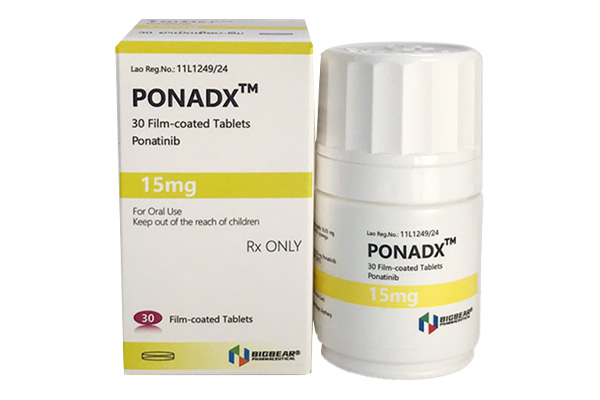
Ponatinib must be used strictly according to the prescribed medication guidelines and doctor's orders.
How to Use Ponatinib
1. Recommended Starting Dose
(1) Newly diagnosed Philadelphia chromosome-positive (Ph+) acute lymphoblastic leukemia (ALL) (combined with chemotherapy): The starting dose is 30 mg once daily. After achieving minimal residual disease-negative complete remission at the end of induction therapy, the dose can be reduced to 15 mg once daily.
(2) Philadelphia chromosome-positive (Ph+) acute lymphoblastic leukemia (ALL) monotherapy (no other applicable kinase inhibitors or T315I positive): The starting dose is 45 mg once daily.
(3) Chronic phase chronic myeloid leukemia (CML) (resistant to or intolerant to at least two prior kinase inhibitors): The starting dose is 45 mg once daily. Once ≤1% BCR::ABL1^IS is achieved, the dose can be reduced to 15 mg once daily.
(4) Chronic myeloid leukemia (CML) in the accelerated or blast crisis phase: The starting dose is 45 mg once daily.
2. Administration
(1) Ponatinib can be taken with food or on an empty stomach.
(2) The tablet should be swallowed whole; do not crush, break, chew, or dissolve it.
3. Missed Dose Management
If a dose is missed, the next dose should be taken at the usual time the following day. Do not take double the dose at once.
4. Dosage Adjustment
The dosage of ponatinib needs to be interrupted, reduced, or permanently discontinued according to the severity of adverse reactions. For example, clear graded treatment measures have been established for serious adverse reactions such as arterial occlusion events, heart failure, and hepatotoxicity.
Treatment Duration of Ponatinib
The treatment duration of ponatinib is not fixed, but rather based on continuous treatment until disease progression, loss of efficacy, or intolerable toxicity.
Ponatinib is usually required for long-term use to continuously suppress cancer cells. In clinical studies, some patients have been treated for several years. If no therapeutic response is observed after 3 months of treatment, discontinuation should be considered. Furthermore, if serious or life-threatening adverse reactions occur and cannot be tolerated after dose adjustments, permanent discontinuation is necessary.
Special Populations for Ponatinib Use
1. Patients with Hepatic Impairment
For patients with chronic myeloid leukemia (CML) or Philadelphia chromosome-positive (Ph+) acute lymphoblastic leukemia (ALL) receiving monotherapy, if there is a history of hepatic impairment (Child-Pugh A, B, or C), the recommended starting dose should be reduced from 45 mg to 30 mg once daily.
For newly diagnosed Philadelphia chromosome-positive (Ph+) acute lymphoblastic leukemia (ALL) patients receiving combined chemotherapy, no dose adjustment is required for mild hepatic impairment (Child-PughA); data are limited for patients with moderate to severe hepatic impairment (Child-PughB or C), and adverse reactions should be closely monitored, with dose adjustment as necessary.
2. Elderly Patients (≥65 years old)
Elderly patients have a higher risk of adverse reactions (especially vascular occlusion events, hypertension, edema, etc.).
Dose selection should be more cautious, taking into account decreased liver, kidney, and cardiac function, as well as concomitant medications.
3. Women of Childbearing Age and Pregnancy
(1) Contraception: Women of childbearing age must use effective contraception during treatment and for 3 weeks after the last dose.
(2) Pregnancy: Ponatinib has potential risks to the fetus and is contraindicated in pregnant women. Pregnancy status must be confirmed before starting treatment.
(3) Infertility: Based on animal data, ponatinib may impair female fertility. 4. Breastfeeding women
Breastfeeding is prohibited during treatment and for one week after the last dose.