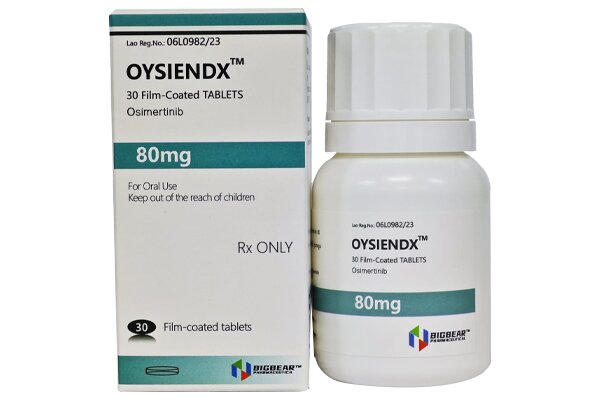
Osimertinib, as a third-generation EGFR-TKI, has become a breakthrough drug in the treatment of non-small cell lung cancer (NSCLC) due to its highly effective inhibition of the T790M mutation and its excellent clinical data.
Common Dosage of Osimertinib
1. Common Dosage for Adults with Non-Small Cell Lung Cancer
80 mg orally once daily.
2. Duration of Treatment
(1) Adjuvant Therapy
Until disease progression, unacceptable toxicity, or up to 3 years.
(2) Metastatic Lung Cancer
Until disease progression or unacceptable toxicity.
The above information is from the drug's official website and only reflects the dosage and administration range of this drug in countries where it is registered outside of China. Please do not make any treatment decisions based on this information.
Osimertinib Medication Management
1. Take with meals or on an empty stomach
Osimertinib can be taken with meals or on an empty stomach.
2. Administration
Take with a full glass of water at the same time each day. Do not crush, break, or chew the tablets; if the patient is unable to swallow, dissolve them in water.
3. Missed Dose Management
If a dose is missed, skip that dose and do not make up for it. Take the next dose as scheduled.
4. Management of Swallowing Difficulties
(1) For patients who have difficulty swallowing solid medications, simply disperse the tablet in 60 ml (2 oz) of non-carbonated water.
(2) Stir until the tablet disperses into small pieces (the tablet will not completely dissolve) and swallow immediately.
(3) Do not crush, heat, or sonicate during preparation.
(4) Rinse the container with 120-240 ml (4-8 oz) of water and drink immediately.
(5) If administration via nasogastric tube, disperse the tablet in 15 ml of non-carbonated water as described above, then transfer any remaining medication to a syringe using 15 ml of water.
(6) Administer the resulting 30 ml solution according to the nasogastric tube instructions, followed by appropriate water flushing (approximately 30 ml).
Osimertinib Monitoring Requirements
1. Cardiovascular System
Monitor left ventricular ejection fraction by electrocardiogram or multi-gated acquisition scan (MUGA) every 3 months before treatment and during treatment; for patients with risk factors, monitor QTc interval and electrolytes regularly by electrocardiogram during treatment.
2. Respiratory System
Monitor for worsening respiratory symptoms (e.g., dyspnea, cough, fever; confirm whether interstitial lung disease is present).
Osimertinib Patient Recommendations
(1) Avoid consuming grapefruit, drinking grapefruit juice, and using St. John's wort during treatment.
(2) Female patients should use effective contraception during treatment and for 6 weeks after treatment. (3) Male patients with female partners should use effective contraception for 4 months after the last dose of the drug.
(4) Breastfeeding should be avoided during treatment and for 2 months after the last dose of the drug.
Osimertinib Dosage Adjustment
Potential CYP4503A Inducers
(1) Avoid concurrent use with osimertinib whenever possible.
(2) If concurrent use cannot be avoided, when used with a potent CYP4503A inducer, the osimertinib dose should be increased to 160 mg daily; after discontinuing the potent CYP4503A4 inducer for 3 weeks, resume the osimertinib dose of 80 mg daily.
Osimertinib Adverse Reactions Dosage Adjustment
1. Lungs
Interstitial Lung Disease (ILD)/Pneumonia: Permanently discontinue osimertinib.
2. Cardiac
(1) At least two independent electrocardiograms showing a QTc interval >500 ms
Suspend treatment until the QTc interval <481 ms or returns to baseline; if the baseline QTc interval ≥481 ms, resume treatment at a dose of 40 mg.
(2) QTc prolongation accompanied by life-threatening signs of arrhythmia
Permanently discontinue osimertinib.
(3) Symptomatic congestive heart failure
Permanently discontinue osimertinib.
3. Skin
Stevens-Johnson syndrome (SJS), severe erythema multiforme (EMM): Suspected cases should suspend treatment; after diagnosis, permanently discontinue osimertinib.
4. Other
Grade 3 or higher adverse reactions: Suspend treatment for up to 3 weeks.
If adverse reactions improve to grade 0-2 within 3 weeks: Resume treatment at a dose of 40-80 mg daily.
If no improvement is observed within 3 weeks: Permanently discontinue osimertinib.
Osimertinib Dosage Adjustment in Special Populations
1. Dosage Adjustment in Renal Impairment
Creonic clearance (CrCl) 15-89 mL/min: No dose adjustment is recommended.
End-stage renal disease (creatinine clearance less than 15 mL/min): No recommended dose.
2. Dosage Adjustment in Hepatic Impairment
Mild hepatic impairment: No dose adjustment is recommended.
Severe hepatic impairment: No recommended dose.
Osimertinib Storage Requirements
Osimertinib should be stored at 25°C (77℉); fluctuations within the range of 15°C-30°C (59℉-86℉) are permissible.