
BIGBEAR
PHARMACEUTICALS
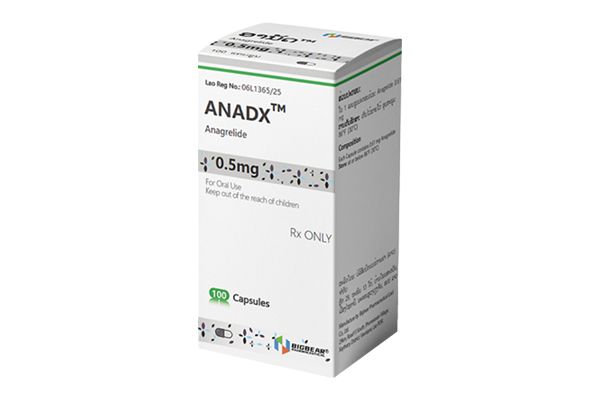
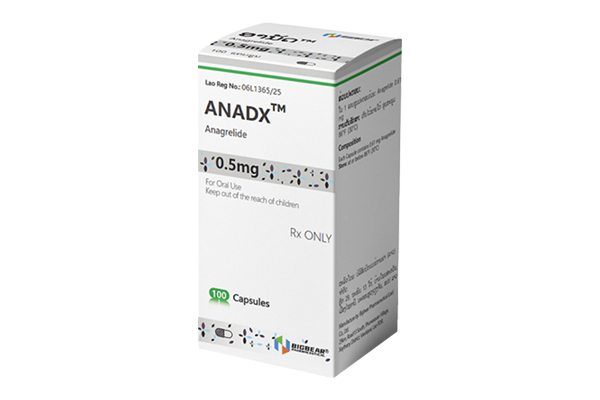
Anagrelide is an oral thrombocytopenic agent that belongs to the class of phosphodiesterase 3 (PDE3) inhibitors.

 AuthenticGuaranteeFast DeliveryPrivacy
 Anagrelide reduces platelet count in patients with thrombocythemia secondary to myeloproliferative neoplasms by inhibiting platelet production and promoting apoptosis of platelet‑forming cells, thereby lowering the risk of thrombosis and alleviating related symptoms such as thrombo‑hemorrhagic events.
Anagrelide is indicated for the treatment of patients with thrombocythemia secondary to myeloproliferative neoplasms, in order to reduce elevated platelet counts and the risk of thrombosis, and to improve related symptoms including thrombo-hemorrhagic events.
The recommended starting dose of anagrelide is 0.5 mg four times daily, or 1 mg twice daily.
The recommended starting dose of anagrelide is 0.5 mg once daily.
The starting dose should be maintained for at least one week, followed by dose titration to reduce and maintain platelet counts below 600,000/µL, with an ideal target range of 150,000/µL to 400,000/µL.The dose should not be increased by more than 0.5 mg per day in any one week.The daily dose must not exceed 10 mg, and the single dose must not exceed 2.5 mg.Most patients achieve an adequate response at a daily dose of 1.5 mg to 3.0 mg.
Monitor platelet counts weekly during the dose‑titration phase, and monthly or as clinically indicated thereafter.
Treatment with anagrelide requires clinical monitoring, including complete blood count, assessment of hepatic and renal function, and electrolyte testing.
To prevent thrombocytopenia, platelet counts should be monitored every two days during the first week of therapy, and at least weekly thereafter until the maintenance dose is reached.With appropriate dosing, platelet counts generally begin to respond within 7 to 14 days.In clinical trials, the time to complete remission (defined as platelet count ≤ 600,000/µL) ranged from 4 to 12 weeks.
If dose interruption or treatment discontinuation occurs, platelet count rebound varies; however, counts typically begin to increase within 4 days and return to baseline within 1 to 2 weeks, and may rise above baseline. Frequent monitoring of platelet counts is required.
For patients with moderate hepatic impairment (Child–Pugh score 7–9), the starting dose of anagrelide is 0.5 mg daily, with frequent monitoring for cardiovascular events (see Warnings and Precautions (5.1), Use in Special Populations (8.6), and Clinical Pharmacology (12.3)).Dose escalation may be considered after one week of toleration in patients with moderate hepatic impairment. The dose must not be increased by more than 0.5 mg per day in any one week.
Anagrelide should be avoided in patients with severe hepatic impairment.
Palpitations, chest pain, tachycardia, peripheral edema, vasodilation, cardiac failure, cerebrovascular accident, myocardial infarction, cardiomyopathy, cardiac hypertrophy, complete atrioventricular block, pericarditis, and ventricular fibrillation. A tendency toward orthostatic hypotension has been observed in healthy volunteers.
Headache, dizziness, paresthesia, seizures, nightmares, and impaired concentration.
Dyspnea. Cases of pulmonary infiltration, pulmonary fibrosis, pulmonary hypertension, and cough have been reported.
Muscle weakness.
Diarrhea, abdominal pain, nausea, flatulence, vomiting, dyspepsia, pancreatitis, gastric ulcer, and duodenal ulcer.
Anemia, thrombocytopenia (platelet count begins to decrease within 7–14 days), ecchymosis, and lymphoma have been reported. Isolated cases of bleeding and thrombosis have been reported.This product has no significant effect on hemoglobin, white blood cell count, reticulocyte count, prothrombin time (PT), or bleeding time.
Rash, urticaria.
1.This product is contraindicated in patients with known hypersensitivity to anagrelide, and in patients with moderate or severe hepatic impairment.
2.Use with caution in patients with cardiovascular diseases and in patients with mild hepatic impairment.
3.There are no adequate and well‑controlled studies in pregnant women. This product should be used during pregnancy only if the potential benefit justifies the risk to the fetus.
4.It is not known whether anagrelide is excreted in human milk. A decision should be made whether to discontinue treatment or to discontinue nursing, taking into account the importance of the drug to the mother.
5.This product is contraindicated in patients with Q‑T interval prolongation.
1.This product may be used in patients for whom other treatment options (hydroxyurea, interferon‑α) are not suitable.
2.A daily dose of 1.5–3 mg is effective in most patients.
3.Platelet counts should be monitored every 2 days during the first week of treatment and at least weekly until the maintenance dose is achieved.
4.Hepatic function should be monitored regularly during treatment.
If any issues arise, please contact us immediately.
Email:haiousales@gmail.com

The onset time of anagrelide for essential thrombocythemia varies among individuals and is not consistent. Clinical trials have shown that the median onset time is 7 days.
Anagrelide is an oral antiplatelet agent that demonstrates significant efficacy in the treatment of thrombocytosis caused by various etiologies, including essential thrombocythemia, and helps alleviate disease progression.
Onset time may be influenced by individual differences, disease stage, physical condition, and drug tolerance. Therefore, use under the guidance of a physician is necessary.
Take the medicine as soon as you can, but skip the missed dose if it is almost time for your next dose. Do not take two doses at one time.
Do not take aspirin unless your doctor has told you to. Follow your doctor's instructions about how much aspirin to take, and how often to take it.
Ask a doctor or pharmacist before using any medicines for pain, fever, swelling, or cold/flu symptoms. They may contain aspirin or similar ingredients (such as ibuprofen, ketoprofen, or naproxen) which can increase your risk of bleeding.
Copyright2024@ BIGBEAR All right reserved BIGBEAR


