
BIGBEAR
PHARMACEUTICALS
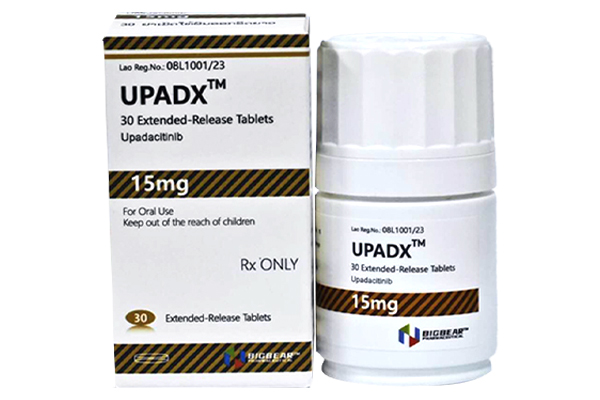
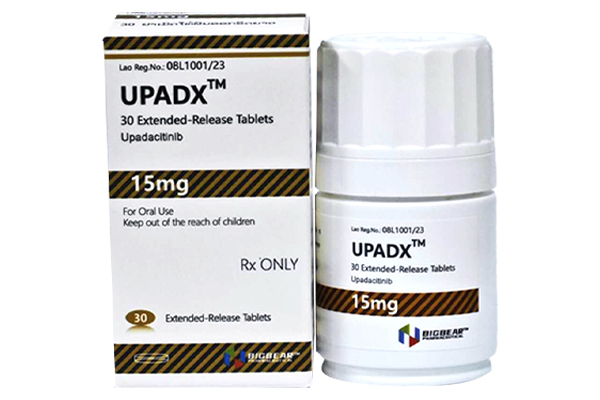
Upadacitinib is a highly potent and selective Janus kinase (JAK) inhibitor. It exerts its pharmacological effect by inhibiting the activity of JAK enzymes.

 AuthenticGuaranteeFast DeliveryPrivacy
 Upadacitinib modulates this signaling pathway at the JAK locus, blocks the phosphorylation and activation of STAT, and exerts a therapeutic effect. The following is a reference for the indications of upadacitinib; please consult a physician for specific details.
This product is indicated for adult and adolescent patients aged 12 years and above with refractory, moderate to severe atopic dermatitis who have had an inadequate response to other systemic therapies (e.g., corticosteroids or biological agents) or for whom such therapies are inappropriate.
Use Restriction: Concomitant use with other JAK inhibitors, biologic immunomodulators, or other immunosuppressants is not recommended.
This product is indicated for adult patients with moderate to severe active rheumatoid arthritis who have had an inadequate response to or intolerance of one or more TNF inhibitors.
Use Restriction: Concomitant use with other JAK inhibitors, biologic DMARDs, or potent immunosuppressants (e.g., azathioprine and cyclosporine) is not recommended.
This product is indicated for adult patients with active psoriatic arthritis who have had an inadequate response to or intolerance of one or more disease-modifying antirheumatic drugs (DMARDs).
This product may be used in combination with methotrexate (MTX).
This product is indicated for the treatment of adult patients with moderate to severe active ulcerative colitis who have had an inadequate response to, intolerance of, or contraindication to one or more TNF inhibitors.
Use Restriction: Concomitant use with other JAK inhibitors, biotherapies for ulcerative colitis, or potent immunosuppressants (e.g., azathioprine and cyclosporine) is not recommended.
This product is indicated for the treatment of adult patients with moderate to severe active Crohn's Disease who have had an inadequate response to, intolerance of, or contraindication to one or more TNF inhibitors.
Use Restriction: Concomitant use with other JAK inhibitors, biotherapies for Crohn's Disease, or potent immunosuppressants (e.g., azathioprine and cyclosporine) is not recommended.
This product is indicated for adult patients with active non-radiographic axial spondyloarthritis who have had an inadequate response to nonsteroidal anti-inflammatory drugs (NSAIDs) and have objective signs of inflammation (manifested as elevated C-reactive protein [CRP] and/or abnormal magnetic resonance imaging [MRI] findings).
Use Restriction: Concomitant use with other JAK inhibitors, biologic DMARDs, or potent immunosuppressants (e.g., azathioprine and cyclosporine) is not recommended.
This product is indicated for adult patients with active ankylosing spondylitis who have had an inadequate response to or intolerance of one or more TNF inhibitors.
Use Restriction: Concomitant use with other JAK inhibitors, biologic DMARDs, or potent immunosuppressants (e.g., azathioprine and cyclosporine) is not recommended.
Treatment with upadacitinib should be initiated and supervised by a physician experienced in the diagnosis and management of the conditions for which this product is indicated.
This product may be taken with or without food, at any time of the day. The tablets should be swallowed whole and should not be split, crushed or chewed to ensure the full dose is administered.
Initiation of upadacitinib is not recommended in patients with an absolute lymphocyte count (ALC) < 500 cells/mm³, an absolute neutrophil count (ANC) < 1000 cells/mm³ or a hemoglobin level < 8 g/dL.
Treatment with upadacitinib should be interrupted in patients who develop a severe infection until the infection is controlled.
Pediatric patients aged 12 years and older with a body weight of ≥40 kg and adult patients aged ≤65 yearsThe recommended starting dose is 15 mg once daily. If the response is inadequate, consider increasing the dose to 30 mg once daily. Discontinue upadacitinib if a sufficient response is not achieved with the 30 mg dose. The lowest effective dose needed to maintain the response should be used.
The safety and efficacy of upadacitinib have not been studied in adolescents with a body weight of <40 kg.
Adult patients aged 65 years and olderThe recommended dose is 15 mg once daily.Limited data are available for patients aged ≥75 years.
The recommended dose is 15 mg once daily.
The recommended dose is 15 mg once daily.
Induction TherapyThe recommended dose for induction therapy is 45 mg once daily for 8 weeks.
Maintenance TherapyThe recommended dose for maintenance therapy is 15 mg once daily. For patients with refractory, severe or extensive disease, a maintenance dose of 30 mg once daily may be considered. Discontinue upadacitinib if the response is inadequate with the 30 mg dose. The lowest effective dose needed to maintain the response should be used.
Induction TherapyThe recommended dose for induction therapy is 45 mg once daily for 12 weeks.
Maintenance TherapyThe recommended dose for maintenance therapy is 15 mg once daily. For patients with refractory, severe or extensive disease, a maintenance dose of 30 mg once daily may be considered. Discontinue upadacitinib if the response is inadequate with the 30 mg dose. The lowest effective dose needed to maintain the response should be used.
The recommended dose is 15 mg once daily.
The recommended dose is 15 mg once daily.
Atopic DermatitisNo dose adjustment is required for patients with mild or moderate renal impairment. Limited data are available on the use of upadacitinib in patients with severe renal impairment. Upadacitinib 15 mg once daily should be used with caution in patients with severe renal impairment. The 30 mg once daily dose of upadacitinib is not recommended in patients with severe renal impairment.Upadacitinib has not been studied in subjects with end-stage renal disease.
Rheumatoid Arthritis, Psoriatic Arthritis, Non-Radiographic Axial Spondyloarthritis and Ankylosing SpondylitisNo dose adjustment is required for patients with mild or moderate renal impairment. Upadacitinib 15 mg once daily should be used with caution in patients with severe renal impairment.
Ulcerative ColitisThe recommended doses for patients with severe renal impairment (eGFR 15 to < 30 mL/min/1.73 m²) are as follows:
Induction Therapy: 30 mg once daily for 8 weeks.
Maintenance Therapy: 15 mg once daily.
No dose adjustment is required for patients with mild or moderate renal impairment (eGFR ≥30 mL/min/1.73 m²).Use of this product is not recommended in patients with end-stage renal disease (eGFR < 15 mL/min/1.73 m²).
Crohn's DiseaseThe recommended doses for patients with severe renal impairment (eGFR 15 to < 30 mL/min/1.73 m²) are as follows:
Induction Therapy: 30 mg once daily for 12 weeks.
Maintenance Therapy: 15 mg once daily.
No dose adjustment is required for patients with mild or moderate renal impairment (eGFR ≥30 mL/min/1.73 m²).Use of this product is not recommended in patients with end-stage renal disease (eGFR < 15 mL/min/1.73 m²).
This product should not be used in patients with severe hepatic impairment (Child-Pugh C).
Rheumatoid Arthritis, Psoriatic Arthritis, Atopic Dermatitis, Non-Radiographic Axial Spondyloarthritis and Ankylosing SpondylitisNo dose adjustment is required for patients with mild (Child-Pugh A) or moderate (Child-Pugh B) hepatic impairment.
Ulcerative ColitisThe recommended doses for patients with mild to moderate hepatic impairment (Child-Pugh A or B) are as follows:
Induction Therapy: 30 mg once daily for 8 weeks.
Maintenance Therapy: 15 mg once daily.
Crohn's DiseaseThe recommended doses for patients with mild to moderate hepatic impairment (Child-Pugh A or B) are as follows:
Induction Therapy: 30 mg once daily for 12 weeks.
Maintenance Therapy: 15 mg once daily.
Rheumatoid Arthritis, Psoriatic Arthritis, Atopic Dermatitis, Non-Radiographic Axial Spondyloarthritis and Ankylosing SpondylitisIn patients receiving strong CYP3A4 inhibitors, the recommended dose is 15 mg once daily.
Ulcerative ColitisThe recommended doses for patients with ulcerative colitis receiving strong CYP3A4 inhibitors are as follows:
Induction Therapy: 30 mg once daily for 8 weeks.
Maintenance Therapy: 15 mg once daily.
Crohn's DiseaseThe recommended doses for patients with Crohn's Disease receiving strong CYP3A4 inhibitors are as follows:
Induction Therapy: 30 mg once daily for 12 weeks.
Maintenance Therapy: 15 mg once daily.
Action: If ANC < 1,000 cells/mm³, treatment should be suspended. Resume treatment once ANC recovers to ≥ 1,000 cells/mm³.
Monitoring Guidance: Assess at baseline and no later than 12 weeks after the start of treatment. Subsequent assessments should be based on individual patient management.
Action: If ALC < 500 cells/mm³, treatment should be suspended. Resume treatment once ALC recovers to ≥ 500 cells/mm³.
Action: If Hb < 8 g/dL, treatment should be suspended. Resume treatment once Hb recovers to ≥ 8 g/dL.
Action: If drug-induced liver injury is suspected, treatment should be suspended.
Monitoring Guidance: Follow routine patient management; assess at baseline and after baseline.
Action: Manage patients in accordance with international clinical guidelines for hyperlipidemia.
Monitoring Guidance: Assess at 12 weeks after the start of treatment, then monitor according to clinical guidelines for hyperlipidemia.
1.This product may be used with or without topical corticosteroids in combination. Topical calcineurin inhibitors may be applied to sensitive areas such as the face, neck, intertriginous regions and genitalia.
2.Hypersensitivity to the active ingredient of this product or any of its excipients.
3.Active tuberculosis or active severe infections.
4.Severe hepatic impairment.
5.Pregnancy.
Serious infections, death, malignant neoplasms and lymphoproliferative disorders, major adverse cardiovascular events, thrombosis, hypersensitivity reactions, gastrointestinal perforation, abnormal laboratory test results, etc.
Women of childbearing potential should be advised to use effective contraceptive measures during treatment with upadacitinib and for 4 weeks after the last dose. Pediatric female patients and/or their parents/caregivers should be informed to contact the treating physician if menarche occurs during upadacitinib treatment.
Data on the use of upadacitinib in pregnant women are limited or lacking.Upadacitinib is contraindicated during pregnancy.If a patient becomes pregnant while receiving upadacitinib, she should be informed of the potential risks of the product to the fetus.
It is unknown whether upadacitinib or its metabolites are excreted in human milk. Available animal pharmacodynamic/toxicological data indicate that upadacitinib is secreted in milk.Risks to neonates/infants cannot be excluded.Upadacitinib should not be used during lactation. When deciding whether to discontinue breastfeeding or upadacitinib treatment, the benefits of breastfeeding for the child and the benefits of the treatment for the mother should be considered.
The effect of upadacitinib on human fertility has not been evaluated. Animal studies have not indicated any impact on fertility.
The safety and efficacy of upadacitinib in pediatric patients with atopic dermatitis under 12 years of age have not been established, and no data are available.No clinical exposure data are available for adolescents with a body weight of <40 kg.The safety and efficacy of upadacitinib in pediatric and adolescent patients aged 0 to <18 years with rheumatoid arthritis, psoriatic arthritis, ulcerative colitis, Crohn's disease, non-radiographic axial spondyloarthritis and ankylosing spondylitis have not been established, and no data are available.
For atopic dermatitis, doses higher than 15 mg once daily are not recommended for patients aged 65 years and older. Based on limited data in patients with atopic dermatitis aged 65 years and older, the overall adverse reaction rate with upadacitinib 30 mg is higher than that with upadacitinib 15 mg.Experience with the use of this product in patients with ulcerative colitis and Crohn's disease aged 65 years and older is limited, and current clinical trial data are insufficient to determine whether treatment responses in geriatric patients differ from those in younger patients. Use should be undertaken only after careful evaluation, and doses higher than 15 mg once daily for maintenance treatment are not recommended for patients aged 65 years and older.Data on the use of this product in patients aged 75 years and older are limited.
If any issues arise, please contact us immediately.
Email:haiousales@gmail.com

You may feel the effects of Rinvoq oral tablet after one or two weeks, but most people with rheumatoid arthritis who respond have significant improvement in about 3 months. The results have lasted for up to 5 years for some people.
Rinvoq is available as an extended-release oral tablet or as an oral solution. It is approved to treat:
Rheumatoid arthritis
Psoriatic arthritis
Atopic dermatitis (eczema)
Ulcerative colitis
Crohn's disease
Ankylosing spondylitis
Non-radiographic axial spondyloarthritis
Polyarticular juvenile idiopathic arthritis
Giant cell arteritis
Rinvoq is an oral drug classified as a Janus kinase (JAK) inhibitor. It is not a biologic. JAK inhibitors help regulate an overactive immune system and interfere with signals in the body that are thought to cause inflammation.
No, you should avoid foods or drinks that contain grapefruit while you are being treated with Rinvoq. Consuming grapefruit or the juice may increase the risk of side effects because blood levels of Rinvoq may increase. Check the labels of foods you eat or drink to see if grapefruit is an ingredient.
Rinvoq is broken down in the body for excretion (or metabolized) by an enzyme called CYP3A4. Grapefruit is considered a strong CYP3A4 inhibitor and may interfere with the metabolism and excretion of Rinvoq. This can increase blood levels and side effects from the drug.
If you take too much Rinvoq/Rinvoq LQ, call your healthcare provider or Poison Help line at 1-800-222-1222, or go to the nearest hospital emergency room right away.
Copyright2024@ BIGBEAR All right reserved BIGBEAR


