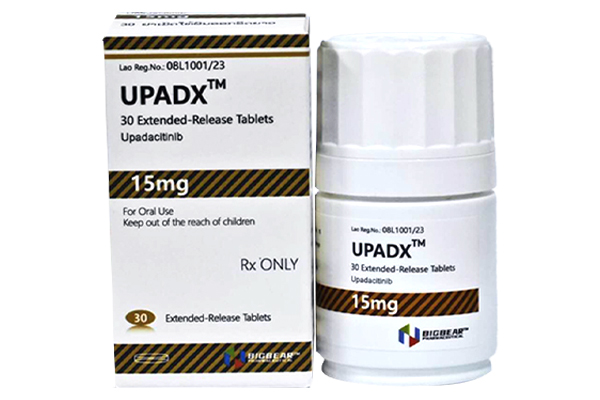
NORTH CHICAGO, Ill., March 16, 2022 /PRNewswire/ -- AbbVie (NYSE: ABBV) today announced that the U.S. Food and Drug Administration (FDA) has approved Rinvoq® (upadacitinib) for the treatment of adults with moderately to severely active ulcerative colitis (UC) who have had an inadequate response or intolerance to one or more tumor necrosis factor (TNF) blockers. This FDA approval is the first indication for Rinvoq in gastroenterology and is supported by efficacy and safety data from three Phase 3 randomized, double-blind, placebo-controlled clinical studies.
AbbVie Official Commentary on the Approval
"There remains an unmet need for patients with moderately to severely active UC, who suffer from debilitating symptoms that are often unpredictable and burdensome," said Thomas Hudson, MD, senior vice president of research and development, chief scientific officer, AbbVie. "With the approval of Rinvoq as a new treatment option, AbbVie continues our leadership in advancing research that can help impact the lives of people living with ulcerative colitis."
Clinical Trial Design and Key Endpoints
The two induction studies (U-ACHIEVE and U-ACCOMPLISH) utilized Rinvoq 45 mg once daily for 8 weeks, and then 15 mg or 30 mg once daily for the maintenance study (U-ACHIEVE maintenance) through 52 weeks. Across all clinical trials, significantly more patients treated with Rinvoq achieved clinical remission at weeks 8 and 52, the primary endpoint based on the mMS: stool frequency subscore (SFS) ≤ 1 and not greater than Baseline, rectal bleeding subscore (RBS) = 0, endoscopy subscore (ES) of ≤ 1 without friability, compared to placebo. In addition, the studies met all ranked secondary endpoints, including endoscopic improvement and histologic-endoscopic mucosal improvement (HEMI), as well as corticosteroid-free clinical remission in the maintenance study. All primary and ranked secondary endpoints achieved p-values of <0.001 versus placebo.
Expert Commentary on Rinvoq's Efficacy
"Ulcerative colitis patients live with unpredictable symptoms such as increased stool frequency and bleeding, which can make daily activities difficult," said Maria T. Abreu, M.D., Professor of Medicine, Professor of Microbiology and Immunology, University of Miami Miller School of Medicine and Director, Crohn's & Colitis Center, University of Miami Health System. "In clinical trials, Rinvoq showed its ability to rapidly control symptoms in just eight weeks for many patients and sustained responses at one year. I believe these types of improvements can make a positive difference for my patients."
Clinical Response and Durable Remission Data
Induction Trial Results (Week 8)
During the U-ACHIEVE and U-ACCOMPLISH induction trials at week 8, 26 percent and 33 percent of patients treated with Rinvoq 45 mg achieved clinical remission, the primary endpoint based on mMS, compared to 5 percent and 4 percent of patients who received placebo.
Onset of response occurred as early as Week 2, with a greater proportion of patients receiving Rinvoq 45 mg once daily achieving clinical response, defined as a decrease of ≥1 point and ≥30 percent from Baseline and a decrease in RBS of ≥1 or an absolute RBS ≤1 per the pmMS, compared to placebo.
Maintenance Trial Results (Week 52)
During the maintenance trial, 42 percent and 52 percent of patients treated with Rinvoq 15 mg or 30 mg, respectively, achieved clinical remission at week 52, the primary endpoint, compared to 12 percent of patients who received placebo.
Additionally, 57 percent and 68 percent of patients receiving Rinvoq 15 mg or 30 mg, respectively, achieved corticosteroid free remission, defined as clinical remission (per mMS) and corticosteroid free for ≥90 days immediately preceding Week 52 among patients who achieved clinical remission at the end of the induction treatment, compared to 22 percent of patients on placebo.