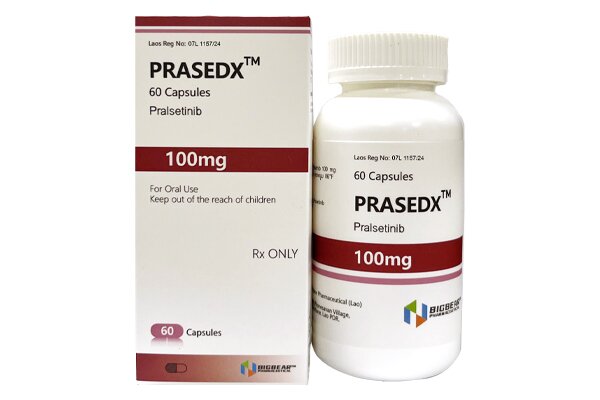
Pralsetinib is a potent, highly selective RET tyrosine kinase inhibitor developed by Blueprint Medicines, Inc. It is used to treat RET fusion-positive metastatic non-small cell lung cancer (NSCLC) and RET-mutant thyroid cancer, marking a milestone in precision medicine for RET-driven tumors.
Pralsetinib Indications
1. Non-Small Cell Lung Cancer (NSCLC)
For the treatment of adult patients with metastatic RET fusion-positive NSCLC. Designated by the FDA as an orphan drug for the treatment of JAK1/2-positive or TRKC-positive NSCLC.
2. Thyroid Cancer
For the treatment of advanced or metastatic RET fusion-positive thyroid cancer in adults and children aged 12 years and older who require systemic therapy and are refractory to radioactive iodine (for those who have received radioactive iodine therapy). Designated by the FDA as an orphan drug for the treatment of this cancer.
The above information is from the drug's official website and only reflects the indications for this drug in countries where it is registered overseas. It does not represent the approved use in mainland China. Please do not make any treatment decisions based on this information.
Pralsetinib Dosage and Administration
1. Pre-treatment Screening
(1) For patients with non-small cell lung cancer or thyroid cancer, confirm the presence of RET gene fusion.
(2) Assess serum alanine aminotransferase (ALT) and aspartate aminotransferase (AST) concentrations.
(3) Assess blood pressure. Patients with uncontrolled hypertension should not begin pralatinib treatment.
(4) Confirm the pregnancy status of women of reproductive potential.
2. Patient Monitoring
(1) Assess serum ALT and AST concentrations every 2 weeks for the first 3 months of treatment, then monthly thereafter, and monitor according to clinical status.
(2) Monitor blood pressure 1 week after starting pralatinib treatment, then at least monthly thereafter, and monitor according to clinical status.
(3) Skeletal and dental abnormalities were observed in immature animals treated with pralatinib; growth plate status should be monitored in adolescents with open growth plates.
(4) Closely monitor patients at risk of tumor lysis syndrome (e.g., those with high tumor burden, rapid tumor growth, renal insufficiency, or dehydration).
(5) Monitor for signs of interstitial lung disease or pneumonia (e.g., dyspnea, cough, fever).
3. Administration
(1) Oral Administration
Operately once daily on an empty stomach (i.e., at least 2 hours after and 1 hour before food).
(2) Management of Missed Doses
If a dose is missed, take it as soon as you remember it on the same day. The next dose should be taken at the usual scheduled time.
(3) Management of Vomiting
If vomiting occurs after taking the medication, no additional dose is needed to make up for the missed dose; the next dose should be taken at the usual scheduled time.
4. Usual Dosage
(1) Children with Thyroid Cancer
12 years and older: 400 mg once daily. Continue treatment until disease progression or unacceptable toxicity occurs.
(2) Adult Non-Small Cell Lung Cancer
400 mg once daily. Continue treatment until disease progression or unacceptable toxicity occurs.
(3) Adult Thyroid Cancer
400 mg once daily. Continue treatment until disease progression or unacceptable toxicity occurs.
The above information is from the drug's official website and only reflects the dosage range of this drug in countries where it is registered outside of mainland China. It does not represent the approved use range in mainland China. Please do not make any treatment decisions based on this information.
Common Adverse Reactions of Pralsetinib
(1) Common Adverse Reactions (≥25%)
Musculoskeletal pain, constipation, hypertension, diarrhea, fatigue, edema, fever, cough.
(2) Common Grade 3 or 4 Laboratory Abnormalities (≥2%)
Lymphopenia, neutropenia, phosphate depletion, hemoglobin depletion, leukopenia, sodium depletion, corrected calcium depletion, elevated ALT/AST levels, thrombocytopenia, elevated alkaline phosphatase, elevated or decreased potassium, elevated bilirubin.
Precautions for Pralsetinib
1. Interstitial Lung Disease (ILD)/Pneumonia
Severe, life-threatening, and fatal ILD or pneumonia has been reported. Monitor for lung symptoms suggestive of ILD or pneumonia, such as cough, dyspnea, and fever. Pralsetinib should be discontinued immediately in any patient who develops acute or worsening respiratory symptoms suggestive of ILD (such as dyspnea, cough, and fever), and ILD should be investigated immediately.
2. Hypertension
Hypertension, including grade 3 and 4 hypertension, has been reported. Hypertension that develops during treatment is usually controllable with antihypertensive therapy.
Pralsetinib treatment should not be started in patients whose hypertension is not controlled. Assess blood pressure before starting treatment, and monitor blood pressure at least monthly after one week of treatment, and as clinically relevant thereafter. Initiate antihypertensive therapy or adjust as appropriate to control blood pressure during treatment. If hypertension develops, it may be necessary to interrupt treatment, reduce the dose, or permanently discontinue treatment.
3. Hepatotoxicity
Serious adverse liver reactions have been reported. Monitoring ALT and AST levels is recommended before initiating pralatinib treatment. Monitoring should be performed every 2 weeks for the first 3 months, then monthly, and based on clinical progress. Hepatotoxicity may necessitate discontinuation of treatment, dose reduction, or permanent discontinuation.
4. Bleeding Events
Serious (including fatal) bleeding events have been reported. Patients experiencing severe or life-threatening bleeding should permanently discontinue treatment.
5. Tumor Dissolution Syndrome
Tumor lysis syndrome has been reported in patients with medullary thyroid carcinoma treated with pralatinib. Closely monitor patients at risk for tumor lysis syndrome (e.g., those with rapidly growing tumors, high tumor burden, renal insufficiency, or dehydration). Consider appropriate preventative measures (e.g., adequate fluid resuscitation).
6. Wound Healing Complications
Inhibitors of the vascular endothelial growth factor (VEGF) signaling pathway (such as pralatinib) may impair wound healing. Pralatinib treatment should be discontinued for at least 5 days prior to elective surgery. Pralatinib should not be used for at least 2 weeks after major surgery or until the wound has fully healed. The safety of resuming pralatinib treatment after resolution of wound healing complications has not been established.
7. Fetal/Neonatal Morbidity and Death
May cause harm to the fetus. Embryotoxicity and malformations have been observed in animals. Confirm pregnancy status before starting treatment. Avoid pregnancy during treatment.
Women of reproductive potential should use effective non-hormonal contraception during pralatinib treatment and for 2 weeks after the last dose.
Men with such female partners are advised to use effective contraception during treatment with this drug and for 1 week after the last dose. If used during pregnancy, the patient should be informed of the potential harm to the fetus.
Special Populations for Pralsetinib
1. Pregnancy
May cause harm to the fetus. Confirm pregnancy status before starting treatment. If used during pregnancy, the patient should be informed of the potential harm to the fetus.
2. Lactation
It is unknown whether pralatinib or its metabolites enter human breast milk, affect milk production, or affect breastfed infants. Women should not breastfeed during treatment and for 1 week after the last dose.
3. Women and Men of Reproductive Potential
Confirm the pregnancy status of women of reproductive potential before initiating pralatinib. Women of reproductive potential are advised to use effective non-hormonal contraception during treatment and for 2 weeks after the last dose. Men with partners of women of reproductive potential are advised to use effective contraception during treatment and for 1 week after the last dose.
4. Pediatric Use
The safety and efficacy of pralatinib for the treatment of metastatic RET fusion-positive non-small cell lung cancer have not been established.
The safety and efficacy in pediatric patients aged 12 years and older with RET fusion-positive thyroid cancer were supported by extrapolation from clinical study data evaluating pralatinib in adults and pharmacokinetic data in pediatric patients aged 12 years and older.
5. Elderly Use
No overall difference in safety was observed compared to younger adults.
6. Hepatic Impairment
Mild, moderate, or severe hepatic impairment: No significant changes in pharmacokinetics; no dose adjustment is required.
7. Renal Impairment
Population pharmacokinetic analysis showed that mild or moderate renal impairment did not affect pralatinib exposure. Severe renal impairment was not studied.
Pralsetinib Drug Interactions
1. Drugs Affecting or Affecting Hepatic Microsomal Enzymes
(1) Potent or Intermediate CYP3A Inhibitors and/or P-glycoprotein Inhibitors
These may increase pralatinib exposure, increasing the risk or severity of adverse reactions. Avoid concomitant use of pralatinib with potent or intermediate CYP3A inhibitors and/or P-glycoprotein inhibitors. If concomitant use with potent or intermediate CYP3A and/or P-glycoprotein inhibitors cannot be avoided, the dose of pralatinib should be reduced as directed by a physician. After discontinuation of P-glycoprotein and/or CYP3A inhibitors, (after 3-5 elimination half-lives) restore the pralatinib dose to the level prior to initiation of P-glycoprotein and/or CYP3A inhibitors.
(2) Strong or Intermediate CYP3A Inducers
These may reduce pralatinib exposure and decrease its efficacy. Avoid co-administration of pralatinib with strong or intermediate CYP3A inducers. If co-administration with a strong or intermediate CYP3A inducer cannot be avoided, increase the pralatinib dose as directed in the instructions, starting on day 7 of co-administration. After at least 14 days of discontinuation of the intermediate or strong CYP3A inducer, restore the pralatinib dose to the level before starting the intermediate or strong CYP3A inducer.
2. Certain Drugs
Antacids, cyclosporine, histamine H2 receptor antagonists, efavirenz, fluconazole, itraconazole, proton pump inhibitors, rifampin, verapamil, voriconazole, etc., may interact. Avoid concurrent use or consult a doctor.