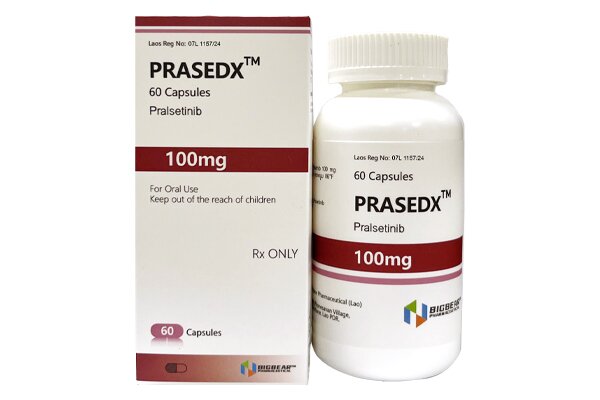
Pralsetinib, developed by Blueprint Medicines, is an oral, highly selective, and potent RET inhibitor.
Common Dosages for Pralsetinib
1. Adult Non-Small Cell Lung Cancer
400 mg orally daily until disease progression or unacceptable toxicity.
2. Adult Thyroid Cancer
400 mg orally daily until disease progression or unacceptable toxicity.
3. Common Dosage for Pediatric Thyroid Cancer
12 years and older: 400 mg orally daily until disease progression or unacceptable toxicity.
Pralsetinib Management
1. Dosage Recommendations
Oral administration on an empty stomach. Do not eat for at least 2 hours before and at least 1 hour after administration.
2. Missed Dosage
If a dose is missed, take it as soon as possible on the same day. Resume the regular daily dose the following day.
3. Management of Vomiting
If vomiting occurs, no additional dose is required; simply take the next dose as scheduled.
4. Storage Requirements
Store at 20°C to 25°C, with permissible fluctuations within 15°C to 30°C. Protect from moisture.
Pralsetinib Monitoring and Management
1. Monitor for pulmonary symptoms.
2. Monitor blood pressure one week after starting treatment, then monthly thereafter, and as needed based on clinical progress.
3. Obtain aspartate aminotransferase (AST) and alanine aminotransferase (ALT) levels at baseline, every two weeks for the first 3 months of treatment, monthly thereafter, and as needed based on clinical progress.
4. Monitor at-risk patients for tumor lysis syndrome.
5. Monitor growth plate status in adolescent patients with open growth plates.
Pralsetinib Dosage Adjustments
Dose Reductions for Adverse Reactions:
Initial Dose Reduction: 300 mg orally daily.
Second Dose Reduction: 200 mg orally daily.
Third Dose Reduction: 100 mg orally daily.
Patients who cannot tolerate the 100 mg daily dose should discontinue treatment.
Pralsetinib Adverse Reactions Dosage Adjustments
1. Interstitial Lung Disease/Pneumonia
Grade 1 or 2: Discontinue treatment until symptoms resolve; resume treatment at a reduced dose.
Grade 3 or 4 or Relapse: For relapsed or confirmed interstitial lung disease/pneumonia, permanently discontinue treatment.
2. Hypertension
Grade 3: For grade 3 hypertension that persists despite optimal antihypertensive therapy, discontinue treatment; resume treatment at a reduced dose once hypertension is controlled.
Grade 4: Permanently discontinue treatment.
3. Hepatotoxicity
Grade 3 or 4: Discontinue treatment and monitor transaminases weekly until they return to Grade 1 or baseline levels. Resume medication at a reduced dose. If hepatotoxicity recurs to Grade 3 or higher, discontinue the medication.
4. Bleeding Events
Grade 3 or 4: Discontinue treatment until they return to baseline levels, Grade 0 or 1.
Serious or life-threatening bleeding events: Discontinue the medication.
5. Concomitant Use with P-glycoprotein (P-gp) and potent CYP4503A inhibitors
(1) Avoid concomitant use with P-gp and potent CYP4503A inhibitors.
(2) If concomitant use cannot be avoided, reduce the dose of this drug (if the current dose is 300 mg or 400 mg daily, reduce to 200 mg daily; if the current dose is 200 mg daily, reduce to 100 mg daily).
(3) After discontinuing P-gp and a potent CYP4503A inhibitor for 3 to 5 elimination half-lives, resume the dosage of this drug used before starting the combination therapy with P-gp and a potent CYP4503A inhibitor.
6. Concomitant use with potent CYP4503A inducers
(1) Avoid concomitant use with potent CYP4503A inducers.
(2) If concomitant use with potent CYP4503A inducers cannot be avoided, starting on day 7 of concomitant use, increase the starting dose of this drug to twice the current dose.
(3) After discontinuing the CYP4503A inducer for at least 14 days, resume the dosage of this drug used before starting the combination therapy with the CYP4503A inducer.
7. Other adverse reactions
Grade 3 or 4: Discontinue treatment until improvement to Grade 2 or lower, and reduce the dose upon resumption of treatment.
Grade 4 relapse: Permanently discontinue treatment.
Dosage Adjustment for Pralsetinib in Special Populations
1. Dosage Adjustment for Renal Impairment
Mild to moderate renal impairment: Dosage adjustment is not recommended.
Severe renal impairment: No data available.
End-stage renal disease: No data available.
2. Dosage Adjustment for Hepatic Impairment
Mild hepatic impairment: Dosage adjustment is not recommended.
Moderate and severe hepatic impairment: No data available.