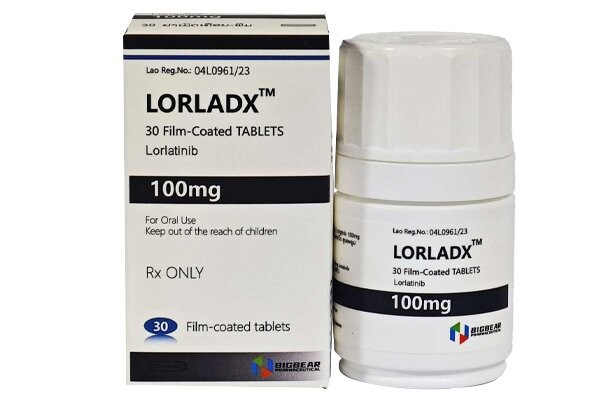
Lorlatinib was first approved for marketing in Japan in September 2018, followed by approval from the U.S. Food and Drug Administration (FDA) in November of the same year, and approval in Europe in March 2019.
Lorlatinib Indications
Lorlatinib is indicated for the treatment of adult patients with metastatic non-small cell lung cancer (NSCLC) whose tumors are confirmed to be anaplastic lymphoma kinase (ALK) positive by an FDA-approved assay.
Used Dosage of Lorlatinib: 100 mg orally once daily. Patients with metastatic NSCLC are selected for treatment based on the presence of ALK positivity in tumor specimens. Treatment should continue until disease progression or unacceptable toxicity.
Lorlatinib Dosage Recommendations
1. Lorlatinib can be taken with food or on an empty stomach.
2. Lorlatinib tablets should be swallowed whole; do not chew, crush, or break them.
3. Do not take any broken, cracked, or incomplete Lorlatinib tablets.
4. If a dose is missed, take it as soon as possible, unless less than 4 hours have passed since the next dose. Do not take two doses simultaneously to make up for a missed dose.
5. If vomiting occurs, do not take an extra dose; continue with the scheduled next dose.
Lorlatinib Monitoring Recommendations
1. Monitor blood pressure for 2 weeks after starting treatment, and then at least monthly during treatment.
2. Monitor serum cholesterol and triglycerides regularly before starting treatment, during the first and second months of treatment, and thereafter.
3. Monitor electrocardiograms (ECGs) regularly before starting treatment and afterward.
4. Obtain fasting serum glucose before starting treatment and monitor it regularly thereafter.
Dose Adjustment for Adverse Reactions to Lorlatinib
Initial Dose Reduction: 75 mg orally once daily.
Second Dose Reduction: 50 mg orally once daily.
For patients who cannot tolerate 50 mg orally daily, Lorlatinib should be permanently discontinued.
Dose Adjustment for Lorlatinib in Special Populations
1. Dose Adjustment in Renal Impairment
Mild or Moderate Renal Impairment: Creatinine clearance 30 to 89 mL/min, no dose adjustment is recommended.
Severe Renal Impairment: Creatinine clearance 15 to less than 30 mL/min, 75 mg orally once daily.
2. Dose Adjustment in Hepatic Impairment
Mild Hepatic Impairment: Total bilirubin less than or equal to the upper limit of normal (ULN) and AST greater than the upper limit of normal, or total bilirubin greater than 1 to 1.5 times the upper limit of normal and AST any value, no dose adjustment is recommended.
Moderate or Severe Hepatic Impairment: No data available.
Dosage Adjustments for Specific Adverse Reactions of Lorlatinib
1. Central Nervous System Adverse Reactions
Grade 1: Continue treatment at the same dose, or discontinue administration until baseline levels are restored; resume treatment at the same dose or a reduced dose.
Grade 2 or 3: Discontinue administration until Grade 0 or 1 is restored; resume treatment at a reduced dose.
Grade 4: Permanently discontinue Lorlatinib.
2. Hyperlipidemia
Grade 4 hypercholesterolemia or Grade 4 hypertriglyceridemia: Discontinue administration until Grade 2 or lower is restored; resume treatment at the same dose. If severe hypercholesterolemia and/or hypertriglyceridemia recurs, resume treatment at a reduced dose.
3. Atrioventricular (AV) Block
(1) Second-degree AV block: Discontinue administration until the PR interval is less than 200 ms; resume treatment at a reduced dose. (2) First occurrence of third-degree atrioventricular block: Discontinue administration until a pacemaker is implanted or the PR interval is less than 200 ms; if a pacemaker is implanted, resume treatment at the same dose; if a pacemaker is not implanted, resume treatment at a reduced dose.
(3) Recurrent third-degree atrioventricular block: Implant a pacemaker or permanently discontinue lorlatinib.
4. Interstitial lung disease (ILD)/pneumonia: Any grade of treatment-related ILD/pneumonia: Permanently discontinue lorlatinib.
5. Hypertension: Grade 3: Discontinue administration until hypertension returns to Grade 1 or lower, then resume treatment at the same dose. If grade 3 hypertension recurs, discontinue administration until it returns to Grade 1 or lower, and resume treatment at a reduced dose. If adequate hypertension control cannot be achieved with optimal medical therapy, lorlatinib should be permanently discontinued.
Grade 4: Discontinue administration until grade 1 or lower is achieved, then resume treatment at a reduced dose or permanently discontinue. If grade 4 hypertension recurs, permanent discontinuation is necessary.
6. Hyperglycemia: If grade 3 or 4 hyperglycemia persists after antihyperglycemic therapy, discontinue administration until hyperglycemia is adequately controlled, then resume treatment at the next lowest dose. If adequate hyperglycemic control cannot be achieved with medication, lorlatinib should be permanently discontinued.