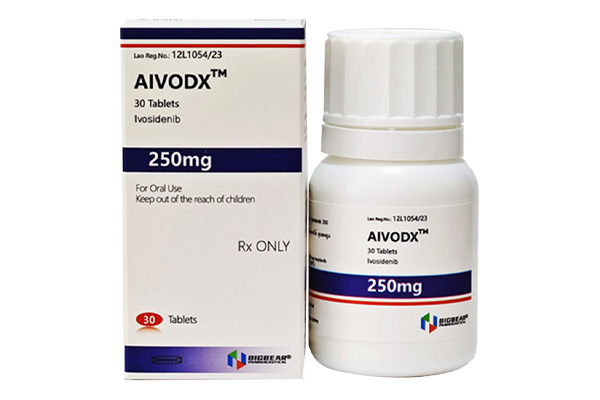
Ivosidenib Indications
1. Leukemia
Ivosidenib, used in combination with azacitidine or as monotherapy, is indicated for newly diagnosed acute myeloid leukemia (AML) patients aged 75 years and older with a susceptibility isocitrate dehydrogenase-1 (IDH1) mutation detected by an FDA-approved assay, or for patients who are ineligible for intensive induction chemotherapy due to comorbidities.
It is also indicated for the treatment of relapsed or refractory AML patients with a susceptibility IDH1 mutation detected by an FDA-approved assay.
2. Cholangiocarcinoma
It is indicated for the treatment of previously treated locally advanced or metastatic cholangiocarcinoma patients with an IDH1 mutation detected by an FDA-approved assay.
Ivosidenib Dosage and Administration
1. Routine Adult Dosage for Acute Myeloid Leukemia
(1) Dosage
Oral administration, 500 mg once daily.
(2) Duration of Treatment
Until disease progression or unacceptable toxicity occurs.
For patients without disease progression or unacceptable toxicity, treatment should continue for at least 6 months to allow sufficient time for a clinical response.
(3) Combination Therapy Regimen
This product should be used in combination with azacitidine, starting on day 1 of cycle 1; consult the manufacturer's product information for azacitidine.
2. Routine Adult Dosage for Biliary Tract Cancer (Chlorocholangiocarcinoma)
(1) Dosage
Oral administration, 500 mg once daily.
(2) Duration of Treatment
Until disease progression or unacceptable toxicity occurs.
Ivosidenib Dosage Adjustment
1. Renal Function Adjustment
(1) Mild to moderate renal impairment (estimated glomerular filtration rate [eGFR] ≥ 30 mL/min/1.73 m², using the modified diet for kidney disease [MDRD] formula): Starting dose, no adjustment is recommended.
(2) Severe renal impairment (estimated glomerular filtration rate [eGFR] < 30 mL/min/1.73 m², MDRD): Risks and benefits should be weighed before starting ivonib.
2. Hepatic Function Adjustment
(1) Mild to moderate hepatic impairment (Child-Pugh A or B): Starting dose, no adjustment is recommended.
(2) Severe hepatic impairment (Child-Pugh C): Risks and benefits should be weighed before starting ivonib.
3. Dosage Adjustment for Toxicity
(1) Differentiation Syndrome
If differentiation syndrome is suspected, systemic corticosteroid therapy should be initiated with hemodynamic monitoring until symptoms resolve and persist for at least 3 days.
If severe signs/symptoms persist more than 48 hours after initiation of systemic corticosteroid therapy, treatment with this product should be discontinued.
Evonib treatment should be resumed when signs/symptoms improve to grade 2 or below.
(2) Non-infectious Leukocytosis
White blood cell count (WBC) greater than 25 x 10⁹/L, or an absolute increase in total white blood cells from baseline greater than 15 x 10⁹/L:
Hydroxyurea therapy should be initiated according to standard institutional practice, with leukoablation performed as clinically indicated.
The dosage of hydroxyurea should only be gradually reduced after the leukocytosis improves or resolves.
If leukocytosis does not improve after hydroxyurea treatment, evanixib treatment should be discontinued; once the leukocytosis has subsided, administration should be resumed at a dose of 500 mg once daily.
(3) QTc interval greater than 480 to 500 ms
Electrolyte levels should be monitored and supplemented as clinically indicated.
Concomitant medications known to prolong the QTc interval should be reviewed and adjusted.
Eevanixib treatment should be discontinued.
When the QTc interval recovers to 480 ms or less, evanixib treatment should be restarted at a dose of 500 mg once daily.
Electrocardiogram (ECG) monitoring should be performed at least weekly for two weeks after the QTc prolongation has subsided.
(4) QTc interval greater than 500 ms
Electrolyte levels should be monitored and supplemented as clinically indicated.
Concomitant medications known to prolong the QTc interval should be reviewed and adjusted.
This product treatment should be discontinued.
When the QTc interval recovers to a prolongation of no more than 30 ms from baseline, or 480 ms or less, dosing should be resumed at a reduced dose of 250 mg once daily.
Electrocardiogram (ECG) monitoring should be performed at least weekly for two weeks after the QTc prolongation is resolved.
If other causes of QTc prolongation can be identified, the dose of evanixib should be considered, increasing it back to 500 mg once daily.
QTc prolongation with life-threatening signs/symptoms of arrhythmia: Evanixib should be permanently discontinued.
(5) Guillain-Barré syndrome
Evanixib should be permanently discontinued.
(6) Other Grade 3 adverse reactions
AML monotherapy:
Treatment with this product should be interrupted until the toxicity is resolved to Grade 2 or less.
Dosing should be resumed at a dose of 250 mg once daily; if the toxicity is resolved to Grade 1 or less, the dose may be increased to 500 mg once daily.
If grade 3 or higher toxicity occurs again, this product should be discontinued.
AML combined with azacitidine regimen, cholangiocarcinoma:
Evonib treatment should be interrupted until the toxicity resolves to grade 1 or below, or returns to baseline levels, then resumed at a dose of 500 mg once daily (for grade 3 toxicity) or 250 mg once daily (for grade 4 toxicity).
If grade 3 toxicity recurs a second time, the evanib dose should be reduced to 250 mg once daily until the toxicity resolves, then resumed at 500 mg once daily.
If grade 3 toxicity recurs a third time, or grade 4 toxicity recurs, evanib should be discontinued.
(7) Dosage adjustment for concomitant use with potent CYP4503A4 inhibitors
If concomitant use with a potent CYP4503A4 inhibitor is necessary: the dose of this product should be reduced to 250 mg once daily.
If a potent CYP4503A4 inhibitor is discontinued: the dose of this product should be increased to 500 mg once daily after at least 5 half-lives of the potent CYP4503A4 inhibitor has been discontinued.