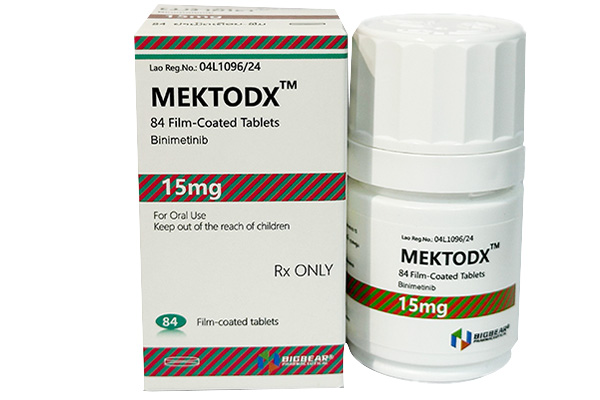
In June 2018, the U.S. Food and Drug Administration (FDA) approved binimetinib for marketing as a treatment for unresectable metastatic melanoma or melanoma with BRAF V600E or V600K mutations. In October 2023, the FDA approved binimetinib in combination with cannefenib for the treatment of adult patients with metastatic non-small cell lung cancer harboring BRAF V600E mutations.
Binimetinib Indications:
1. Melanoma
Binimetinib in combination with cannefenib is used to treat unresectable or metastatic melanoma harboring BRAF V600E or V600K mutations (the FDA has designated it as an orphan drug for this purpose).
Before initiating treatment, the presence of BRAF V600E or V600K mutations in the tumor specimen must be confirmed by an FDA-approved diagnostic test.
2. Non-Small Cell Lung Cancer
Binimetinib, in combination with cannefenib, is used to treat adult patients with metastatic non-small cell lung cancer (NSCLC) harboring the BRAF V600E mutation.
Before initiating treatment, the presence of the BRAF V600E mutation in the tumor or plasma sample must be confirmed by an FDA-approved diagnostic test. If the mutation is not detected in the plasma sample, tumor tissue testing is required.
Monitoring Recommendations for Binimetinib
1. One month after starting binimetinib, assess LVEF by echocardiography or MUGA, and then every 2 to 3 months during treatment.
2. Assess visual symptoms at each visit. Perform regular ophthalmological examinations to monitor for new or worsening visual disturbances and to track new or persistent ophthalmic abnormalities.
3. Evaluate for new or progressive unexplained lung symptoms or signs to rule out possible interstitial lung disease (ILD).
4. Monitor liver function monthly during treatment, and as needed based on clinical condition.
5. Monitor CPK and creatinine levels regularly during treatment, and as needed based on clinical condition.
6. Monitor for signs of bleeding and thrombosis during treatment.
7. Monitor for the development of new malignancies during treatment and after discontinuation of the drug.
Binimetinib Dosage and Administration
1. Administration Method
Oral administration: Twice daily, approximately 12 hours apart, with or without food.
2. Common Dosage
(1) Adult Melanoma
45 mg orally twice daily, in combination with cannefenib. Continue treatment until disease progression or unacceptable toxicity.
If cannefenib is permanently discontinued, binimetinib should also be discontinued. For information on dose adjustments for cannefenib, please refer to the cannefenib package insert.
(2) Non-Small Cell Lung Cancer (NSCLC)
45 mg orally twice daily, in combination with cannefenib. Continue treatment until disease progression or unacceptable toxicity occurs.
If cannefenib is permanently discontinued, binimetinib should also be discontinued. For information on dose adjustments for cannefenib, please refer to the cannefenib package insert.
Common Adverse Reactions of Binimetinib
Common adverse reactions (≥25%) when binimetinib is used in combination with cannefenib to treat melanoma and non-small cell lung cancer:
1. Melanoma
Fatigue, nausea, diarrhea, vomiting, abdominal pain.
2. Non-small cell lung cancer
Fatigue, nausea, diarrhea, musculoskeletal pain, vomiting, abdominal pain, visual impairment, constipation, dyspnea, rash, cough.
Precautions for Binimetinib
1. Combination Therapy
When binimetinib is used in combination with cannefenib, the precautions, precautions, and contraindications of cannefenib should be considered.
2. New Primary Malignancies
New primary malignancies may occur, including cutaneous and non-cutaneous malignancies. Patients should be monitored for new malignancies before, during, and after treatment.
3. Cardiomyopathy
Cardiomyopathy (i.e., symptomatic or asymptomatic decreased left ventricular ejection fraction) has been reported in patients receiving binimetinib in combination with cannefenib, sometimes requiring temporary interruption of treatment or dose reduction. If left ventricular dysfunction occurs, treatment may need to be interrupted, followed by dose reduction or discontinuation.
4. Venous Thromboembolism
Ventrovenous thromboembolism (VTE) has been reported in patients receiving binimetinib in combination with cannefenib. Deep vein thrombosis or pulmonary embolism may require interruption of treatment, followed by dose reduction or discontinuation.
5. Ocular Effects
Ocular toxicities, including serous retinopathy, retinal vein occlusion, retinal pigment epithelium detachment, and macular edema, have been reported in patients receiving binimetinib in combination with cannefenib. Monitor the patient's visual symptoms at each visit. If ocular toxicity occurs, treatment should be interrupted, the dose reduced, or the drug permanently discontinued.
6. Lung Effects
Interstitial lung disease or pneumonia has been reported in patients receiving bismuth substantia nigra in combination with cannefenib. Evaluate patients exhibiting signs of interstitial lung disease (such as new-onset or progressive lung symptoms). If interstitial lung disease is diagnosed, treatment may need to be interrupted, followed by dose reduction or discontinuation.
7. Hepatotoxicity
Abnormal liver function tests (i.e., elevated ALT, AST, or alkaline phosphatase) have been reported in patients receiving bismuth substantia nigra in combination with cannefenib.
Perform liver function tests before treatment begins and monthly thereafter, and more frequently as needed based on clinical circumstances. If abnormal liver function tests occur, treatment should be interrupted, the dose reduced, or the drug permanently discontinued.
8. Musculoskeletal Effects
Rhabdomyolysis has been reported in patients receiving bismuth substantia nigra in combination with cannefenib. If elevated CK levels occur, treatment may need to be interrupted, followed by dose reduction or discontinuation.
9. Bleeding
Bleeding has been reported in patients receiving bimetinib in combination with cannefenib. There have also been reports of fatal intracranial hemorrhage. If a bleeding event occurs, treatment may need to be interrupted, followed by dose reduction or discontinuation.
10. Fetal/Neonatal Morbidity and Death
May cause harm to the fetus. Embryotoxicity, fetal toxicity, and teratogenicity have been shown in animals. Confirm pregnancy status before starting treatment. Avoid pregnancy during treatment. Women of childbearing potential should use effective contraception during bimetinib treatment and for ≥30 days after the last dose.
Special Populations for Bimetinib Use:
1. Pregnancy: May cause harm to the fetus.
2. Lactation: It is unclear whether bimetinib or its metabolites enter human milk. The effects on breastfeeding infants and milk production are also unclear. Breastfeeding should be discontinued during treatment and for 3 days after the last dose.
3. Women and Men of Reproductive Potential: Confirm pregnancy status in women of childbearing potential before starting treatment.
Women of childbearing potential are advised to use effective contraception during treatment and for ≥30 days after the last dose of bimetinib.
4. Pediatric Use: Safety and efficacy have not been established.
5. Elderly Use: Overall, the safety and efficacy of bimetinib in combination with cannefenib are not significantly different compared to younger adults.
6. Hepatic Impairment: Mild hepatic impairment has no significant effect on systemic exposure to bimetinib; no dose adjustment is required.
In patients with moderate or severe hepatic impairment, systemic exposure increases; dose reduction is recommended.
7. Renal Impairment: Severe renal impairment has no significant effect on systemic exposure to bimetinib.
Drug Interactions with Bimemetinib:
1. Drugs Metabolized by Hepatic Microsomal Enzymes:
CYP3A4 Substrate: No pharmacokinetic interactions have been observed to date.
2. Drugs Affecting Urate Diphosphate Glucuronyl Transferase:
(1) UGT1A1 Inhibitors: No clinically significant pharmacokinetic interactions are expected.
(2) UGT1A1 inducers: No clinically significant pharmacokinetic interactions are expected.
3. Drugs transported via organic cation transporters: OCT1 or OCT2 substrates: No clinically significant pharmacokinetic interactions are expected.
4. Specific drugs: Atazanavir, cannefenib, midazolam, rabeprazole, etc., showed no significant effect on systemic exposure compared to metinib.