
BIGBEAR
PHARMACEUTICALS
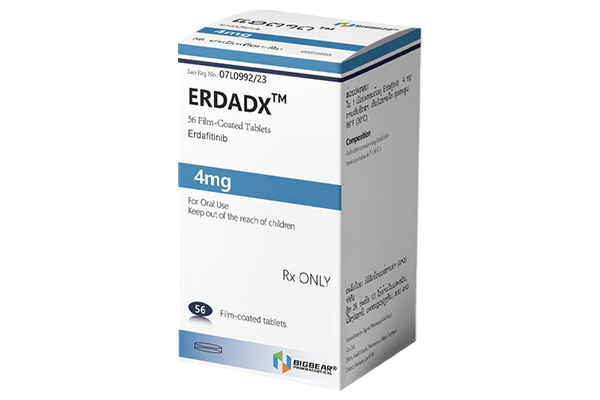
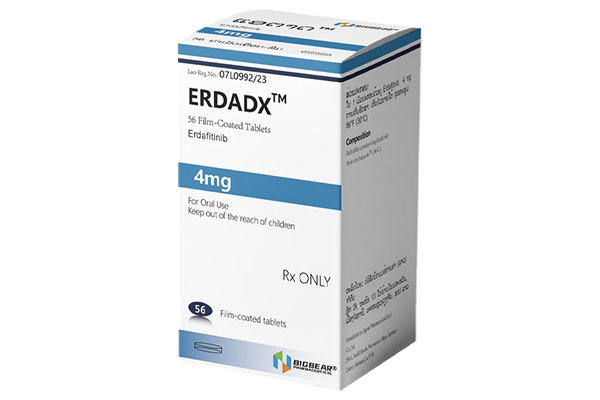
Erdafitinib exerts its antitumor effect by selectively inhibiting FGFR1‑4, blocking downstream signaling to suppress tumor cell proliferation and survival.

 AuthenticGuaranteeFast DeliveryPrivacy
 Erdafitinib is indicated for the treatment of patients with locally advanced or metastatic urothelial carcinoma (mUC) harboring specific FGFR3 genetic alterations, particularly for adult patients whose disease has progressed following at least one prior line of systemic therapy.
This product is indicated for the treatment of adult patients with locally advanced or metastatic urothelial carcinoma (UC) that is unresectable by surgery, harboring susceptible FGFR3 genetic variants, and whose disease has progressed during or after at least one prior line of anti-PD-1 or anti-PD-L1 therapy.
This product should be administered under the guidance of a physician experienced in the use of antineoplastic agents.
Prior to initiating treatment with this product, a validated testing method should be used to confirm the presence of FGFR3 mutations in the patient. Patients confirmed to carry FGFR3 mutations via genetic testing in a hospital or laboratory can receive treatment with this product. The FGFR3 gene status should be detected using a research companion diagnostic method approved by Janssen in designated hospitals or laboratories.
The recommended starting dose of this product is 8 mg administered orally once daily. Based on serum phosphate levels and drug-related toxicities, the dose may be increased to 9 mg once daily in eligible individuals.
This product should be swallowed whole and can be taken with or without food. If vomiting occurs after administration, the next dose should be taken on the following day. Treatment should be continued until disease progression or unacceptable toxicity is observed.
If a dose is missed, it should be taken as soon as possible. On the next day, resume the patient's regular daily dosing schedule. Do not take an extra dose to make up for a missed dose.
Serum phosphate (PO₄) levels should be assessed 14 to 21 days after treatment initiation. If the serum phosphate level is < 9.0 mg/dL and no drug-related toxicities are present, the dose should be increased to 9 mg once daily as soon as possible. If the serum phosphate level is ≥ 9.0 mg/dL, appropriate dose reductions should be performed. After 21 days, dose adjustment should not be guided by serum phosphate levels.
1.For patients on a 9 mg dose (three 3 mg tablets):
1st dose reduction: 8 mg (two 4 mg tablets)
2nd dose reduction: 6 mg (two 3 mg tablets)
3rd dose reduction: 5 mg (one 5 mg tablet)
4th dose reduction: 4 mg (one 4 mg tablet)
5th dose reduction: Discontinue treatment
2.For patients on an 8 mg dose (two 4 mg tablets):
1st dose reduction: 6 mg (two 3 mg tablets)
2nd dose reduction: 5 mg (one 5 mg tablet)
3rd dose reduction: 4 mg (one 4 mg tablet)
Subsequent dose reduction: Discontinue treatment
Hyperphosphatemia is an expected transient laboratory abnormality associated with FGFR inhibitor use (see "Clinical Pharmacology: Pharmacodynamics"). Serum phosphate levels should be monitored monthly. If an elevation in serum phosphate is observed in patients receiving treatment, the dose adjustment guidelines should be followed. If the elevation in phosphate concentration is persistent, consideration may be given to using a calcium-free phosphate binder (e.g., sevelamer carbonate).
Serum phosphate < 6.99 mg/dL (< 2.24 mmol/L): Continue treatment at the current dose.
Serum phosphate 7.00–8.99 mg/dL (2.25–2.90 mmol/L): Continue treatment. Initiate a phosphate binder (administered with food) until serum phosphate decreases to < 7.00 mg/dL. If serum phosphate remains ≥ 7.00 mg/dL for 2 months, or if clinically indicated, reduce the dose.
Serum phosphate 9.00–10.00 mg/dL (2.91–3.20 mmol/L): Suspend treatment until serum phosphate recovers to < 7.00 mg/dL (monitor weekly). Initiate a phosphate binder (administered with food) until serum phosphate decreases to < 7.00 mg/dL. Resume treatment at the same dose level. If serum phosphate remains ≥ 9.00 mg/dL for 1 month, or if clinically indicated, reduce the dose.
Serum phosphate > 10.00 mg/dL (> 3.20 mmol/L): Suspend treatment until serum phosphate recovers to < 7.00 mg/dL (monitor weekly). Resume treatment at the next lower dose level. If serum phosphate remains > 10.00 mg/dL for 2 consecutive weeks, permanently discontinue treatment. Provide symptomatic medical management based on clinical circumstances.
Permanent discontinuation: If hyperphosphatemia leads to a marked deterioration in renal function from baseline or grade 3 hypocalcemia.
Note: If phosphate concentration is ≥ 5.5 mg/dL (1.75 mmol/L), restrict dietary phosphate intake to 600–800 mg per day.
Prior to initiating treatment, a baseline ophthalmologic examination should be performed, including Amsler grid testing, fundoscopy, visual acuity, and optical coherence tomography (OCT) if available.
To prevent and treat dry eyes, use artificial tears, hydrating, or lubricating eye drops or ointment at least 2 hours before bedtime. Reassurance of treatment-related dry eye should be provided by an ophthalmologist.
Subsequently, patients should be examined monthly, including Amsler grid testing. If any abnormalities are observed, the management guidelines should be followed.
Conduct ophthalmologic evaluation (OE). If an eye examination cannot be performed within 7 days, suspend treatment until the eye examination is completed.
If no ocular toxicity is identified, continue treatment at the same dose level.
If the eye examination is diagnostic of keratitis or retinal abnormalities (i.e., CSR), suspend treatment until the eye examination is normal. If recovery occurs within 4 weeks of receiving the eye check, resume treatment at a 1 dose level lower. After resuming treatment, continue monitoring for recurrence every 1–2 weeks for 1 month. If no recurrence is observed, consider re-escalating the dose.
Immediately suspend treatment and perform an eye examination.
Resume treatment at a 1 dose level lower. If the eye examination is diagnostic of keratitis or retinal abnormalities (i.e., CSR), suspend treatment until the eye examination is normal. If recovery occurs within 4 weeks of receiving the eye check (complete resolution and no symptoms), resume treatment at a 1 dose level lower. After resuming treatment, monitor for recurrence every 1–2 weeks for 1 month.
Immediately suspend treatment and perform an eye examination.
If recovery occurs within 4 weeks (complete resolution and no symptoms), resume treatment at a 2 dose level lower. Monitor for recurrence every 1–2 weeks for 1 month. If recurrence occurs, consider permanently discontinuing treatment.
Permanently discontinue treatment.
Continue monitoring until complete resolution or stabilization.
Nail, skin, and mucosal changes observed with the use of this product should be managed according to the following dose adjustment guidelines.
Grade 1: Continue treatment at the current dose.
Grade 2: Consider suspending treatment and re-evaluate within 1–2 weeks. If it is the first occurrence and recovers to ≤ grade 1 or baseline within 2 weeks, resume treatment at the same dose. If it is a recurrent event or toxicity persists > 2 weeks before recovering to ≤ grade 1 or baseline, resume treatment at a 1 dose level lower.
Grade 3: Suspend treatment and re-evaluate within 1–2 weeks. If recovery to ≤ grade 1 or baseline occurs, resume treatment at a 1 dose level lower.
Grade 4: Discontinue treatment.
Grade 1: Continue treatment at the current dose.
Grade 2: Continue treatment at the current dose.
Grade 3: Suspend treatment (maximum 28 days) and review clinical status weekly. If recovery to ≤ grade 1 or baseline occurs, resume treatment at a 1 dose level lower.
Grade 4: Discontinue treatment.
Grade 1: Continue treatment at the current dose.
Grade 2: If the patient has other grade 2 AEs related to the study drug, consider suspending treatment. If the patient has received symptomatic management for more than one week, suspend treatment. If treatment is suspended and re-evaluated within 1–2 weeks. If it is the first occurrence of toxicity and recovers to ≤ grade 1 or baseline within 2 weeks, resume treatment at the same dose. If it is a recurrent event or toxicity persists > 2 weeks before recovering to ≤ grade 1 or baseline, resume treatment at a 1 dose level lower.
Grade 3: Suspend treatment and re-evaluate within 1–2 weeks. If recovery to ≤ grade 1 or baseline occurs, resume treatment at a 1 dose level lower.
Grade 4: Discontinue treatment.
Grade 1: Continue treatment at the current dose.
Grade 2: Continue treatment at the current dose.
Grade 3: Suspend treatment (maximum 28 days) and review clinical status weekly. If recovery to ≤ grade 1 or baseline occurs, resume treatment at a 1 dose level lower.
There are no available human data on the risk associated with erdafitinib use during pregnancy. Based on the results of animal reproductive studies, erdafitinib use by pregnant women may cause fetal harm. In a rat embryo-fetal toxicity study, erdafitinib was embryotoxic and teratogenic at exposures lower than the human exposure at all studied doses. The characteristics of fetal toxicity included hand/foot defects and malformations in certain large blood vessels (e.g., the aorta).
If this product is used during pregnancy, or if the patient becomes pregnant while taking this product, the patient should be informed of the potential risk to the fetus, and consultation should be sought from a healthcare provider regarding their clinical and treatment options. It is recommended that patients who become pregnant or suspect pregnancy while receiving this product and within 1 month after treatment should contact a healthcare professional.
There are no data indicating the presence of erdafitinib in human milk, or its effects on breastfed infants or milk production.
Because this product may cause serious adverse reactions in breastfed infants, it is recommended that women do not breastfeed during treatment with this product and for 1 month after the last dose.
It is recommended that females of reproductive potential undergo a highly sensitive pregnancy test before starting treatment with this product.
Use of this product by pregnant women may cause fetal harm. Females of reproductive potential should be advised to use highly effective contraception before and during treatment with this product and for 1 month after the last dose. Male patients must use effective contraception (e.g., condoms) during treatment with this product and for 1 month after the last dose, and must not donate or store semen.
There are no relevant data to determine the potential effects of this product on male or female fertility.
The safety and efficacy of erdafitinib in children have not been established.
No specific dose adjustment is required for elderly patients.
No dose adjustment is required for patients with mild or moderate renal impairment. Data in patients with severe renal impairment are limited.
No dose adjustment is required for patients with mild or moderate hepatic impairment. Data in patients with severe hepatic impairment are limited.
The most common adverse reactions (≥20%) are hyperphosphatemia (78.5%), diarrhea (55.5%), stomatitis (52.8%), dry mouth (39.9%), decreased appetite (31.7%), dry skin (28.0%), anemia (28.2%), constipation (27.3%), dysgeusia (26.3%), palmar-plantar erythrodysesthesia (PPES, 25.5%), alopecia (23.2%), alanine aminotransferase increased (21.7%), onycholysis (21.7%), nausea (18.6%), weight decreased (21.7%), aspartate aminotransferase increased (18%), dry eye (16.7%), paronychia (15.9%), vomiting (13.8%), blood creatinine increased (13.8%), nail disease (13.4%), onychitis (12.5%), nail dystrophy (11.9%), onychomadesis (11.5%), epistaxis (10.6%), and hypocalcemia (10.2%).
The most common grade ≥3 ADRs are stomatitis (10.6%), hyponatremia (8.8%), palmar-plantar erythrodysesthesia (7.9%), onycholysis (4.8%), fatigue (4.0%), hyperglycemia (2.9%), decreased appetite (2.5%), and nail dystrophy (2.5%).
Compared with patients <65 years, patients ≥65 years had a higher incidence of grade 3 or 4 treatment-emergent adverse events (TEAEs) (47.6% vs. 43.5%) and a higher frequency of serious adverse events (14.6% vs. 10.5%).
59.7% of patients experienced adverse reactions leading to dose reduction. The most common adverse events leading to dose reduction were stomatitis (15.4%), palmar-plantar erythrodysesthesia (9.6%), onycholysis (7.3%), and hyperphosphatemia (5.2%).
19.4% of patients discontinued treatment due to adverse reactions. The most common adverse events leading to treatment discontinuation were retinal pigment epithelial detachment (1.7%) and stomatitis (1.5%).
None.
Prior to initiating treatment with this product, a baseline ophthalmologic examination should be performed, including Amsler grid testing, fundoscopy, visual acuity assessment, and optical coherence tomography (OCT) if available.
This product can cause ocular disorders, including central serous retinopathy (CSR) (an umbrella term encompassing retinal pigment epithelial detachment [RPED]), which can lead to visual field defects . Compared with patients <65 years (28.8%), the overall incidence of central serous retinopathy was higher in patients ≥65 years (33.3%). Compared with patients <65 years (2.1%), the incidence of RPED events was higher in patients ≥65 years (6.3%), with grade 3 events occurring more frequently in the first month. For patients ≥65 years and those with pre-existing clinically significant ocular diseases (e.g., central serous retinopathy, macular/retinal degeneration, diabetic retinopathy, and retinal detachment), close clinical monitoring is recommended.
During treatment with this product, 16.7% of patients experienced dry eye symptoms, with 0.3% of patients experiencing grade 3 or 4 events (see "Adverse Reactions"). All patients should receive at least 2 hours of preventive eye care or use eye lubricants (e.g., artificial tears, hydrating, or lubricating eye drops or ointments) during waking hours. Treatment-related dry eye should be evaluated by an ophthalmologist.
During the first 4 months of treatment, an ophthalmologic examination (including Amsler grid testing) should be performed monthly, followed by examinations every 3 months, and urgent examinations should be performed if visual symptoms occur. If any abnormalities are observed, the management guidelines should be followed. Ophthalmologic examinations should include re-evaluation, slit-lamp examination, fundoscopy, and OCT. For patients who develop ocular events that do not resolve, close monitoring including comprehensive ophthalmologic examinations should be performed.
When CSR occurs, suspend treatment. If the event does not resolve within 4 weeks or is grade 4, permanently discontinue treatment. For other ocular adverse reactions, follow the dose adjustment guidelines.
This product can cause hyperphosphatemia. Prolonged hyperphosphatemia can lead to soft tissue mineralization, cutaneous calcium deposition, non-uremic calcific arteriopathy, hypocalcemia, anemia, secondary hyperparathyroidism, muscle cramps, seizures, QT interval prolongation, and arrhythmias. Hyperphosphatemia was reported early in treatment with this product, with most events occurring within the first 3–4 months, and grade 3 events occurring within the first month.
Monitor for hyperphosphatemia throughout treatment. When serum phosphate levels are ≥5.5 mg/dL, strictly restrict dietary phosphate intake (600–800 mg per day) and avoid concomitant use of medications that may increase serum phosphate levels. Supplementation with vitamin D is not recommended in patients receiving erdafitinib, as this may lead to elevated serum phosphate and calcium levels.
If serum phosphate levels are >7.0 mg/dL, consider initiating an oral phosphate binder until serum phosphate levels decrease to <7.0 mg/dL. Based on the duration and severity of hyperphosphatemia, consider suspending, reducing, or permanently discontinuing this product.
Caution should be exercised when this product is used concomitantly with drugs known to prolong the QT interval or that may induce torsade de pointes, such as Class IA (e.g., quinidine, procainamide) or Class III (e.g., amiodarone, sotalol, ibutilide) antiarrhythmics, macrolide antibiotics, selective 5-hydroxytryptamine receptor antagonists (e.g., ziprasidone, asenapine), mesalazine, moxifloxacin, and antipsychotics (e.g., quetiapine and risperidone).
Hypophosphatemia can occur during treatment with this product. Monitor serum phosphate levels during treatment and treatment interruptions. If serum phosphate levels fall below normal, discontinue phosphate-lowering therapy and dietary phosphate restriction (if applicable). Severe hypophosphatemia can manifest as confusion, seizures, focal neurological signs, cardiac arrest, respiratory failure, muscle weakness, rhabdomyolysis, and hemolytic anemia. For dose adjustments, see "Dosage and Administration". Hypophosphatemia reactions of grade 3–4 occurred in 1.0% of patients.
The above content is not comprehensive; for more information, please refer to the full prescribing information of this medication.
If any issues arise, please contact us immediately.
Email:haiousales@gmail.com

Copyright2024@ BIGBEAR All right reserved BIGBEAR


