
BIGBEAR
PHARMACEUTICALS
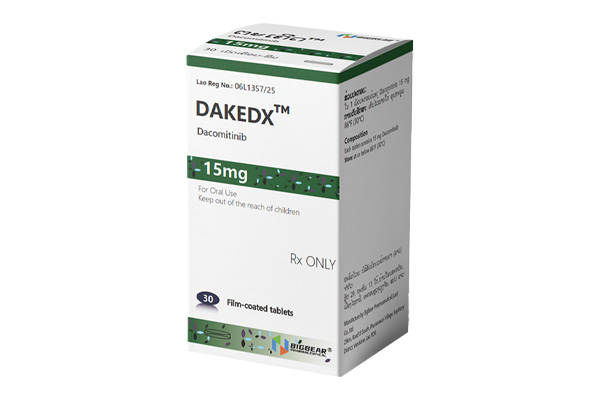
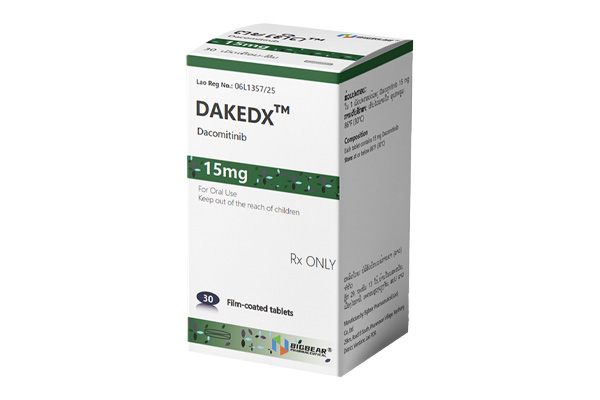
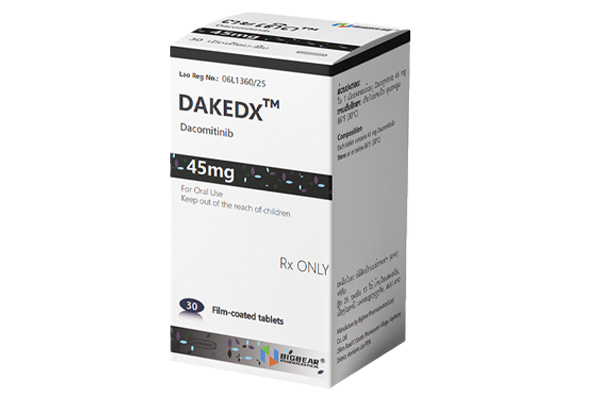
Dacomitinib blocks tumor cell signaling pathways through its unique mechanism of action, thereby inhibiting the proliferation and growth of tumor cells.

 AuthenticGuaranteeFast DeliveryPrivacy
 Dacomitinib is an oral kinase inhibitor that blocks tumor cell signaling pathways through its distinct mechanism of action, thereby inhibiting tumor cell proliferation and growth to achieve an antitumor effect.
As monotherapy for the first‑line treatment of patients with locally advanced or metastatic non‑small cell lung cancer (NSCLC) harboring epidermal growth factor receptor (EGFR) exon 19 deletion mutations or exon 21 L858R substitution mutations.
This product should be used in medical institutions with experienced practitioners and under the guidance of specialized technical personnel. It should only be used in patients whose tumor samples have been confirmed positive for EGFR exon 19 deletion mutations or exon 21 L858R substitution mutations via a fully validated testing method.
The recommended dose of this product is 45 mg administered orally once daily, until disease progression or unacceptable toxicity occurs. This product can be taken with or without food.
It is recommended to take this product at approximately the same time each day. If a patient vomits or misses a dose, no additional dose or make-up dose should be administered; instead, the prescribed dose should be taken at the next scheduled dosing time.
If adverse reactions occur, the dose of this product should be reduced according to the following scheme.
First dose reduction: 30 mg once daily
Second dose reduction: 15 mg once daily
All grades: Permanently discontinue this product.
Grade 2:
Temporarily suspend this product until recovery to ≤ Grade 1, then continue treatment at the same dose level.
For recurrent Grade 2 diarrhea, temporarily suspend this product until recovery to ≤ Grade 1, then reduce the dose by one level and continue treatment.
Grade 3 or 4:
Temporarily suspend this product until recovery to ≤ Grade 1, then reduce the dose by one level and continue treatment.
Grade 2:
For persistent skin adverse reactions, temporarily suspend this product. Once recovery to ≤ Grade 1 occurs, continue treatment at the same dose level.
For recurrent Grade 2 skin adverse reactions, temporarily suspend this product until recovery to ≤ Grade 1, then reduce the dose by one level and continue treatment.
Grade 3 or 4:
Temporarily suspend this product until recovery to ≤ Grade 1, then reduce the dose by one level and continue treatment.
Grade 3 or 4:
Temporarily suspend this product until recovery to ≤ Grade 2, then reduce the dose by one level and continue treatment.
Note: The National Cancer Institute Common Terminology Criteria for Adverse Events (CTCAE) version 4.03 is used for grading.
When using this product, avoid concomitant use of proton pump inhibitors (PPIs). Locally acting antacids or histamine 2 (H2) receptor antagonists may be used as alternatives to PPIs. This product should be administered at least 6 hours before or at least 10 hours after taking an H2 receptor antagonist).
Based on animal study results and its mechanism of action, administration of this product to pregnant women can cause fetal harm (see "Pharmacology: Toxicology"). There are currently no human data on the use of this product in pregnant women. In animal reproductive studies, oral administration of dacomitinib to pregnant rats during organogenesis at exposures (exposure close to 45 mg human dose exposure) resulted in increased incidences of post-implantation loss and fetal body weight decrease (see "Data"). EGFR signaling deficiency leads to embryonic death and postnatal death. Advise pregnant women of the potential risk to the fetus.
There is currently no information on the presence of dacomitinib or its metabolites in human milk, or its effects on breastfed infants or milk production. Since breastfed infants may experience serious adverse reactions due to this product, advise females not to breastfeed during treatment with this product and for at least 17 days after the last dose.
Before using this product, first confirm the pregnancy status of females of reproductive potential.
Administration of this product to pregnant women can cause fetal harm.
Advise females of reproductive potential to use effective contraception during treatment with this product and for at least 17 days after the last dose.
The safety and efficacy of this product in pediatric patients have not been established.
In 5 clinical studies (ARCHER 1050 [N=227], Study A7471009 [N=38], Study A7471011 [N=83], Study A7471028 [N=16], and Study A7471017 [N=30]), patients with EGFR mutation-positive NSCLC (N=394) received 45 mg of this product orally once daily, of which 40% were ≥65 years of age.
Exploratory analyses in this population showed that compared with patients <65 years of age, patients ≥65 years of age had a higher incidence of grade 3 or 4 adverse reactions (67% vs 56%), and a higher frequency of dose interruptions (53% vs 45%) and discontinuations (24% vs 10%).
No dose adjustment is recommended for patients with mild or moderate renal impairment (based on estimated creatinine clearance [CLcr] of 30–89 mL/min using the Cockcroft-Gault formula). No recommended dose has been established for patients with severe renal impairment (CLcr < 30 mL/min) .
No dose adjustment is recommended for patients with mild hepatic impairment (total bilirubin ≤ upper limit of normal [ULN] and AST > ULN, or total bilirubin > 1 to 1.5 × ULN with any AST) or moderate hepatic impairment (total bilirubin > 1.5 to 3 × ULN with any AST). No recommended dose has been established for patients with severe hepatic impairment (total bilirubin > 3 × ULN with any AST) .
In patients receiving dacomitinib, the most common adverse reactions (incidence ≥20%) were:
Diarrhea (87%)
Rash (69%)
Stomatitis (54%)
Paronychia (45%)
Decreased appetite (31%)
Dry skin (30%)
Weight loss (26%)
Alopecia (23%)
Cough (21%)
Pruritus (21%)
27% of patients receiving this product experienced severe adverse reactions. The most common (≥2%) severe adverse reactions were:
Diarrhea (2.2%)
Interstitial lung disease (1.3%)
57% of patients receiving this product interrupted treatment. The most common adverse reactions (>5%) leading to treatment interruption were:
Rash (23%)
Paronychia (13%)
Diarrhea (10%)
66% of patients receiving this product had dose reductions. The most common adverse reactions (>5%) leading to dose reduction were:
Paronychia (17%)
Rash (17%)
Diarrhea (8%)
18% of patients discontinued treatment permanently due to adverse reactions. The most common adverse reactions (>0.5%) leading to permanent discontinuation were:
Rash (2.6%)
Interstitial lung disease (1.8%)
Oral mucositis (0.9%)
Diarrhea (0.9%)
None.
Severe and fatal ILD/pneumonitis has occurred in patients treated with this product. Among 394 patients treated with this product, the incidence of ILD was 0.5%, with 0.3% of cases resulting in death.
Monitor patients for pulmonary signs and symptoms of ILD/pneumonitis. If respiratory symptoms worsen and may herald ILD (e.g., dyspnea, cough, and fever), temporarily suspend treatment with this product and immediately initiate a diagnosis of ILD. If ILD of any grade is confirmed, permanently discontinue treatment with this product (see "Adverse Reactions").
Severe and fatal diarrhea has occurred in patients treated with this product. Among 394 patients treated with this product, the incidence of diarrhea was 86%, with 11% of patients reporting grade 3 or 4 diarrhea and 0.3% of cases resulting in death.
For ≥ grade 2 diarrhea, temporarily suspend treatment with this product until recovery to ≤ grade 1, then continue treatment at the same dose level or reduce the dose by one level based on the severity of diarrhea (see "Dosage and Administration" and "Adverse Reactions"). For patients with diarrhea, immediately initiate antidiarrheal therapy (e.g., loperamide or berberine hydrochloride with atropine sulfate).
Rash and exfoliative skin reactions have occurred in patients treated with this product. Among 394 patients treated with this product, the incidence of rash was 78%, with 21% of patients reporting grade 3 or 4 rash, 7% of patients reporting exfoliative skin reactions of varying severity, and 1.8% of patients reporting grade 3 or 4 exfoliative skin reactions.
For persistent grade 2 or any grade 3 or 4 skin adverse reactions, temporarily suspend treatment with this product until recovery to ≤ grade 1, then continue treatment at the same dose level or reduce the dose by one level based on the severity of the skin adverse reaction (see "Dosage and Administration" and "Adverse Reactions"). The incidence and severity of rash and exfoliative skin reactions may increase with exposure to sunlight. When initiating treatment with this product, use adequate sun protection and take appropriate precautions. Once grade 1 rash occurs, start topical antibiotics and topical corticosteroid therapy. For ≥ grade 2 skin adverse reactions after appropriate management, start oral antibiotic therapy.
Based on animal study results and its mechanism of action, administration of this product to pregnant women can cause fetal harm. In animal reproductive studies, oral administration of dacomitinib to pregnant rats during organogenesis at exposures (exposure close to 45 mg human dose exposure) resulted in increased incidences of post-implantation loss and fetal body weight decrease. EGFR signaling deficiency leads to embryonic death and postnatal death. Advise pregnant women of the potential risk to the fetus. Advise females of reproductive potential to use effective contraception during treatment with this product and for at least 17 days after the last dose.
If any issues arise, please contact us immediately.
Email:haiousales@gmail.com

Dacomitinib can cause skin reactions. Use a skin moisturizer and avoid sunlight or tanning beds. Wear protective clothing and use sunscreen (SPF 30 or higher) when you are outdoors.
Take your dacomitinib dose 6 hours before or 10 hours after taking any of the following:
1.an antacid; or
2.a stomach acid reducer (such as Tagamet, Pepcid, Zantac).
This list is not complete. Other drugs may affect dacomitinib, including prescription and over-the-counter medicines, vitamins, and herbal products. Not all possible drug interactions are listed here.
Skip the missed dose and use your next dose at the regular time. Do not take two doses at one time.
Copyright2024@ BIGBEAR All right reserved BIGBEAR


