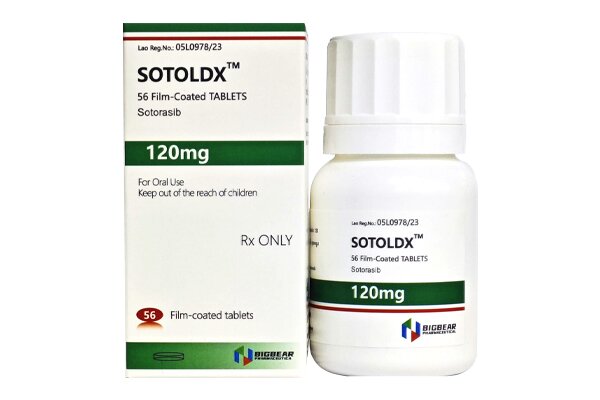
In 2021, the U.S. Food and Drug Administration (FDA) granted accelerated approval to sotorasib for the treatment of certain adult patients with non-small cell lung cancer (NSCLC). In January 2025, sotorasib in combination with panitumumab was approved for the treatment of certain metastatic colorectal cancer (mCRC).
Indications for Sotorasib
(I) Non-Small Cell Lung Cancer
As monotherapy: For the treatment of locally advanced or metastatic NSCLC with a KRAS G12C mutation-positive FDA-approved diagnostic test in patients who have previously received at least one systemic therapy (FDA designates it as an orphan drug for this use).
(II) Colorectal Cancer
In combination with panitumumab: For the treatment of metastatic colorectal cancer with a KRAS G12C mutation-positive FDA-approved diagnostic test in patients who have previously received chemotherapy based on fluoropyrimidine, oxaliplatin, and irinotecan (FDA designates it as an orphan drug for this use). Image sourced from public sources (e.g., FDA website, original drug manufacturer's website), for reference only.
Standard Dosage and Dosage Adjustment of Sotorasidub
(I) Pre-treatment Screening
1. Non-Small Cell Lung Cancer Screening
Confirm the presence of a KRAS G12C mutation in a non-small cell lung cancer (NSCLC) tumor or plasma sample (determined by an FDA-approved test); if the KRAS G12C mutation is not detected in a plasma sample, retest with tumor tissue.
2. Colorectal Cancer Screening
Confirm the presence of a KRAS G12C mutation in a tumor sample (determined by an FDA-approved test).
3. Liver Function Tests
Obtain baseline liver function tests (i.e., alanine aminotransferase, aspartate aminotransferase, alkaline phosphatase, total bilirubin).
(II) Standard Dosage
Since this drug has multiple indications, the standard dosage varies for different indications, which will be described separately below.
Non-small cell lung cancer
Oral: 960 mg once daily (3 320 mg tablets, 4 240 mg tablets, or 8 120 mg tablets). Continue treatment until disease progression or unacceptable toxicity.
Colorectal cancer
Oral: 960 mg once daily (3 320 mg tablets, 4 240 mg tablets, or 8 120 mg tablets), in combination with panitumumab. Administer a first dose of sotorasib before the first infusion of panitumumab. Continue treatment until disease progression or unacceptable toxicity. For recommended dosing regimens for panitumumab, please refer to the panitumumab prescribing information.
(III) Dosage Adjustment
1. Hepatotoxicity
(1) If serum aspartate aminotransferase (AST) or alanine aminotransferase (ALT) concentrations are >3 times and ≤5 times the upper limit of normal (ULN) (or >3 times and ≤5 times the baseline value if the baseline is abnormal) and accompanied by symptoms, or if serum AST or ALT concentrations are >5 times the ULN (or >5 times the baseline value if the baseline is abnormal), sotorasib treatment should be suspended until the concentrations return to ≤3 times the ULN or ≤3 times the baseline value if the baseline is abnormal. After recovery, sotorasib treatment should be restarted at a lower dose level.
(2) If, in the absence of other etiologies, serum AST or ALT concentrations are >3 times the ULN and serum total bilirubin concentrations are >2 times the ULN, sotorasib treatment should be permanently discontinued. 1. Sotorasib Treatment: If other causes are identified, do not restart sotorasib treatment until aspartate aminotransferase/alanine aminotransferase (AST) and bilirubin levels return to baseline.
2. Interstitial Lung Disease/Pneumonia: If any grade of interstitial lung disease/pneumonia is suspected, sotorasib treatment should be discontinued. If interstitial lung disease/pneumonia is diagnosed, sotorasib treatment should be permanently discontinued.
3. Gastrointestinal Effects: If grade 3 or 4 nausea, vomiting, or diarrhea occurs and does not improve with appropriate supportive care, sotorasib treatment should be discontinued. When the toxicity improves to grade 1 or below or baseline, treatment should be restarted at a lower dose.
4. Other Toxicity: If other grade 3 or 4 toxicities occur, sotorasib treatment should be discontinued. When the toxicity improves to grade 1 or below or baseline, treatment should be restarted at a lower dose.
Sotorasib Administration Methods
(I) Administration Methods
1. Oral Administration
Administer orally at the same time every day, with or without food. Swallow whole; do not crush, chew, or break.
2. Handling of Inability to Swallow
For patients unable to swallow whole, disperse the tablet in 120 ml (4 oz) of non-carbonated room temperature water. Place all the tablets required for one dose in the water, do not crush, stir or shake for about 3 minutes to disperse the tablets into small pieces (not completely dissolved). The resulting mixture may range in color from pale yellow to bright yellow. Take the entire mixture immediately or within 2 hours of mixing, without chewing any remaining tablet fragments. Rinse the container with an additional 120 ml of water, stir or shake, and drink immediately.
3. Handling of Missed Dose
If a dose of Sotorasib is missed for ≤6 hours, take the prescribed dose as soon as you remember. If a dose is missed by more than 6 hours, take the prescribed dose at the next scheduled time; do not take an extra dose to make up for the missed dose.
4. Management of Vomiting
If vomiting occurs after taking the medication, no extra dose is needed; take the next dose at the next scheduled time.
Common Adverse Reactions of Sotorasiib
1. Sotorasiib Monotherapy for Non-Small Cell Lung Cancer
≥20% of adverse reactions
Includes diarrhea, musculoskeletal pain, nausea, fatigue, hepatotoxicity, and cough.
≥25% of laboratory abnormalities
Includes lymphopenia, decreased hemoglobin, increased alanine aminotransferase and/or aspartate aminotransferase levels, decreased calcium, increased alkaline phosphatase, increased proteinuria, and decreased sodium levels.
2. Sotorasiib in Combination with Panitumumab for Colorectal Cancer
≥20% of adverse reactions
Includes rash, dry skin, diarrhea, stomatitis, fatigue, and musculoskeletal pain.
Common Grade 3 or 4 laboratory abnormalities
Includes decreased magnesium, potassium, and corrected calcium levels, as well as increased potassium. Recommended Article: Common Adverse Reactions of Sotorasib
Precautions for Sotorasib
Hepatotoxicity
Monitor liver function tests (i.e., serum alanine aminotransferase, aspartate aminotransferase, alkaline phosphatase, and total bilirubin concentration) before starting sotorasib treatment, every 3 weeks for the first 3 months of treatment, and monthly thereafter, or as clinically necessary. More frequent monitoring may be required for patients with elevated transaminases and/or total bilirubin. If hepatotoxicity occurs, temporary interruption of sotorasib treatment, dose reduction, or discontinuation may be necessary. Consider using corticosteroids to treat hepatotoxicity.
Interstitial Lung Disease/Pneumonia
Monitor patients for new or worsening lung symptoms suggestive of interstitial lung disease/pneumonia (e.g., dyspnea, cough, fever). If interstitial lung disease/pneumonia is suspected, sotorasib should be discontinued immediately. If no other cause is found, the drug should be permanently discontinued.
Drug Interactions of Sotorasib
1. Drugs Affected or Influenced by Hepatic Microsomal Enzymes
(1) Strong CYP3A4 Inducers
May reduce systemic exposure to sotorasib and decrease its efficacy. Avoid concomitant use.
(2) CYP3A4 Substrates
May reduce plasma concentrations of CYP3A4 substrate drugs and decrease their efficacy. Avoid concomitant use with sensitive CYP3A4 substrates with a narrow therapeutic index. If concomitant administration cannot be avoided, refer to the manufacturer's label of the sensitive CYP3A4 substrate drug for dose adjustment.
2. Drugs Affected or Influenced by Transport Systems
(1) P-glycoprotein Substrates
May increase plasma concentrations of P-glycoprotein substrate drugs and increase their toxicity. Avoid concomitant use with P-glycoprotein substrates where small changes in concentration can lead to serious toxicity. If concomitant administration cannot be avoided, refer to the manufacturer's label of the P-glycoprotein substrate drug for dose adjustment.
(2) Breast Cancer Resistance Protein Substrates
May increase plasma concentrations of breast cancer resistance protein substrate drugs and increase their toxicity. Monitor for adverse reactions to breast cancer resistance protein substrates; dose reduction may be necessary when used in combination with sotorasib.
3. Drugs Affecting Gastric Acid
(1) May reduce systemic exposure to sotorasib.
(2) Avoid concomitant use with proton pump inhibitors, H2 receptor antagonists, and locally acting antacids. If concomitant use with locally acting antacids cannot be avoided, sotorasib should be taken 4 hours before or 10 hours after taking the locally acting antacid.
Note: Due to space limitations, please refer to the original drug instructions for details. Specific medication use should be performed according to your doctor's prescription.
Storage of Sotorasib
Store at 20-25℃ (permissible fluctuations between 15-30℃). When tablets are dispersed in non-carbonated room temperature water, the entire mixture must be taken immediately or within 2 hours of mixing.