However, adherence to prescribed medication regimens directly impacts treatment efficacy and patient safety when using quizartinib. Patients should strictly follow their doctor's instructions regarding quizartinib use.
1. Patient Selection:
Patients selected for quizartinib treatment of AML are based on the presence of FLT3-ITD mutation positivity.
2. Recommended Dosage:
Treatment duration includes up to 2 cycles of quizartinib combined with induction cytarabine and anthracyclines, up to 4 cycles of quizartinib combined with high-dose cytarabine consolidation therapy, and up to 36 cycles of quizartinib maintenance therapy until disease progression or unacceptable toxicity. Maintenance therapy should be initiated after consolidation chemotherapy when the absolute neutrophil count is >500/mm³ and the platelet count is >50,000/mm³.
Recommended Dosage for Each Treatment Phase
Induction Phase: Begin on day 8 (7+3 regimen), administer 35.4 mg orally once daily for 2 weeks per cycle (days 8-21), with a maximum of 2 cycles. For patients using the 5+2 regimen for the second induction cycle, quezartinib will be administered on days 6-19.
Consolidation Phase: Begin on day 6, administer 35.4 mg orally once daily for 2 weeks per cycle (days 6-19), with a maximum of 4 cycles.
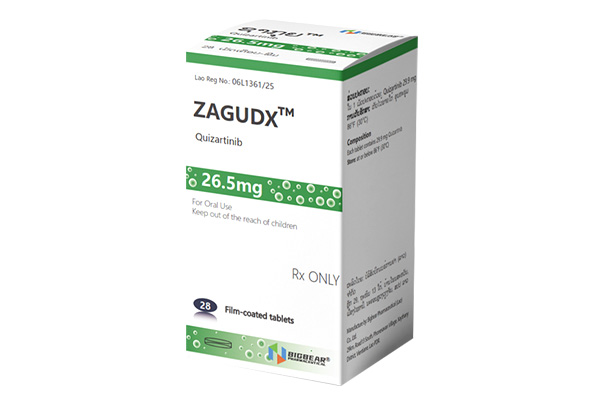
Maintenance Phase: If QTcF ≤ 450 ms, administer 26.5 mg orally once daily for days 1-14 of the first cycle, increasing to 53 mg once daily from day 15. If QTcF > 500 ms is observed during induction or consolidation, maintain the dose of 26.5 mg once daily. No cycle interval, once daily, for a maximum of 36 cycles. For patients undergoing hematopoietic stem cell transplantation (HSCT), quezartinib treatment should be discontinued 7 days prior to the start of the conditioning program. Quezatinib should be taken orally at approximately the same time each day, with or without food. Tablets should be swallowed whole and not cut, crushed, or chewed. If vomiting occurs, no additional dose is needed; wait until the next scheduled time. If a dose is missed or not taken at the usual time, take it as soon as possible on the same day, resuming the regular dose the following day. Do not take two doses on the same day.
3. Monitoring for Adverse Reactions and Dosage Adjustment
Quezatinib treatment should only be initiated when QTcF ≤ 450 ms. During induction and consolidation, perform ECG weekly before and during treatment, or more frequently as clinically indicated. During maintenance, perform ECG weekly before treatment, at least for the first month after dose initiation and escalation, and thereafter as clinically indicated. Increment the dose only when QTcF ≤ 450 ms. Correct electrolyte abnormalities (hypokalemia and hypomagnesemia) and avoid concomitant use with drugs that prolong the QT interval whenever possible.
Recommended Dose Adjustment for Adverse Reactions
QTcF 450-480ms (Grade 1): Continue quinzatinib.
QTcF 481-500ms (Grade 2): Reduce quinzatinib dose. If QTcF drops to <450ms in the next cycle, the original dose can be restored. Closely monitor the patient for QT prolongation during the first cycle of dose increase.
QTcF > 500ms (Grade 3): Discontinue quinzatinib treatment. Resume treatment at the reduced dose when QTcF recovers to <450ms. If QTcF > 500ms is observed during induction or consolidation, maintain a maintenance dose of 26.5 mg once daily.
Relapsed QTcF > 500ms (Grade 3): If relapse occurs despite appropriate dose reduction and correction/elimination of other risk factors (e.g., serum electrolyte abnormalities, concomitant use of QT prolonging drugs), permanently discontinue quinzatinib.
Tortiplano ventricular tachycardia, polymorphic ventricular tachycardia, or signs/symptoms of life-threatening arrhythmias (Grade 4): Permanently discontinue quinzartinib.
Grade 3 or 4 non-hematologic adverse reactions: Discontinue quinzartinib treatment. If the adverse reaction improves to Grade 1 or below, resume treatment at the original dose; if it improves to Grade 2, resume treatment at a reduced dose; if a Grade 3 or 4 adverse reaction persists for more than 28 days, discontinue the drug.
Grade 3 or 4 hypokalemia (<3 mmol/L) or hypomagnesemia (<0.4 mmol/L or <0.9 mg/dL): Discontinue quinzartinib treatment. Correct hypokalemia and hypomagnesemia according to institutional guidelines. When the adverse reaction improves to Grade 2 or below and is asymptomatic, quinzartinib treatment can be restarted at the original dose.
Grade 4 neutropenia or thrombocytopenia after remission: Reduce the quinzartinib dose.
4. Dosage Adjustment for Concomitant Use with a Potent CYP3A Inhibitor
When used in combination with a potent CYP3A inhibitor, reduce the quinzartinib dose:
Current dose: 53 mg once daily; adjust to 26.5 mg once daily.
Current dose: 35.4 mg once daily; adjust to 17.7 mg once daily.
Current dose: 26.5 mg once daily; adjust to 17.7 mg once daily.
Discontinue quinzartinib treatment with the current dose of 17.7 mg once daily during the use of the potent CYP3A inhibitor.
Restore the quinzartinib dose to the level before starting the inhibitor five half-lives after discontinuing the potent CYP3A inhibitor.