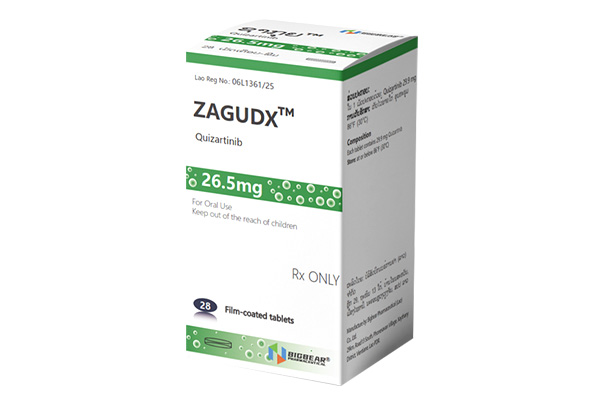
Recently, the European Commission (EC) authorized VANFLYTA in combination with standard cytarabine and anthracycline induction therapy, followed by standard cytarabine consolidation chemotherapy, for maintenance therapy in the treatment of adult patients newly diagnosed with FLT3-ITD-positive acute myeloid leukemia (AML).
Quizartinib, developed by Daiichi Sankyo Pharmaceutical Co., Ltd., is a targeted therapy for FLT3-ITD mutations. In AML, it is primarily used to target FLT3-ITD-mutant leukemia cells by inhibiting their overactivated signaling pathways, thereby reducing cell proliferation and survival.
This drug was initially approved in Japan in June 2019 for the treatment of adult patients with relapsed/refractory AML harboring FLT3-ITD mutations. In the United States, quizartinib received FDA approval in July of this year for use in combination with standard cytarabine and anthracycline induction therapy, as well as cytarabine consolidation therapy, and as maintenance monotherapy after consolidation chemotherapy, for the treatment of newly diagnosed adult patients with FLT3-ITD-positive acute myeloid leukemia (AML) who have been approved by the FDA.
Notably, quizartinib is the first FLT3 inhibitor approved in the European Union for newly diagnosed FLT3-ITD-positive acute myeloid leukemia (AML).
The European Commission's decision was based on the results of the QuANTUM-First phase III clinical trial published in *The Lancet*, which enrolled 539 newly diagnosed FLT3-ITD-positive AML patients, who were randomly assigned 1:1 to the quizartinib group (n=268) and the placebo group (n=271). The trial results showed a 22% reduction in the risk of death compared to standard chemotherapy in newly diagnosed FLT3-ITD-positive acute myeloid leukemia patients.
Furthermore, during a median follow-up of 39.2 months, the median overall survival was 31.9 months in patients receiving VANFLYTA, compared to 15.1 months in the control group.
Regarding safety, the proportion of adverse events in the quizartinib group was comparable to that in the placebo group. It is important to note that quizartinib may cause adverse reactions such as QT interval prolongation, torsades de pointes, and cardiac arrest; therefore, patients should promptly report any adverse symptoms and pay close attention to the dosage during treatment.
In summary, VANFLYTA has been shown to significantly improve survival in patients with FLT3-ITD-positive acute myeloid leukemia.