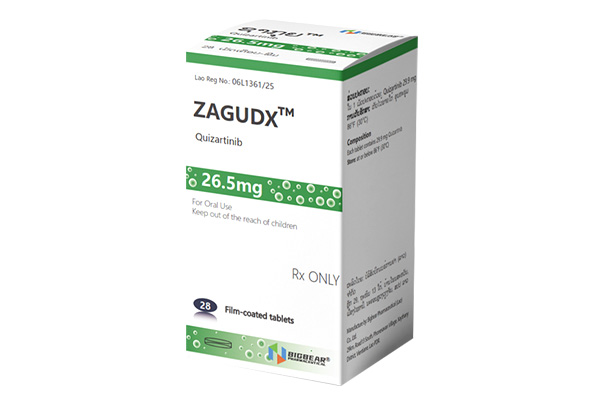
Daiichi Sankyo announced on July 20 that the U.S. Food and Drug Administration (FDA) has approved Vanflyta (quizartinib) in combination with standard cytarabine and anthracycline induction and cytarabine consolidation therapy, and as maintenance monotherapy after consolidation chemotherapy, for the treatment of newly diagnosed adult patients with FLT3-ITD-positive acute myeloid leukemia (AML).
Vanflyta is a second-generation FLT3 inhibitor, an orally administered small-molecule receptor tyrosine kinase inhibitor that selectively targets and inhibits FLT3. It was previously approved by the Japanese Ministry of Health, Labour and Welfare in June 2019 for the treatment of adult patients with relapsed/refractory AML harboring FLT3-ITD mutations. The company stated that the drug is planned for launch in the United States in the coming weeks.
This approval is based on the Quantum-First trial, which enrolled 539 newly diagnosed FLT3-ITD-positive AML patients. Based on initial allocation, patients were randomized (1:1) to receive either quinzartinib (n=268) or placebo (n=271) for induction and consolidation therapy, as well as maintenance monotherapy to evaluate the efficacy of quinzartinib in combination with chemotherapy.
The trial demonstrated that Vanflyta reduced the risk of death by 22% compared to chemotherapy alone. Although the complete response (CR) rate was similar in both groups, the median duration of CR was more than three times longer in the Vanflyta group (38.6 months) compared to 12.4 months in the control group.
Notably, Vanflyta is not suitable for maintenance monotherapy after allogeneic HSCT. In this case, an improvement in overall survival (OS) with Vanflyta has not been demonstrated.
Regarding safety, the most common adverse reactions observed with Vanflyta in the trial included lymphopenia, hypokalemia, hypoalbuminemia, hypophosphatemia, elevated alkaline phosphatase, hypomagnesemia, febrile neutropenia, diarrhea, mucositis, nausea, and hypocalcemia.
The most common grade 3/4 adverse events were febrile neutropenia (43% in the quizartinib group vs. 41% in the placebo group); neutropenia (18% vs. 9%); hypokalemia (19% vs. 16%); and pneumonia (both 11%). Adverse events were fatal in 11.3% of patients treated with quizartinib, compared to 9.7% in patients receiving placebo, primarily due to infection.
Furthermore, Vanflyta prescribing information included a boxed warning regarding the risk of QT interval prolongation, torsades de pointes, and cardiac arrest.