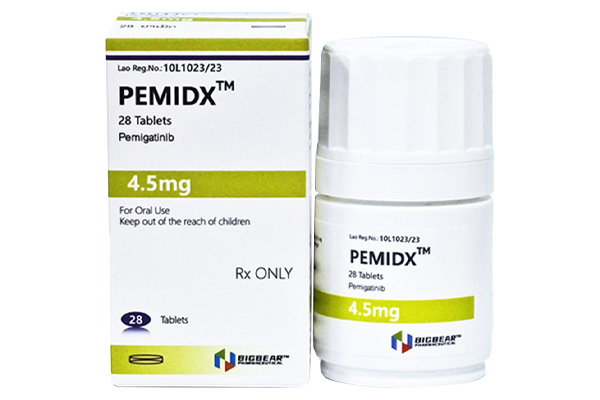
Pemigatinib is a kinase inhibitor used to treat previously treated adult patients with unresectable locally advanced or metastatic cholangiocarcinoma who have been diagnosed with fibroblast growth factor receptor 2 (FGFR2) fusions or rearrangements.
Pemigatinib Dosage and Administration
1. Recommended Dosage
(1) Dosage: 13.5 mg orally once daily.
(2) Treatment Cycle: 14 days of continuous administration, followed by a 7-day break, constituting a 21-day complete treatment cycle.
(3) Administration: Swallow whole, with or without food.
(4) Administration Time: It is recommended to take the medication at the same time each day.
2. Precautions
(1) The tablet must be swallowed whole. Do not crush, chew, break, or dissolve the tablet.
(2) If a dose is missed by more than 4 hours or vomiting occurs after taking the medication, do not take a make-up dose. Take the next dose at the scheduled time the following day. (3) Treatment should continue until disease progression or intolerable toxicity occurs.
Pemigatinib Dosage Adjustment
1. Adverse Reactions Dosage Adjustment
(1) First dose reduction: 9 mg once daily for 14 days, followed by a 7-day break (21-day cycle).
(2) Second dose reduction: 4.5 mg once daily for 14 days, followed by a 7-day break (21-day cycle).
(3) If the patient cannot tolerate the 4.5 mg once daily dose, pemigatinib should be permanently discontinued.
2. Retinal Pigment Erection (RPED)
(1) Asymptomatic and stable examination: Continue the current dose.
(2) Symptomatic or worsening examination: Discontinue administration.
(3) If subsequent examination improves and symptoms disappear: Resume administration after dose reduction.
(4) If symptoms persist or examination does not improve: Consider permanent discontinuation.
3. Hyperphosphatemia
(1) Serum phosphorus > 7 mg/dL but ≤ 10 mg/dL.
(2) Initiate phosphorus-lowering therapy and monitor serum phosphorus weekly.
(3) If serum phosphorus does not decrease to < 7 mg/dL within 2 weeks: discontinue administration.
(4) After serum phosphorus recovers: continue with the original dose for the first occurrence; reduce the dose if it recurs.
4. Serum phosphorus > 10 mg/dL
(1) Initiate phosphorus-lowering therapy and monitor serum phosphorus weekly.
(2) If serum phosphorus does not decrease to ≤ 10 mg/dL within 1 week: discontinue administration.
(3) Continue with a reduced dose after serum phosphorus recovers.
(4) If serum phosphorus recurs to > 10 mg/dL after two dose reductions: permanently discontinue administration.
Pemigatinib Use in Special Populations
1. Renal Impairment
(1) Mild to moderate renal impairment (GFR 30-89 mL/min): No dose adjustment required.
(2) Severe renal impairment (GFR < 30 mL/min): Recommended dose not yet established.
2. Hepatic Impairment
(1) Mild hepatic impairment (bilirubin ≤ 1.5 × ULN or AST > ULN): No dose adjustment required.
(2) Moderate hepatic impairment (bilirubin 1.5-3 × ULN): No dose adjustment required.
(3) Severe hepatic impairment (bilirubin > 3 × ULN): Recommended dose not yet established.
3. Pregnancy
(1) Pemigatinib may cause fetal harm and is contraindicated in pregnant women.
(2) Pregnancy status of women of childbearing age must be confirmed before treatment.
(3) Women of childbearing age should use effective contraception during treatment and for one week after the last dose.
(4) Male patients of childbearing age should use effective contraception during treatment and for one week after the last dose.
4. Lactation
(1) There is no data on whether pemitinib is excreted into breast milk.
(2) It is recommended to discontinue breastfeeding during treatment and for one week after the last dose.