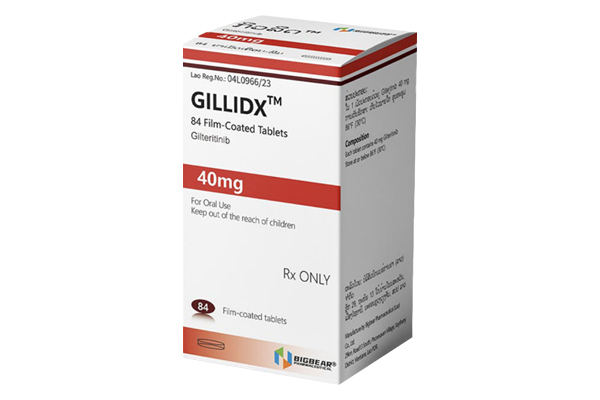
Asteras Pharmaceuticals recently announced that the National Medical Products Administration (NMPA) of China has conditionally approved XOSPATA® (giteritinib fumarate tablets, hereinafter collectively referred to as gilteritinib) for the treatment of adult patients with relapsed (disease relapse) or refractory (treatment resistant) acute myeloid leukemia (AML) who have been diagnosed with an FMS-like tyrosine kinase 3 (FLT3) mutation using a fully validated assay. Gilteritinib received priority review status from the NMPA in July 2020 and was included in the third batch of urgently needed overseas new drugs in November 2020. Under the accelerated pathway, it has now received approval.
Gefitinib has shown significant inhibitory activity against two FLT3 mutations: FLT3 internal tandem duplication (FLT3-ITD) and FLT3 tyrosine kinase domain (FLT3-TKD). FLT3-ITD mutations affect approximately 30% of acute myeloid leukemia (AML) patients, with a higher risk of relapse and shorter overall survival compared to wild-type FLT3. FLT3-TKD mutations affect approximately 7% of AML patients.3 The FLT3 mutation status can change during AML treatment and even after relapse. Therefore, confirming a patient's FLT3 mutation status at relapse helps identify appropriate and promising targeted therapies.
This approval is based on results from the Phase III ADMIRAL trial, published in the *New England Journal of Medicine*. Gefitinib treatment significantly prolonged overall survival (OS) compared to patients receiving salvage chemotherapy. The median overall survival was 9.3 months in patients treated with gipretinib, compared to 5.6 months in those receiving salvage chemotherapy [hazard ratio = 0.64 (95% CI 0.49, 0.83), P = 0.0004]. Additional pharmacokinetic data from the ongoing Phase III COMMODORE trial in Chinese patients were reviewed.
The safety of gipretinib was evaluated in 319 patients with relapsed or refractory acute myeloid leukemia harboring an FLT3 mutation and receiving at least one dose of 120 mg gipretinib daily.11 The most common adverse reactions (incidence ≥10%) across all grades after receiving gipritinib were: elevated alanine aminotransferase (ALT) (25.4%), elevated aspartate aminotransferase (AST) (24.5%), anemia (20.1%), thrombocytopenia (13.5%), neutropenic fever (12.5%), decreased platelet count (12.2%), diarrhea (12.2%), nausea (11.3%), elevated alkaline phosphatase (11%), fatigue (10.3%), and white blood cell count. Decreased neutrophil count (10%) and elevated serum creatine phosphokinase (10%). One fatal adverse reaction, differentiation syndrome, occurred in patients receiving giretinib.
The most common serious adverse reactions (incidence ≥3%) were febrile Neutropenia (7.5%), elevated alanine aminotransferase (ALT) (3.4%), and elevated aspartate aminotransferase (AST) (3.1%). Other clinically significant serious adverse reactions included QT interval prolongation on ECG (0.9%) and reversible posterior encephalopathy syndrome (0.3%).
About the ADMIRAL trial
Phase III A The DMIRAL trial (NCT02421939) was a global, multicenter, open-label, randomized controlled trial comparing the efficacy of gipretinib versus salvage chemotherapy in adult patients with relapsed or refractory FLT3-mutant AML. The primary composite endpoint was overall survival (OS) and the complete response (CR/CRh) rate with complete or partial hematologic recovery. The study ultimately enrolled 371 patients with relapsed or refractory AML who had FLT3 mutations detected in their blood or bone marrow. Subjects were randomized 2:1 to receive either gipretinib (120 mg) or salvage chemotherapy.
About the COMMODORE trial
Phase III COMMODORE Trial (N CT03182244 is an ongoing, multicenter, open-label, randomized controlled trial comparing the efficacy of gipretinib versus salvage chemotherapy in adult patients with relapsed or refractory FLT3-mutant AML in China and other countries. The primary endpoint of the trial is overall survival (OS). The study will also compare gipretinib versus salvage chemotherapy in terms of event-free survival (EFS) and complete remission rate (CRrate) to assess safety and determine overall efficacy. Participants will be randomized 1:1 to receive either gipretinib (120 mg) or salvage chemotherapy.