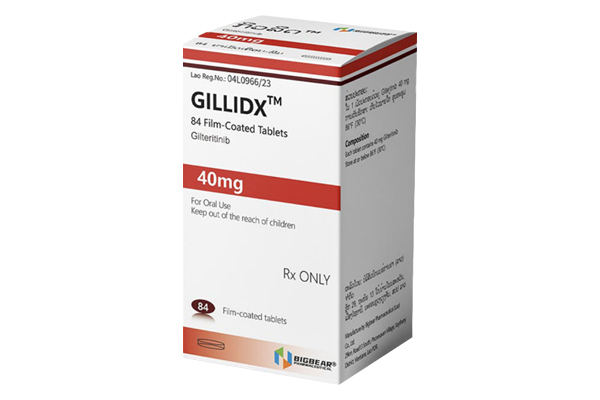
The U.S. Food and Drug Administration (FDA) today approved Xospata (gilteritinib) tablets for the treatment of adult patients with relapsed or refractory acute myeloid leukemia (AML) who have an FLT3 mutation. The FDA also approved expanded companion diagnostic indications, including use with Xospata.
“Approximately 25% to 30% of AML patients have a mutation in the FLT3 gene. These mutations are associated with disease progression and a higher risk of relapse,” said Richard Pazdur, director of the FDA’s Center for Oncology, acting director of the Office of Hematology and Oncology Products at the FDA’s Center for Oncology. “Xospata targets this gene and is the first drug that can be used alone to treat patients with relapsed or unresponsive AML with an FLT3 mutation.”
AML is a rapidly progressing cancer that suppresses normal cells in the bone marrow and blood, resulting in a reduced number of normal blood cells and a persistent need for transfusions. The National Cancer Institute estimates that approximately 19,520 people will be diagnosed with AML this year; approximately 10,670 AML patients will die from the disease in 2018.
The efficacy of Xospata was investigated in a clinical trial of 138 patients with relapsed or refractory AML and a confirmed FLT3 mutation. 21% of patients achieved complete remission (complete recovery of blood counts with no evidence of disease) or complete remission and partial hematologic recovery (partial recovery of blood counts with no evidence of disease). Of the 106 patients who required red blood cell or platelet transfusions at the start of Xospata treatment, 31% did not require transfusions for at least 56 days.
Common side effects reported by patients in the clinical trial were muscle and joint pain (myalgia/arthralgia), fatigue, and elevated liver enzymes (liver transaminases). Healthcare providers are advised to monitor patients for posterior reversible encephalopathy syndrome (a syndrome characterized by headache, confusion, seizures, and vision loss), QT interval prolongation (which may lead to a rapid heartbeat and tachycardia), and pancreatitis (inflammation of the pancreas). Rare differentiation syndromes may occur in patients taking Xospata (symptoms may include fever, cough, difficulty breathing, fluid around the lungs or heart, rapid weight gain, swelling, renal insufficiency, or hepatic insufficiency). Pregnant or breastfeeding women should not take Xospata as it may harm a developing fetus or newborn.
What is XOSPATA?
XOSPATA is a prescription drug used to treat acute myeloid leukemia (AML) in adults who have an FMS-like tyrosine kinase 3 (FLT3) mutation when the disease relapses or does not improve after previous treatment. Your healthcare provider will test XOSPATA to ensure it is right for you. It is unknown whether XOSPATA is safe and effective in children.
Before taking XOSPATA, inform your healthcare provider of all your medical conditions, including whether you:
1. Have heart disease, including a condition called long QT syndrome.
2. Have a history of hypokalemia (low potassium) or hypomagnesemia (low magnesium).
3. Are pregnant or planning to become pregnant. XOSPATA can harm your unborn baby. Tell your healthcare provider immediately if you become pregnant during XOSPATA treatment or think you may be pregnant.
4. If you are able to conceive, your healthcare provider may perform a pregnancy test 7 days before you become pregnant.
5. Women who are able to conceive should use effective contraception during treatment and continue for at least 6 months after the last dose of XOSPATA.
6. Men with female partners who are able to conceive should use effective birth control (contraception) during XOSPATA treatment and for at least 4 months after the last dose of XOSPATA.
7. Breastfeeding or planning to breastfeed. You don't know if XOSPATA will pass into your breast milk. Tell your healthcare provider about all the medications you are taking, including prescription and over-the-counter medications, vitamins, and herbal supplements.
How should I take XOSPATA?
Take XOSPATA as your healthcare provider tells you. Do not change your dosage or stop taking XOSPATA unless your healthcare provider tells you to.
Take XOSPATA once a day at approximately the same time. Swallow the XOSPATA tablet whole with a glass of water. Do not break, crush, or chew the XOSPATA tablet. If you miss a dose of XOSPATA, take your next scheduled dose as soon as possible within at least 12 hours of the same day. Return to your normal dosing time the next day. Do not take two doses within 12 hours.
What are the possible side effects of XOSPATA?
XOSPATA can cause serious side effects, including:
Posterior reversible encephalopathy syndrome (PRES). If you are taking XOSPATA, you may be at risk of developing a brain disorder called PRES.
Tell your healthcare provider immediately if you have a seizure or your symptoms worsen rapidly, such as headache, decreased alertness, confusion, decreased vision, blurred vision, or other visual problems. Your healthcare provider will perform tests to check for PRES. If you develop PRES, your healthcare provider will stop XOSPATA.
Heart rhythm problems (QT prolongation). XOSPATA may cause heart problems called QT prolongation. Your healthcare provider should check your heart's electrical activity via electrocardiogram (ECG) before you start taking XOSPATA and during treatment with XOSPATA. Tell your healthcare provider immediately if you experience any changes in your heart rate, or if you feel dizzy, lightheaded, or lightheaded. People with low magnesium or low potassium levels are at higher risk of QT prolongation. Your healthcare provider will perform blood tests to check your potassium and magnesium levels before and during XOSPATA treatment.
Pancreatitis (pancreatitis). Tell your healthcare provider immediately if you have persistent, severe stomach pain. This pain may or may not be accompanied by nausea and vomiting. The most common side effects of XOSPATA include: joint or muscle pain, changes in liver function tests, fatigue, fever, swollen rash due to fluid retention, nausea, mouth ulcers, infection that has spread throughout the body (sepsis), headache, low blood pressure, diarrhea, pneumonia, dizziness, shortness of breath, cough, and vomiting.
If you experience any side effects during XOSPATA treatment, your healthcare provider may advise you to reduce the dose, temporarily stop, or discontinue XOSPATA altogether. These are not all the possible side effects of XOSPATA.
How should I store XOSPATA?
XOSPATA comes in child-safe packaging. Store XOSPATA at room temperature between 68°F and 77°F (20°C and 25°C). Keep XOSPATA in its original container. Keep XOSPATA and all medications out of the reach of children.