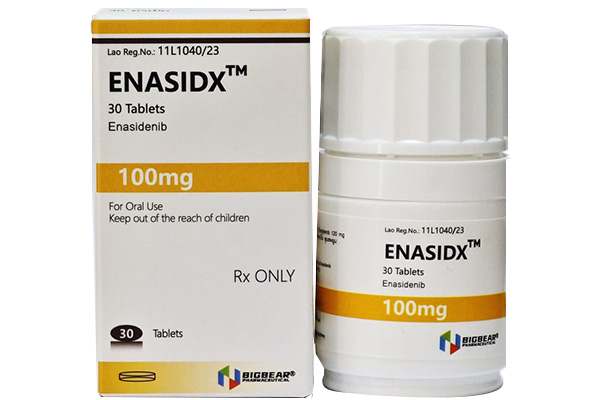
Enasidenib was developed by Celgene in the United States and approved for marketing by the US FDA on August 1, 2017.
Enasidenib (English Indications)
Enasidenib (Chinese Indications) is used for relapsed or refractory acute myeloid leukemia (AML) with IDH2 mutations.
Orphan Drug Designation: The US Food and Drug Administration (FDA) has granted it Orphan Drug Designation for this use.
The presence of an IDH2 mutation must be confirmed by an FDA-approved diagnostic test before initiating treatment.
Enasidenib Dosage and Administration
1. Screening before treatment
Confirm the presence of an IDH2 mutation in peripheral blood or bone marrow before starting enasidenib treatment; assess complete blood count (CBC) and blood chemistry parameters to rule out leukocytosis and tumor lysis syndrome; and confirm pregnancy status for women of childbearing potential.
2. Patient Monitoring
During the initial 3 months of treatment, monitor complete blood counts and blood chemistry at least every 2 weeks; monitor for signs and symptoms of differentiation syndrome, such as fever, dyspnea, acute respiratory distress, pulmonary infiltration, pleural or pericardial effusion, rapid weight gain, peripheral edema, lymphadenopathy, bone pain, and liver, kidney, or multiple organ dysfunction.
3. Administration
Administration: Administer orally once daily at approximately the same time each day, regardless of meal times; swallow whole with water; do not chew, crush, or break.
If vomiting occurs, a missed dose is taken, or a dose is missed at the usual time, take the missed dose as soon as possible on the same day, and resume the normal dosage the following day. Do not take a double dose to make up for a missed dose.
4. Dosage
Adult AML patients take 100 mg orally once daily until disease progression or unacceptable toxicity occurs.
5. Continuing Treatment
Most patients achieve optimal response within 6 months of starting entithipin treatment; therefore, treatment should be continued for at least 6 months to ensure efficacy.
6. Toxicity and Dosage Adjustment
(1) Differentiation Syndrome
If severe pulmonary symptoms requiring respiratory support (e.g., intubation, assisted ventilation) and/or persistent renal dysfunction after more than 48 hours of systemic corticosteroid treatment occur, entasidipine should be discontinued until toxicity improves to grade 2 or below.
(2) Leukocytosis
If leukocytosis persists after hydroxyurea treatment, entasidipine should be discontinued.
When the white blood cell count drops to <30,000/mm³, the original dose (100 mg once daily) should be restored.
(3) Hepatotoxicity
If serum bilirubin concentration is >3 times the upper limit of normal (ULN) and persists for ≥2 weeks (without elevated ALT/AST or other liver disease), the dose should be reduced to 50 mg once daily.
When serum bilirubin improves to <2 times the ULN, the dose should be increased back to 100 mg once daily.
(4) Tumor Dissolution Syndrome
If grade 3 or higher tumor lysis syndrome occurs, entasidipine should be discontinued.
If improvement reaches grade 2 or below, resume dosing at 50 mg once daily. If improvement reaches grade 1 or below, the dose can be increased back to 100 mg once daily. If relapse occurs, discontinue the drug permanently.
(5) Other Toxicity
If grade 3 or higher adverse reactions occur, discontinue enasidenib. If improvement reaches grade 2 or below, resume dosing at 50 mg once daily. If improvement reaches grade 1 or below, the dose can be increased back to 100 mg once daily. If relapse occurs, discontinue the drug permanently.
Enasidenib Dosage Adjustment for Special Populations
1. Mild hepatic impairment (total bilirubin ≤ ULN with AST > ULN, or total bilirubin 1–1.5 times ULN with any AST level): No dose adjustment is required.
2. Glomerular filtration rate (eGFR) ≥ 30 mL/min: No dose adjustment is required.
3. Elderly patients: No dose adjustment is required.
Precautions for Enasidenib
1. Differentiation Syndrome
Enasidenib may cause differentiation syndrome, manifested as acute respiratory distress (dyspnea/hypoxia), hypoxia requiring supplemental oxygen, pulmonary infiltration, kidney or liver injury, multiple organ dysfunction, fever, lymphadenopathy, bone pain, peripheral edema, rapid weight gain, and pleural or pericardial effusion, with or without leukocytosis.
If related symptoms occur without a clear other cause, differentiation syndrome should be suspected. Initiate intravenous or oral corticosteroid therapy immediately (e.g., dexamethasone 10 mg every 12 hours until symptoms improve, then gradually tapering off), and monitor hemodynamics until improvement.
If severe pulmonary symptoms requiring respiratory support occur and/or renal dysfunction persists after 48 hours of corticosteroid treatment, enasidenib should be discontinued.
Hospitalization and close monitoring are recommended for pulmonary or renal manifestations.
2. Fetal/Neonatal Morbidity and Death
May cause fetal harm; animal studies have shown teratogenicity, embryotoxicity, and fetal toxicity. Pregnancy should be avoided during treatment. Women of childbearing potential and their male partners should use effective contraception during treatment and for two months after discontinuation of the drug. Those using hormonal contraception should also use effective non-hormonal contraception.
Special Populations for Enasidenib:
1. Pregnancy
Enasidenib may cause harm to the fetus. Confirm pregnancy status before treatment and inform the patient of the risks if pregnant.
2. Lactation
It is unknown whether enasidenib passes into breast milk. Breastfeeding should be discontinued during treatment and for two months after discontinuation of the drug.
3. Women of childbearing potential
Contraception is necessary. Animal studies suggest that enasidenib may affect fertility.
4. Children
Safety and efficacy have not been established.
5. Elderly Patients
No difference compared to young adults.
6. Mild Hepatic Impairment
May increase exposure (as enasidenib is primarily metabolized in the liver).
7. Renal Impairment
Does not affect pharmacokinetics.
Enasidenib Adverse Reactions
Common adverse reactions of enasidenib (≥20%): nausea, vomiting, diarrhea, elevated bilirubin, decreased appetite.
Enasidenib Drug Interactions
1. CYP1A2 and CYP2C19 Substrates
May increase substrate drug exposure and adverse reaction risk. Avoid concomitant use (unless recommended by the prescribing information). Sensitive individuals should reduce the frequency of caffeine intake.
2. CYP3A Substrates
May reduce substrate drug exposure and efficacy. Avoid concomitant use (unless recommended by the prescribing information). Do not use with CYP3A substrate antifungal drugs. Concomitant use with hormonal contraceptives may reduce their blood concentration; alternative contraception is recommended.
3. OATP1B1, OATP1B3, and BCRP Substrates
May increase substrate drug exposure and adverse reaction risk. If concomitant use is necessary, the substrate dose should be reduced according to the prescribing information.
4. P-gp Substrate
May increase substrate drug exposure and adverse reaction risk. If co-administration is required, follow the prescribing information and closely monitor for adverse reactions.
Enasidenib Pharmacokinetics
1. Absorption
Absolute oral bioavailability is 57%. AUC increases proportionally within the daily dose range of 50–450 mg. Median time to peak concentration after a single dose is 4 hours.
The average systemic accumulation ratio with daily dosing is 10-fold. Steady-state concentration is reached in 29 days. A high-fat diet increases exposure by 50%.
2. Distribution
Whether it enters milk is unknown. Enasidenib has a plasma protein binding rate of 98.5%, and AGI-16903 is 96.6%.
3. Elimination
Enasidenib is metabolized by CYP and UGT enzymes to AGI-16903, which is further metabolized. It is mainly excreted as metabolites in feces (89%) and urine (11%), with a half-life of 7.9 days.
Pharmacokinetics of Enasidenib in Special Populations
Mild hepatic or renal impairment does not affect systemic exposure. Age (19–100 years), sex, race, weight (39–136 kg), or body surface area does not affect pharmacokinetics.
Storage of Enasidenib
Store tablets in their original container with desiccant at 20–25°C (15–30°C permissible).
Mechanism of Action of Enasidenib
Enasidenib is a potent and selective inhibitor of IDH2. Approximately 15–20% of AML cases carry IDH2 mutations, most commonly IDH2R140Q, followed by IDH2R172K.
IDH2 mutations lead to the reduction of α-ketoglutarate to the oncogenic metabolite 2-hydroxyglutarate, causing epigenetic dysregulation, histone and DNA hypermethylation, and hematopoietic stem cell differentiation arrest.
In vitro experiments showed that entididipine inhibited IDH2 R140Q, R172S, and R172K mutations at concentrations approximately 40-fold lower than in the wild-type.
In IDH2-mutant tumor xenograft mice, it reduced 2-hydroxyglutarate levels and induced myeloid cell differentiation.
In IDH2-mutant AML patients, it reduced 2-hydroxyglutarate levels, decreased blast cell counts, and increased the proportion of mature myeloid cells.
Patient Recommendations:
1. Swallow the tablet whole with water. Do not chew, crush, or break it. Take the medication at approximately the same time each day. If a dose is missed, take it on the same day. Do not double the dose.
2. Report differentiation syndrome symptoms immediately, such as fever, cough, dyspnea, bone pain, rapid weight gain, and peripheral edema.
3. Monitor blood chemistry indicators and maintain adequate hydration.
4. Contact your doctor if you experience diarrhea, nausea, vomiting, decreased appetite, or changes in taste.
5. Individuals with fertility potential and their partners must use effective contraception during treatment and for two months after discontinuation of medication. They must be informed of the risks during pregnancy; discontinue medication during breastfeeding; and disclose all co-administered medications and their health status.