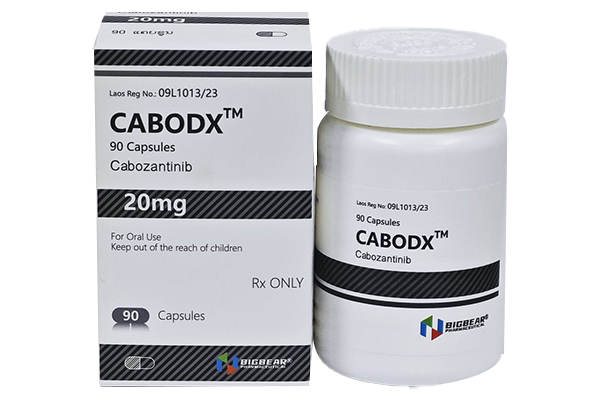
Cabozantinib is a broad-spectrum, multi-target anti-tumor drug developed by Exelixis Biopharmaceuticals, Inc. While most anti-tumor drugs target 1-3 targets, cabozantinib targets more than 9, thus establishing its broad-spectrum anti-tumor activity.
Cabozantinib Indications
Cabozantinib is a multi-receptor tyrosine kinase inhibitor. Its FDA-approved indications include:
1. Medullary Thyroid Carcinoma
Cabozantinib capsules: used to treat advanced, metastatic medullary thyroid carcinoma. Its efficacy is determined based on improvement in progression-free survival. Guidelines generally support the use of tyrosine kinase inhibitors, including cabozantinib, as first-line treatment for advanced and metastatic medullary thyroid carcinoma. The US FDA has designated it as an orphan drug for this purpose.
2. Differentiated Thyroid Cancer
Cabozantinib tablets: Used to treat locally advanced or metastatic differentiated thyroid cancer (DTC) in adults and children aged 12 years and older whose disease has progressed after vascular endothelial growth factor receptor targeted therapy and who are refractory to or ineligible for radioactive iodine (I-131) therapy. Guidelines indicate that for patients with metastatic radioactive iodine-refractory differentiated thyroid cancer, if disease progression is rapid, symptomatic, and/or urgent, and cannot be controlled by other methods, a tyrosine kinase inhibitor should be considered.
3. Renal Cell Carcinoma
Used as monotherapy for patients with advanced renal cell carcinoma (RCC); in combination with nivolumab as first-line treatment. Guidelines generally support the use of tyrosine kinase inhibitors, including cabozantinib, in treatment-naïve and treatment-experienced advanced renal cell carcinoma.
4. Hepatocellular Carcinoma
Used for patients with hepatocellular carcinoma (HCC) who have previously received sorafenib therapy. Guidelines generally support the use of another tyrosine kinase inhibitor, including cabozantinib, as second-line therapy in hepatocellular carcinoma patients who have received multiple first-line treatments.
The US FDA has designated it as an orphan drug for the treatment of hepatocellular carcinoma patients.
Cabozantinib Dosage and Administration
1. Differentiated Thyroid Cancer in Children
(1) Pediatric patients aged 12 years and older with a body surface area ≥1.2 m²:
60 mg daily. Continue treatment until disease progression or unacceptable toxicity.
(2) Pediatric patients aged 12 years and older with a body surface area <1.2 m²:
40 mg daily. Continue treatment until disease progression or unacceptable toxicity.
2. Medullary Thyroid Carcinoma in Adults
140 mg orally once daily (1 80 mg capsule and 3 20 mg capsules). Continue treatment until disease progression or unacceptable toxicity.
3. Differentiated Thyroid Carcinoma
Adults with a body surface area ≥1.2 m²:
60 mg daily. Continue treatment until disease progression or unacceptable toxicity occurs.
4. Renal Cell Carcinoma
(1) Monotherapy
60 mg daily. Continue treatment until disease progression or unacceptable toxicity occurs.
(2) Combination Therapy with Nivolumab
40 mg daily. Administered in combination with nivolumab at 240 mg (30-minute intravenous infusion) every 2 weeks or 480 mg (30-minute intravenous infusion) every 4 weeks. Continue treatment for up to 2 years, or until disease progression or unacceptable toxicity occurs.
5. Hepatocellular Carcinoma
60 mg daily. Continue treatment until disease progression or unacceptable toxicity occurs.
Common Adverse Reactions of Cabozantinib
1. Cabozantinib Capsules (Incidence ≥25%)
Diarrhea, stomatitis, palmoplantar erythema sensory disturbance syndrome (hand-foot syndrome), weight loss, decreased appetite, nausea, fatigue, oral pain, hair color change, taste disturbance, hypertension, abdominal pain, constipation, elevated AST, elevated ALT, lymphopenia, elevated alkaline phosphatase, hypocalcemia, neutropenia, thrombocytopenia, hypophosphatemia, hyperbilirubinemia.
2. Cabozantinib Tablets (Incidence ≥20%)
Diarrhea, fatigue, palmoplantar erythema sensory disturbance syndrome (hand-foot syndrome), decreased appetite, hypertension, nausea, vomiting, weight loss, constipation.
3. Cabozantinib in combination with nivolumab (incidence ≥20%)
Diarrhea, fatigue, hepatotoxicity, palmoplantar erythema sensory disturbance syndrome (hand-foot syndrome), stomatitis, rash, hypertension, hypothyroidism, musculoskeletal pain, loss of appetite, nausea, taste disturbance, abdominal pain, cough, upper respiratory tract infection.
Caozantinib Precautions
1. Perforation and Fistula
Monitor patients for symptoms of perforation and fistula. Cabozantinib should be permanently discontinued in patients with gastrointestinal perforation or fistula.
2. Bleeding
Serious, sometimes fatal, bleeding events, including hemoptysis and gastrointestinal bleeding, have been reported. Cabozantinib is contraindicated in patients with severe bleeding or a recent history of bleeding, hemoptysis, hematemesis, or melena. Treatment should be discontinued before surgery or in cases of grade 3 or 4 bleeding.
3. Thromboembolic Events
The risk of thromboembolic events is increased. Venous thromboembolism and arterial thromboembolism have been reported. 4. Impaired Wound Healing
Wound healing complications have been reported. Cabozantinib should be discontinued at least 3 weeks before elective surgery (including invasive dental procedures). After major surgery, treatment can be resumed at least 2 weeks after clinical assessment of adequate wound healing. The safety of resuming cabozantinib after the resolution of wound healing complications has not been established.
5. Hypertension
The incidence of treatment-induced hypertension is increased. Cabozantinib should not be used in patients with uncontrolled hypertension. Blood pressure should be monitored regularly before and during treatment. For hypertension that is not adequately controlled with medication, cabozantinib should be discontinued; treatment should be resumed at a reduced dose once blood pressure is controlled. Cabozantinib should be permanently discontinued in cases of hypertensive crisis or persistent hypertension that is not well controlled with best medical care.
6. Osteonecrosis of the Jaw (ONJ)
Osteonecrosis of the jaw has been reported. Its manifestations may include jaw pain, osteomyelitis, osteitis, bone erosion, tooth or periodontal infection, toothache, gingival ulceration or erosion, persistent jaw pain, or delayed healing of the oral cavity or jaw after dental surgery. After the osteonecrosis of the jaw has resolved, cabozantinib tablets (Cabometyx) should be resumed at a reduced dose.
7. Diarrhea
If diarrhea occurs, cabozantinib should be discontinued until the diarrhea resolves to grade 1, then resumed at a reduced dose.
8. Palmoplantar erythema sensory disturbance syndrome
If palmoplantar erythema sensory disturbance syndrome occurs, it may be necessary to temporarily discontinue cabozantinib treatment and reduce the dose.
9. Proteinuria
Urine protein should be monitored regularly during treatment. Patients who develop nephrotic syndrome should permanently discontinue cabozantinib. If proteinuria occurs, it may be necessary to temporarily discontinue cabozantinib treatment and reduce the dose.
10. Reversible Posterior Encephalopathy Syndrome (RPLS)
Reversible posterior encephalopathy syndrome should be considered when patients experience seizures, headache, visual disturbances, confusion, or altered mental function. Cabozantinib should be permanently discontinued in patients with reversible posterior encephalopathy syndrome.
11. Hepatotoxicity
The incidence of grade 3 or 4 hepatotoxicity and elevated ALT/AST levels is higher in patients receiving cabozantinib tablets (Cabometyx) in combination with nivolumab compared to cabozantinib monotherapy.
Depending on the severity, cabozantinib tablets (Cabometyx) should be discontinued, and the dose reduced upon resumption of treatment. Liver enzymes should be monitored regularly before and during treatment; more frequent monitoring should be considered when cabozantinib is used in combination with nivolumab. If liver enzymes are elevated, cabozantinib tablets (Cabometyx) and nivolumab treatment should be temporarily interrupted, and systemic corticosteroids should be considered.
12. Adrenal Insufficiency
Primary or secondary adrenal insufficiency has been reported in patients receiving cabozantinib tablets (Cabometyx) in combination with nivolumab. In clinical trials, management of adrenal insufficiency has included the use of systemic corticosteroids, temporary discontinuation of the cabozantinib/nivolumab combination therapy, and/or hormone replacement therapy.
For grade 2 or higher adrenal insufficiency, symptomatic treatment (including hormone replacement therapy) should be initiated based on clinical indications. Depending on the severity, cabozantinib (Cabometyx) and/or nivolumab treatment may be temporarily suspended, and cabozantinib (Cabometyx) treatment should be resumed at a reduced dose.
12. Thyroid Dysfunction
Before initiating cabozantinib (Cabometyx), patients should be assessed for signs of thyroid dysfunction; signs and symptoms of thyroid dysfunction should be monitored during treatment and managed according to clinical indications.
13. Hypocalcemia
Hypocalcemia has been reported in patients treated with cabozantinib. Monitor serum calcium levels and supplement with calcium if necessary. Depending on the severity, discontinue cabozantinib treatment after recovery from hypocalcemia and resume at a reduced dose, or discontinue permanently.
14. Fetal/Neonatal Morbidity and Mortality
May cause harm to the fetus; has been shown to be embryotoxic, fetal toxic, and teratogenic in animals. Women of reproductive potential should be advised to use effective contraception during treatment with this drug and for 4 months after discontinuation. If this drug is used during pregnancy or if the patient becomes pregnant, she should be informed of the potential harm to the fetus.
Special Populations for Cabozantinib Use
1. Pregnancy
May cause harm to the fetus. Confirm the pregnancy status of women of reproductive potential before initiating treatment and advise them to use effective contraception during treatment with this drug and for 4 months after the last dose.
2. Lactation
It is unknown whether cabozantinib or its metabolites enter human breast milk. The effects of this drug on breastfed infants or milk production are unclear. Women should not breastfeed during treatment and for 4 months after the last dose.
3. Women and Men of Reproductive Potential
Women of reproductive potential should be advised to use effective contraception during cabozantinib treatment and for 4 months after the last dose.
4. Pediatric Use
The safety and efficacy of cabozantinib tablets (Cabometyx) in differentiated thyroid carcinoma (DTC) in pediatric patients aged 12 years and older have been established; safety and efficacy in patients under 12 years of age have not been established. For children with open growth plates during treatment, monitoring of epiphyseal and longitudinal growth is recommended.
5. Elderly Use
Capsules: In patients 65 years and older, experience is insufficient to determine whether the response differs from that in younger adults. In adults (20–86 years), pharmacokinetics are not affected by age.
Tablets: No overall difference in safety or efficacy was observed between patients 65 years and older and younger patients.
6. Hepatic Impairment
Mild to moderate hepatic impairment: Increased exposure to cabozantinib was observed.
Severe (Child-Pugh C) hepatic impairment: Not studied.
7. Renal Impairment
Not studied in patients with severe renal impairment or requiring dialysis. No dose adjustment of cabozantinib is required in patients with mild or moderate renal impairment.
Storage of Cabozantinib
Capsules: 20-25°C (permissible deviation 15-30°C).
Tablets: 20-25°C (permissible deviation 15-30°C).