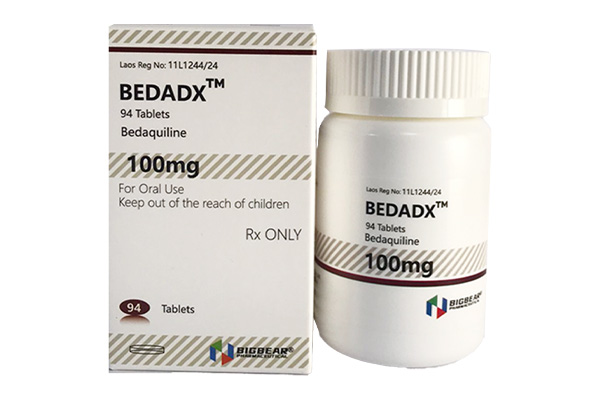
Bedaquiline is a diarylquinoline anti-mycobacterial drug, available primarily as tablet formulation.
Indications and Usage
Bedaquiline is a diarylquinoline anti-mycobacterial drug, administered as tablets.It is indicated as part of combination therapy for the treatment of multidrug‑resistant tuberculosis (MDR‑TB) in adults (≥18 years of age).
Bedaquiline should be used only when an effective treatment regimen cannot otherwise be provided.Treatment should be administered under directly observed therapy (DOT).
The indication is established based on analyses of time to sputum culture conversion in patients with MDR‑TB from two Phase II clinical trials.
Combination Therapy
Bedaquiline must be used in combination with at least three drugs to which the patient’s MDR‑TB isolate is susceptible in vitro.If in vitro susceptibility data are not available, bedaquiline may be combined with at least four drugs that are likely to be active against the patient’s MDR‑TB isolate.Refer to the prescribing information for medicinal products used in combination with bedaquiline.
Pharmacokinetics
Following oral administration, peak plasma concentration (Cmax) of bedaquiline is achieved at approximately 5 hours.Plasma protein binding is greater than 99.9%.
After reaching Cmax, plasma concentrations decline in a tri‑exponential manner.The mean terminal elimination half‑life of bedaquiline and its N‑monodesmethyl metabolite (M2) is approximately 5.5 months.Bedaquiline is primarily excreted via feces.
Pharmacology and Toxicology
Pharmacodynamics
Bedaquiline is a diarylquinoline anti‑mycobacterial agent that inhibits mycobacterial ATP synthase, an enzyme essential for energy production in Mycobacterium tuberculosis.It acts by binding to the c‑subunit of ATP synthase.
Studies have demonstrated activity of bedaquiline in vitro and in clinical infections caused by most clinical isolates of Mycobacterium tuberculosis.
Toxicology
Genotoxicity
Bedaquiline fumarate tested negative in the Ames test, mouse lymphoma cell assay, and mouse micronucleus test.
Reproductive Toxicity
Bedaquiline fumarate had no adverse effects on fertility in male and female rats.No developmentally related effects were observed in rats or rabbits.
Carcinogenicity
No carcinogenicity was observed in rats administered bedaquiline at the maximum tolerated dose of up to 10 mg/kg/day.
Other Toxicity
Bedaquiline is a cationic, amphiphilic drug that induces phospholipidosis in animals, observed in nearly all dose groups even after short‑term exposure, predominantly in cells of the mononuclear phagocyte system (MPS).