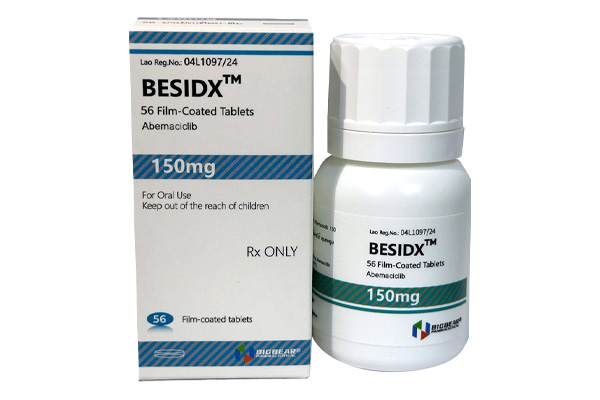
FDA Approval Announcement
INDIANAPOLIS, Feb. 26, 2018 /PRNewswire/ -- Eli Lilly and Company announced that the U.S. Food and Drug Administration (FDA) has approved Verzenio (abemaciclib) in combination with an aromatase inhibitor (AI) as initial endocrine‑based therapy for postmenopausal women with hormone receptor‑positive (HR+), human epidermal growth factor receptor 2‑negative (HER2‑) advanced or metastatic breast cancer.
This is the third FDA indication for Verzenio within five months.In September 2017, Verzenio was approved:
In combination with fulvestrant for women with HR+, HER2‑ advanced/metastatic breast cancer progressing after endocrine therapy
As monotherapy for patients with HR+, HER2‑ advanced/metastatic breast cancer progressing after endocrine therapy and prior chemotherapy in the metastatic setting
Recommended Dosage and Formulations
Dose in combination with an AI: 150 mg orally twice daily, continued until disease progression or unacceptable toxicity
Available strengths: 200 mg, 150 mg, 100 mg, 50 mg
Basis for Approval: Phase 3 MONARCH 3 Trial
The approval was based on efficacy and safety from the pivotal MONARCH 3 trial.
Trial Design
Phase 3, randomized, double‑blind, placebo‑controlled
Enrolled 493 postmenopausal women with HR+, HER2‑ advanced breast cancer
No prior systemic therapy for advanced disease
Minimum 12‑month disease‑free interval after neoadjuvant/adjuvant endocrine therapy
Designation: Priority Review; Breakthrough Therapy Designation (2015)
Key Efficacy Results
Median progression‑free survival (PFS):28.2 months (Verzenio + AI) vs 14.8 months (placebo + AI)HR: 0.54; 95% CI: 0.418–0.698; P < 0.0001
Objective response rate (ORR):55.4% (Verzenio + AI) vs 40.2% (placebo + AI)Complete response (CR): 3.4%; partial response (PR): 52.1%
Median duration of response (DoR):27.4 months (Verzenio + AI) vs 17.5 months (placebo + AI)
Expert Commentary
Dr. Joyce O’Shaughnessy stated that the approval represents an important milestone, showing that Verzenio plus an AI significantly reduces tumor size and delays progression, including in patients with liver metastases, helping to guide treatment decisions in advanced breast cancer.